





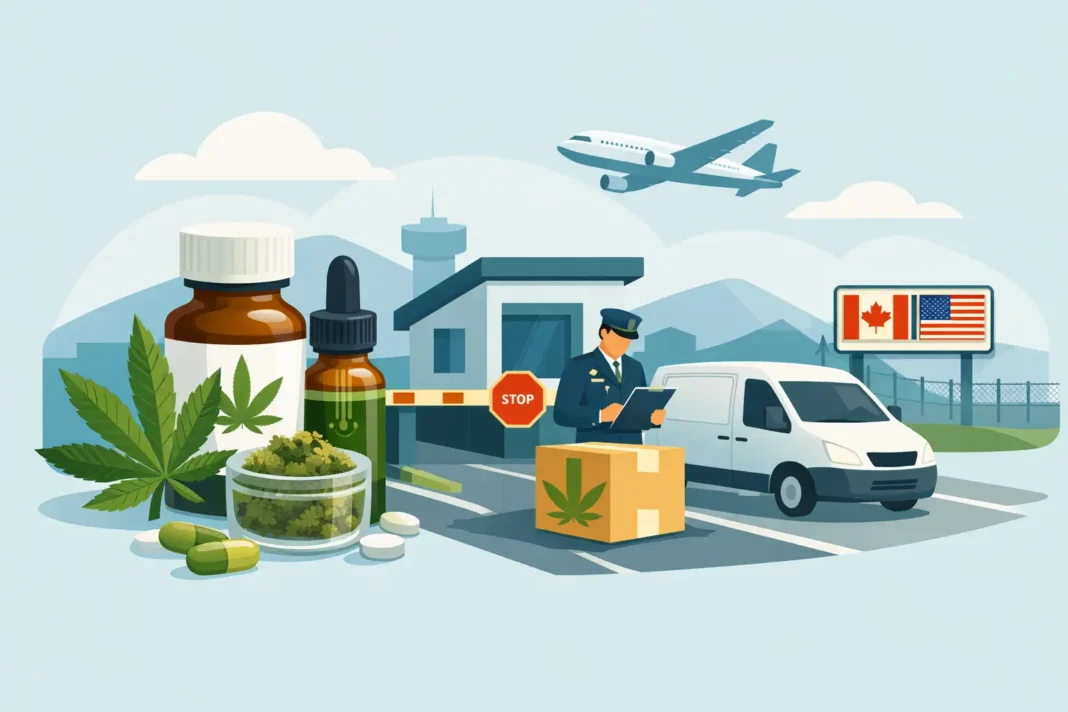

A valid prescription is not a universal travel document. Medical cannabis import rules can turn a routine journey into a seizure, a missed flight or a customs investigation when patients assume that legal access at home carries across a border. It does not.
For European patients and businesses, the central problem is fragmentation. Medical cannabis may be prescribed in one jurisdiction, tolerated in another and treated as a controlled narcotic in the next. The product’s format, THC content, source, route of travel and paperwork can all change the answer.
Why medical cannabis import rules remain difficult
Cannabis regulation is still primarily national, even where countries share customs arrangements or participate in the Schengen Area. Schengen can simplify movement between participating states, but it does not erase national controls over narcotic medicines. A prescription issued in one country may support a traveller’s case, yet it does not automatically authorise possession or import elsewhere.
The distinction between possession and importation matters. A country may permit a resident patient to hold prescribed cannabis while requiring a prior permit before that medicine can enter its territory. It may also allow dried flower but restrict extracts, oils or vape cartridges. Customs authorities assess the product being carried, not simply the patient’s diagnosis.
For companies, the issue is wider still. Commercial imports can trigger requirements around narcotics licences, Good Manufacturing Practice documentation, batch release, labelling, import quotas, customs declarations, storage security and local distribution permissions. A shipment that is legally produced and exported can still be stopped because the importer has the wrong authorisation or the documents do not align.
Patients travelling with prescribed cannabis
Patients should start with the destination country, not the airport they are departing from. The relevant question is whether that country permits a non-resident to bring prescribed cannabis for personal treatment, and under what conditions. Rules for transit countries also matter, particularly when luggage is checked through or a journey requires an overnight stay.
A prescription alone is often insufficient. Authorities may request a doctor’s letter that identifies the patient, medicine, active ingredients, daily dose and treatment duration. They may also expect the cannabis to remain in its original pharmacy packaging, with a dispensing label that matches the traveller’s passport. Carrying more than a personal supply can create immediate concern, even when the medicine is genuine.
Some jurisdictions require advance permission from a health ministry, medicines regulator or narcotics authority. Others apply a defined maximum supply, commonly tied to a set number of days. The limit is not consistent across Europe, and it can differ according to whether the product contains THC, whether it is a licensed medicine, and whether it is a magistral preparation made by a pharmacy.
There is another practical constraint: the carrier. Airlines, ferry operators and rail services can impose conditions that are stricter than a destination’s possession law. Cannabis should never be placed in checked baggage if an airline requires medicines to remain with the passenger, but it should not be carried in cabin baggage unless the traveller has confirmed both airline policy and border rules. Vaping or consuming a product during travel is a separate issue and is generally prohibited.
What paperwork should travel with the medicine?
A patient’s file should be concise, legible and consistent. It should include the original prescription or a certified copy, a recent clinician’s letter, proof of the pharmacy dispensing, and any import permit required by the destination. The packaging should clearly show the patient name, product name, quantity and dosage instructions.
Translation can matter. Where a destination authority does not routinely work in English, travellers should ask whether documents must be provided in the local language or accompanied by a certified translation. A vague letter stating that someone uses cannabis for medical reasons is weaker than a document that identifies the formulation and confirms it was prescribed lawfully.
Do not decant oils into unmarked bottles or transfer flower into a different container to save space. That destroys the evidence that helps customs officers identify the product. It can also make a lawful medicine look indistinguishable from an illicit substance.
Medical cannabis import rules for businesses
Commercial movement of medical cannabis is not an extension of patient travel. It is a regulated supply-chain activity involving at least two national regimes: the exporting country’s controls and the importing country’s controls. In many cases, each shipment needs authorisation before it leaves the exporter’s secure facility.
The importer normally needs the appropriate controlled-drug or narcotics licence, while the exporter needs a corresponding export permit. Regulators may specify the authorised product, quantity, consignee, route and time window. A change of freight forwarder, a delayed departure or a mismatch in product description can require the paperwork to be amended before goods move.
Businesses also need to distinguish medicinal cannabis from hemp-derived goods, CBD wellness products and finished pharmaceutical medicines. A low-THC product is not automatically free from import controls, particularly if it contains controlled cannabinoids or if local law uses a different threshold. Conversely, a product classified as a medicine in one market may be treated as a narcotic raw material in another.
Documentation should reflect the whole chain of custody. That means certificates of analysis, batch records, manufacturing evidence, invoices, packing lists, permits and customs data must describe the same product and quantity. A discrepancy that appears administrative can have costly operational consequences: storage charges, product degradation, contractual disruption and potential recall exposure.
The UK and European market split
The UK’s departure from the EU added a border layer that operators cannot treat as a formality. A compliant movement between an EU manufacturer and a UK importer requires the relevant UK permissions alongside export-side documentation. The reverse route has the same dual-regime challenge.
Within the EU, regulatory alignment can reduce friction for some medicines and commercial processes, but medical cannabis remains heavily shaped by national narcotics frameworks, prescribing rules and reimbursement systems. Germany’s large medical market, for example, cannot be used as a shortcut for assumptions about France, Italy, Poland or the Nordic region. Market opportunity and import accessibility are related, but they are not the same question.
For investors and operators, this is why licence announcements need scrutiny. An import licence may authorise a specific activity without guaranteeing that a company can distribute nationally, obtain reimbursement access, process flower, manufacture extracts or sell to pharmacies. The commercial value lies in the permissions actually granted and the ability to use them repeatedly, not in the headline alone.
Common mistakes that create border risk
The first mistake is relying on online commentary that is out of date. Cannabis policy moves quickly, and enforcement practice can shift even when statutory text has not changed. The second is treating a doctor’s recommendation, medical card or private prescription as interchangeable. They are not. Authorities typically assess the legal status of the medicine and the document under their own rules.
The third is assuming that CBD is automatically exempt. CBD products can contain trace THC, use cannabis extracts that are regulated differently from isolated cannabidiol, or fall under medicines and novel-food rules. Product labels do not settle the legal classification at a border.
Finally, travellers and operators sometimes fail to declare a product because they believe a lawful prescription makes declaration unnecessary. Where a declaration or permit is required, non-disclosure can turn a documentation issue into an enforcement issue. Honest, prepared engagement with the relevant authority is the safer position.
A better way to plan a lawful import
Build the plan around a written confirmation from the authority that controls the destination market, rather than a broad reading of cannabis law. Patients should confirm personal-import permission, the permitted quantity, necessary documents and transit requirements before booking. Businesses should map each licence, permit and quality obligation against the exact product and shipment route.
The answer will sometimes be that travel with the medicine is not practical, or that a proposed import route is commercially unworkable. That is not a failure of planning. It is a material regulatory finding, and it may point to alternatives such as a locally prescribed equivalent, a different product format or a licensed local supply partner.
As medical cannabis markets mature, border rules will remain a test of whether policy promises translate into patient access and reliable trade. The most informed participants will be those who treat every crossing as a regulated event, not an administrative afterthought.