







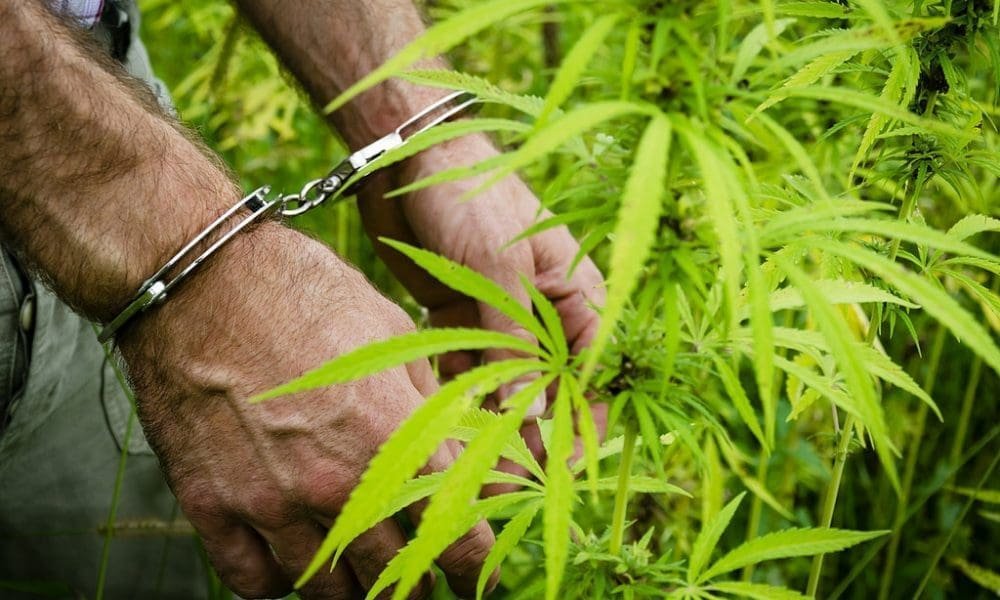

The U.S. Drug Enforcement Administration’s (DEA) enforcement efforts against illegal cannabis operations remained mostly unchanged in 2024 compared with previous years. Newly released data from the agency also counts actions taken against “Chinese grows” for the first.
This report includes the number of arrests, weapons seized, and “eradicated grow sites” in connection with enforcement activities related to marijuana. It also estimates the market value for seized cannabis.
DEA’s latest report does not include data for some states, but the program has counted nationwide 16,330 sites that have been eradicated by 2024. This includes 14,904 sites outdoors and 1,426 sites indoors. A reported 5.3 million plants were seized.
The report states that 5,764 people were arrested and 3125 firearms were confiscated as a result.
The 2024 figures are, in general, lower than they were a decade earlier, when many states hadn’t legalized or regulated cannabis for medical and adult patients. This gave consumers a legal, regulated way to get access to cannabis, and reduced the illicit market demand. However, they are largely similar to recent trends.
DEA was criticized for not releasing data on its eradication programs in a timely or complete manner. In December of last year, critics noted that the agency had not released any new data for more than an hour and a quarter, or since May 2023.
DEA posted new data for 2024, however it seems to have also deleted a previously published statistical report. A 2023 report contains entries for “0” in enforcement across a few states. This indicates either that there are no enforcement data, or enforcement is non-existent.
MEDCAN24 didn’t receive a response from DEA immediately after requesting comment.
Paul Armentano of the advocacy organization NORML called it “troubling”, that the agency hadn’t given more robust data.
The DEA has failed to make this information available in a timely way, and it also fails to have complete statistics for 2022-2023. This highlights once more the government’s intransparency when it comes time to estimate the costs and extent of federal marijuana prohibition. The federal government is not providing a full picture about the real costs of cannabis prohibition in America. This comes at a moment when state and local marijuana policies are being reevaluated by voters.
The recently released report, about enforcement actions from last year, for the first time includes a separate column labeled “Chinese Grows”—illegal cannabis operations that officials and media reports say have become increasingly common in the U.S. in recent years.
The DEA’s data shows that in 2024 15 Chinese operations will be the target of enforcement action, with the majority of these being located in Washington State (5 cases) and Oregon (4).
Armentano, from NORML, pointed out that this is only a small fraction of all illicit cannabis activities nationwide.
He told MEDCAN24 that out of the tens thousands of growing operations seized between 2024 and 2025, only 15 were Chinese-owned. The total of 15 would seem to disprove the claim that Chinese drug traffickers were heavily involved in this domestic operation.
Armentano also added, “it begs to question why Chinese operators have been singled out in contrast with the involvement of international [drug trafficking organizations].”
DEA reports from the past did not separate Mexican cartels involved in cannabis cultivation illegal in California.
The most recent DEA statistics report is notable for not including any data on certain states. For example, Maine was described in news articles last year as the “newest frontier” for illicit marijuana traffic, especially when Chinese were involved. The missing data could indicate that there were significantly more national enforcement actions.
The Department of Justice has charged Chinese nationals in Maine, Massachusetts and elsewhere with illegal marijuana activities. These actions, however, are not recent enough to appear in the DEA’s new report.
U.S. Customs and Border Protection’s (CBP) separate data released in May indicated that cannabis seizures at the southern border decreased again in 2023.
Those figures showed that federal agents intercepted roughly 61,000 pounds of cannabis in the region—a 29 percent drop from the year before.
These findings are in line with the other evidence of a decline in illicit marijuana trafficking, as an increasing number of states have passed laws allowing American citizens to legally purchase cannabis. This includes a U.S. report. Sentencing Commission reported in March 2013 that the number of federal crimes was continuing to drop.
While that report didn’t cite the specific number of marijuana trafficking cases in 2023, it dipped again compared to the previous 2022 low of 806. In 2013, there were approximately 5,000 marijuana cases.
A 2022 report from the Government Accountability Office (GAO) shed some light on who’s getting caught up in enforcement activities. Agents are mainly busting small cartels in the United States, not large ones.
Also, consistent with other studies and federal reports, the GAO analysis showed a significant decline in cannabis seizures at checkpoints overall since 2016.
While DEA’s DCE/SP has not been updated, it is involved in another marijuana-related policy area: The agency is actively participating in a administrative hearing regarding the Biden administration proposal to reschedule Cannabis. The DEA judge who was assigned to the case, however, has been very critical throughout the entire process due to a number of procedural mistakes.
Separately just a few days after the Senate approved DEA administrator Trump’s appointment, the agency has promoted another message warning people against the use of marijuana by linking it with depression and suicide.
DEA is promoting a number of anti-cannabis campaign and editorials. This latest piece comes in a significant time following Terrance’s confirmation by the Senate to be the administrator for the agency. There is a lot of interest from advocates and stakeholders to watch how DEA will handle the cannabis policy with Cole confirmed.
Cole stated during the confirmation process that marijuana would be rescheduled as a priority, but did not give his opinion on this reform. In a press release issued after his appointment, the cannabis policy was left off of a priority list.
It seems that the Trump administration has not given up their anti-marijuana supplementary promotions. Last week, DEA celebrated “World Emoji Day”, promoting its “decoder” guide that it says is associated with drug sales and illegal use.
Also, during “National Prevention Week” in May, DEA highlighted a campaign that encourages people to share memes with dubious claims about the effects of cannabis—including the theory that it is a “gateway drug” to using other substances.
Johnny’s Ambassadors was the group that coordinated “Just Say Know”. It was started by parents whose child had died of suicide from high potency marijuana. However, the federal agency posted the memes onto two of their taxpayer-funded websites as well as sending email blasts.
In 2023, DEA also advised young people that, rather than doing drugs, they should focus on becoming Instagram influencers. As an alternative to drug use, the agency shared “7 Better Highs”, which included tips such as how to achieve a natural high, like becoming famous on Instagram or playing video games.
Sponsored Content
This informative article is brought to you by NUBO CBD →