




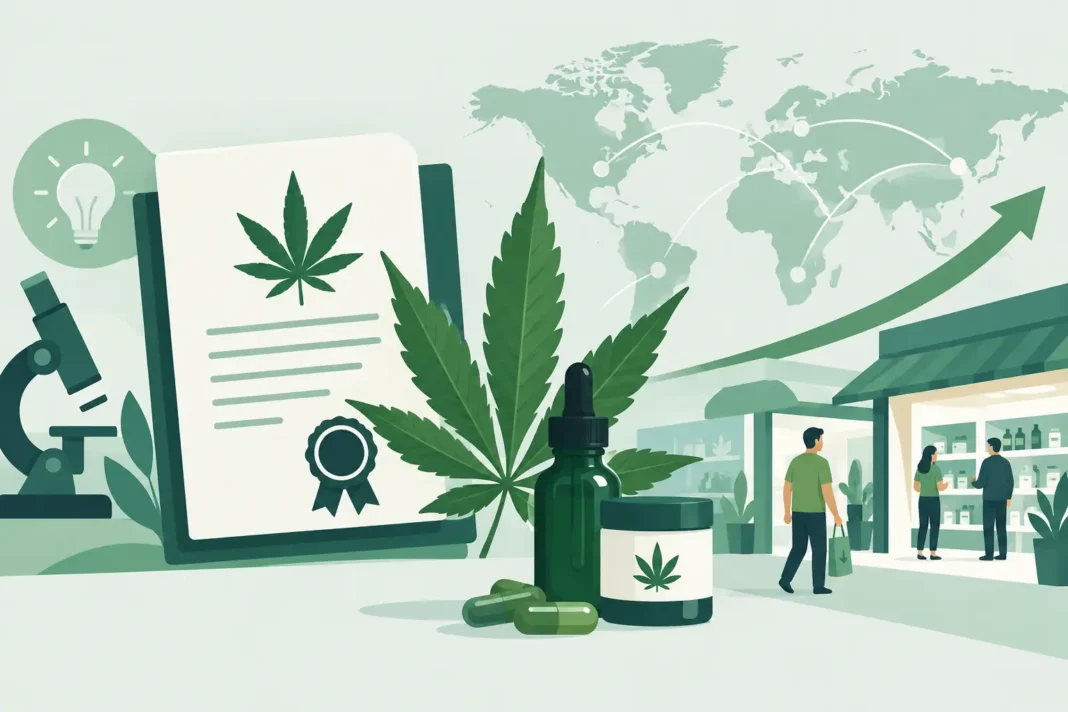

A cannabis cultivar may be easy to copy in appearance, but the genetics, extraction process, formulation data and delivery technology behind it can be far harder to replicate. That is why cannabis patents have moved from a specialist legal issue to a commercial fault line for cultivators, pharmaceutical developers, investors and medical cannabis operators.
For Europe’s regulated cannabis sector, the stakes are rising. Patent rights can shape who supplies a flower variety, whether a manufacturer can produce a particular oil, and how freely competitors can develop products for patients. They can also expose a gap between cannabis businesses that build defensible intellectual property early and those that discover too late that a key process is already protected.
Why cannabis patents matter now
The cannabis market is becoming more technical. Early commercial activity often centred on cultivation licences, brand recognition and distribution agreements. Those remain important, but a mature medical market rewards reproducibility: stable cannabinoid profiles, controlled impurity levels, reliable dosing and evidence that a product performs as claimed.
Patents are designed to protect qualifying inventions for a limited period, generally 20 years from filing where renewal requirements are met. In return, the applicant must publicly describe the invention in sufficient detail. The patent holder can then seek to prevent unauthorised commercial use in the jurisdictions where protection has been granted.
That framework matters in cannabis because product differentiation is increasingly tied to science. A company may pursue protection for a novel formulation combining cannabinoids and terpenes, an extraction technique that improves purity, a device that delivers a measured dose, or a manufacturing route for a rare cannabinoid. A strong patent portfolio can support licensing discussions, fundraising and acquisition value. It can also become a barrier to entry.
The trade-off is equally clear. Broad or overlapping claims can narrow the room for smaller operators to develop competing products, even where they have invested heavily in research. For patients, the concern is practical: exclusive control over a useful technology can affect supplier choice and, potentially, price.
What can actually be patented?
A patent does not grant ownership of cannabis as a plant or of cannabinoids simply because they exist in nature. Patentability turns on the law in the relevant territory and the precise invention claimed. Generally, an applicant must show that an invention is new, inventive and capable of industrial application.
In practice, cannabis-related applications often fall into several categories. These include cultivation systems, extraction and purification methods, pharmaceutical compositions, dosage forms, analytical testing methods, medical uses, synthetic cannabinoid production and delivery devices. A patent may cover a narrow technical improvement or attempt to claim a wider platform technology.
Genetics and plant material
Genetics attract particular attention because named strains can carry substantial commercial value. Yet protecting plant-related innovation is not straightforward, especially in Europe. Under the European Patent Convention, plant varieties and essentially biological processes for producing plants are excluded from patentability. Plant-related inventions may still be patentable in certain circumstances, particularly where claims are not confined to a specific plant variety and meet the other legal tests.
This distinction is not academic. A breeder may have rights over a named variety through plant variety protection, while a separate company may seek patent protection for a technical trait, genetic method or production process. The rights are different, and the route that works in one jurisdiction may not translate cleanly to another.
For operators sourcing genetics internationally, a certificate of analysis and a supply contract are not enough. They need to understand the chain of title, breeding history, permitted use and any restrictions attached to propagation or commercial production.
Formulations, extracts and medical uses
Formulation patents are likely to be among the most commercially significant as medical cannabis markets develop. The claim may concern a particular ratio of cannabinoids, an encapsulation technology that changes absorption, or a composition intended for a defined clinical indication.
However, the existence of a patent does not prove that a medicine works, and a favourable clinical result does not automatically create a patentable invention. Regulatory approval, clinical evidence, manufacturing compliance and intellectual property are separate tests. Businesses that treat a patent filing as a substitute for medical validation are likely to run into difficulty.
Europe is not one patent market
European cannabis companies often operate across multiple national licensing systems, reimbursement rules and prescribing cultures. Intellectual property adds another layer of complexity. A European patent application can provide a route towards protection in multiple countries, but enforcement remains territorial and depends on where rights are validated or otherwise take effect.
The Unified Patent Court and unitary patent system may offer a more centralised route for participating states in some cases. But cannabis businesses should not assume that one filing creates automatic protection across Europe, or that every commercially relevant market is covered. The United Kingdom is outside the unitary patent system, while national rights and European patents validated in the UK remain highly relevant to its medical cannabis sector.
The legal status of cannabis also complicates filing and enforcement strategies. A patent office assesses patentability rather than issuing a cultivation or marketing licence. Even so, an invention that is lawful to describe in a patent application may still face restrictions in manufacture, importation, prescribing or sale under national drug-control rules.
That separation can produce awkward outcomes. A company may hold a patent for a technology but lack a viable route to sell the resulting product in a particular country. Conversely, a licensed producer may be able to grow and supply a product while still needing freedom from third-party patent claims.
The risk of patent thickets
The most contentious area is the potential for patent thickets: clusters of overlapping rights around a technology, product category or production method. This is a familiar concern in pharmaceuticals and biotechnology, and cannabis is beginning to encounter the same dynamic.
A producer developing a standardised extract, for example, may face separate claims relating to biomass processing, purification, formulation, packaging and therapeutic use. No single patent may stop the project, but the combined cost of reviewing risks, redesigning processes and negotiating licences can be substantial.
This does not mean every cannabis patent is enforceable or overly broad. Applications can be rejected, granted patents can be challenged, and claims are often narrower than promotional announcements suggest. Prior art is especially important in cannabis, where historic cultivation knowledge, academic research and public disclosures may undermine claims of novelty.
Still, public information is fragmented. Traditional knowledge, informal breeding communities and legacy market practices have not always been recorded in a form that is easy for patent examiners or challengers to find. That creates a legitimate concern that long-known practices could be repackaged as proprietary inventions unless they are properly documented and scrutinised.
What operators should watch
For cannabis businesses, intellectual property should be addressed before a product reaches the market, not after an objection letter arrives. The practical question is not simply, “Can we patent this?” It is also, “Can we use this without infringing somebody else’s rights?” The second question is commonly described as freedom to operate.
A cultivator expanding into a new territory should review genetics licences and propagation terms. An extractor should map patents around solvents, equipment and purification steps. A medical product developer should examine claims covering formulation, dosing and the indication it intends to promote. The closer a product is to pharmaceutical development, the earlier this work needs to begin.
Businesses should also be cautious with public disclosures. A pitch deck shared widely, a trade-show presentation or an enthusiastic social post can damage novelty before an application is filed. Confidentiality agreements are not a complete solution, but they can form part of a disciplined process for handling unpublished technical information.
For smaller firms, trade secrets may sometimes be more realistic than patents. A manufacturing method that cannot be readily reverse-engineered may be protected through contractual controls, limited access and internal documentation. The downside is that trade secret protection disappears if the information becomes public or is independently developed. Patents are expensive and disclose the invention; trade secrets are cheaper to maintain but more fragile. The right choice depends on the technology, budget and likelihood of reverse engineering.
A policy question as well as a business question
Cannabis patents will increasingly test whether emerging markets can reward genuine innovation without locking up tools that patients, researchers and licensed producers need. Policymakers have an interest in ensuring that public research, smaller breeders and domestic manufacturers are not shut out by opaque ownership claims. Patent offices, meanwhile, need access to better evidence of existing cannabis knowledge when assessing novelty.
For investors, a patent portfolio deserves closer inspection than a headline count. The useful questions are where the patents are granted, what the claims actually cover, whether they have survived opposition, and whether the company can operate legally in the intended market. A large portfolio with weak claims may offer less protection than one carefully drafted patent tied to a validated, scalable product.
As European medical cannabis systems move towards more standardised supply and more evidence-led prescribing, intellectual property will become part of the competitive infrastructure. The companies best placed to benefit will be those that treat cannabis patents neither as marketing trophies nor as an afterthought, but as one element of a credible strategy built on science, compliance and patient access.