






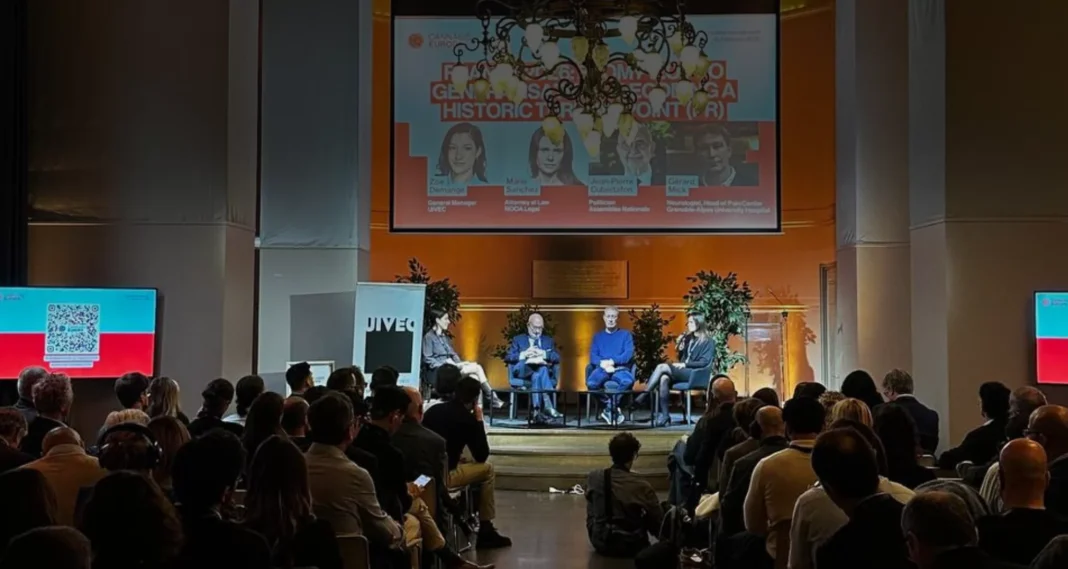

Cannabis Europa will return to France’s capital today (February 19th, 2026) at a crucial time for the new medical cannabis industry in France.
Evening before the meeting, French authorities had met with representatives of the cannabis industry in order to draft the framework for reimbursements, the most awaited piece to help France move from its pilot project to the permanent market. Arriving at the location this morning, delegates knew that they were going to hear first-hand what was said.
Stephen Murphy is the co-founder and CEO of Prohibition PartnersIn his opening remarks, he highlighted how much the European market and Cannabis Europa have progressed in the past seven years.
“We’ve moved from the perception of ‘is medical cannabis legitimate’ all the way through to actually getting medical cannabis into the hands of patients,” Murphy told delegates. In my opinion, the conversation about France is one of most significant European discussions taking place in this year.
We’ve summarized the main insights of the day and will update in real-time.
Draft reimbursement structure
Last night (February 18, 2026) a consultation meeting, organised by the Direction Générale de la Santé (DGS) and the Direction de la Sécurité Sociale (DSS), saw stakeholders receive the first concrete view of the planned economics of the incoming market.
Today, the delegates received a concrete overview of the economic model that the government has for cannabis-based medicines.
Ludovic Rachou, President of UIVEC, who coordinated the reimbursement dossier that was submitted to HAS in September last year, presented the recently revealed plans.
In December 2025, the Haute Autorité de Santé (HAS), the body responsible for evaluating medicines and approving them for coverage under France’s public health system, paused its assessment of cannabis medicines after concluding it could not finalise reimbursement structures without the published decree. The draft of the decree has been completed.
Takeaways from the conference:
- The proposed model establishes a tiered reimbursement structure tied directly to Haute Autorité de Santé’s (HAS) assessment of each product’s therapeutic benefit.
- Rates of coverage will be determined at Benefits are categorized as major, medium, minor or not enough., respectively.
- Rachou pointed out that headline rates are not always as significant for patients. As the French ALD system is based on long-term diseases, the vast majority of eligible patients have these conditions. All cannabis products should eventually be covered by 100% The base level of reimbursement is the same regardless. He noted that the answer to this question is not yet finalised.
- The pricing structure will consist of homogenous product groups, grouped by composition, clinical characteristics and pharmaceutical forms. Single price for all categories.
- Three-year price fix The dose can be increased or decreased if new evidence is discovered.
- After the meeting on February 18, we expect that consultations will last for between Three-week and one-month contractsThe public comment period is open to all stakeholders.
- If all goes according to plan, regulatory decrees pertaining, for example, to the cultivation of marijuana, its technical specifications and the legal status, as well as the cannabis-based drugs, will finally be issued.Orally adopt in June
- The French Drug Agency ANSM will then be able for companies to register their products, and HAS’s evaluation process can resume.
- The final HAS opinion regarding reimbursement should be expected around November 2026.Patients enrolled in the Pilot Programme will be covered by an expanded scheme up to 31 December 2026.
- UIVEC is in constant discussion with the authorities about the pricing methods for the various product categories. Rachou stated that UIVEC will be actively involved in the process of determining the price methodology.

How to Reimburse: Who pays for what and when
A roundtable in French was held a few days later to discuss the new measures.
The Key Takeaways
- France has a system of single payer, which means that companies can negotiate with the Ministry directly. No room for individual cases as in Germany. According to one speaker, either you reach an agreement with the Ministry or else you will be out.
- Governments are expected to start working from the a pre-set budget envelope for medical cannabis instead of simply evaluating the clinical value of each product. HAS may be open to reimbursements in theory, but seeks to protect the public finances. Keeping the Therapeutic Benefit RatingThe reimbursement rate should be as conservative as is possible.
- A target population of patients will likely be a hotly contested issue. It is important to keep the budget under control. A well-defined population will help with this, however a too wide definition can lead to spending being out of control. Panelists warn that companies who make inflated projections of volume will get a lot of pushback. They suggest that reassuring authority with estimates based on epidemiological data is more likely to work.
- You can choose from a variety of The clinical comparator will play a crucial role in pricing. The ministry’s willingness to accept a price will depend on whether the cannabis product is compared against opioids or surgical procedures, intrathecal devices, etc. The panelists raised the issue of potential harm that could be caused by cannabis. The authorities will use any confusion in comparison selection Price reductions are a result of lowering prices.
- The industry is in a tough position with a single price fixed per category of products, which was confirmed yesterday during the consultation. No price differentiation and no promotion of products is allowed. Businesses will have to fight for their survival Cost structure is the only thing that matters. The ones with high production cost, Particularly foreign operators If you underestimate the true cost of French pharmaceutics, then it is possible that the final price will not be in line with what was set.
- It is the cost of dried flowers that poses the greatest risk to international operators. The real cost risk for international operators is not the price of dried flower. French Pharmacovigilance is a full-weighted compliance.. Physicians who are trained, obligations to follow up on patient data, controls for the management of narcotics, and the need for an exploitant and a responsible pharmacy. This must be taken into account when price negotiations are conducted.
- Price-cutting is a risky business. Companies will respond to this by increasing their volume in order to compensate. Overshoot of the Patient Population HAS is defined as Budget breachedFurther regulatory interventions are triggered by.
- Health economics may be the strongest argument in favor of cannabis. Medical cannabis consumption was reduced by patients in the pilot project, according to data. A single cannabis drug can potentially replace five or seven prescriptions and treat several symptoms. This is an excellent argument to support the Social Security system.
- Made-in France is seen more and more as an asset in negotiations, because domestic production aligns well with the government’s priorities.
- The timeliness of patient access remains a major concern. Once reimbursement has been confirmed, the restrictions regarding which specialists are allowed to initiate prescriptions and pain centers, as well as the multidisciplinary requirements, could cause significant bottlenecks during the initial phase of the marketplace.
The morning session provided a number of key insights
The morning sessions, which went beyond the deep dive on reimbursement, reinforced the same theme. France has created a framework of strict standards that safeguards quality and patients, but further delays are becoming more difficult to justify in terms of commercial costs and the impact they have on people.
Speakers were very clear on the domestic production. France was a model for pharmaceuticals, not low-cost markets. It is only a greenhouse market and GACP compliant. Also, it’s tightly connected to supply chains in pharmaceuticals. GMP certification remains the critical and expensive gatekeeper, with one speaker warning companies to ‘triple your budget and triple your time.’ Germany’s continued price compression will accelerate the global supply chain reshape.
Patients’ testimony was equally stark. The president of a patient association described an 18 step regulatory journey that began in 2018 and pointed out patients who died within the last 18 months after new pilot program inclusions were stopped, people who couldn’t access cannabis medicine during their final months. She argued that without viable pricing there would be no cannabis industry. Without reimbursement there would be a two tier system with access restricted to those who could afford it.
Sponsored Content
This informative article is brought to you by NUBO CBD →