







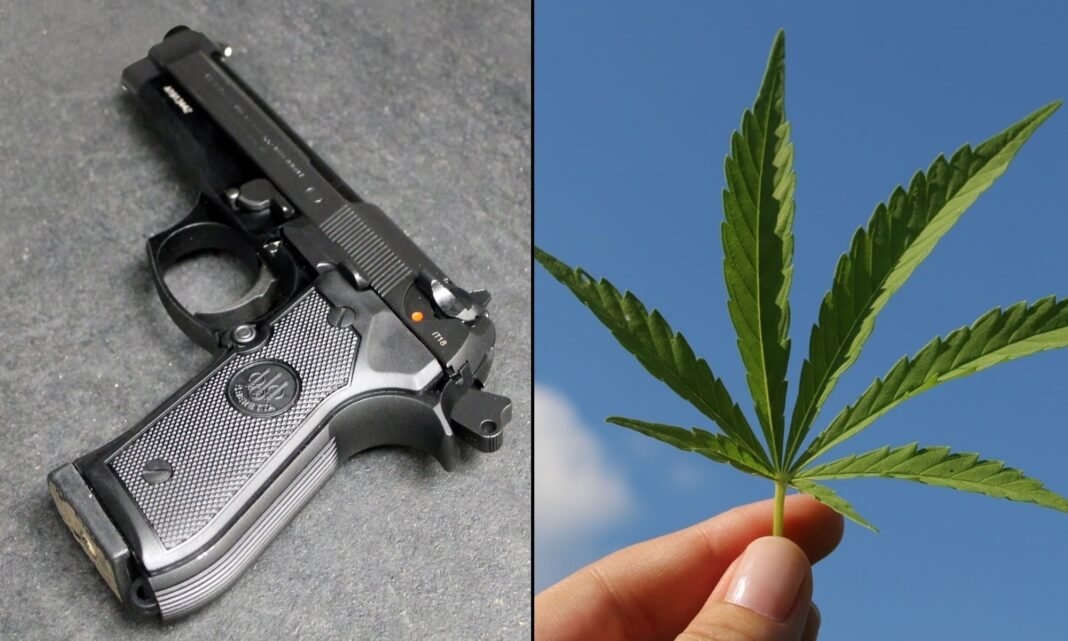

After a string of legal challenges the Trump administration has asked the U.S. Supreme Court for a ruling on the Federal Government’s prohibition on marijuana and illegal drug users owning guns. It says that the 2nd Amendment is not violated by the rule.
In order to achieve this, the DOJ’s solicitor general has asked SCOTUS for a hearing on one of five pertinent cases in an effort to settle conflicting decisions by lower courts regarding gun rights and cannabis users.
In light of multiple legal disputes that have resulted in different rulings by federal appeals court across the nation, DOJ asked SCOTUS last week to review one case in particular, that it described “archetypal”, which was related to the federal code 922 (g) (3), that prevents those who use illegal drugs from owning firearms or ammunition.
This case presents an important Second Amendment question that impacts hundreds of prosecutions each year. It asks whether the government can disarm people who use illegal drugs habitually but not under the influence when they possess a gun. D. John Sauer was appointed by President Donald Trump as Solicitor General.
The solicitor general reiterated his position that, despite recent appeals court decisions calling into question the constitutionality of the firearms ban for people who use cannabis—even in compliance with state law—the restriction is nevertheless lawful.
Some lower courts have said the government’s blanket ban on gun and ammunition possession infringes on the Second Amendment—at least as applied to certain individual cases—because there’s no historical justification for such a broad restriction on an entire category of people.
But in recent years, federal appeals and district courts have adopted different approaches. In its most recent filing, the DOJ stated that “the issue presented is the topic of a growing and multi-sided circuit conflict”.
“The Petition for a Writ of Certiorari [filed by Sauer in June] Three sides were identified in this dispute: the Seventh Circuit supported Section 922(g), the Eighth Circuit ruled that it was a violation of the Second Amendment, unless there is a compelling case for the government to disarm the user; and finally the Fifth Circuit ruled that it would be if the user had been under the influence.
It said that “since then, the dispute has intensified,” referring to several cases on this issue which are currently before the supreme court. The DOJ is asking SCOTUS for a focus on a particular case to solve what they call ‘four-way conflict. U.S. v. Hemani.
Justices’ taking of up cases could be one reason why DOJ is focused on them. Hemani The defendant was not only found to be a drug user in this case, but he also used cocaine in the past and sold drugs, as per court rulings. That could have made him appear less sympathetic. In the other cases, defendants were only found to be in possession of a gun and marijuana.
The lawyers for defendants in Hemani Last month I argued that the Supreme Court should reject the case.
In its response brief to SCOTUS, submitted this week by the Justice Department, it said that “this is the best case available.”
“The government has filed petitions for writs of certiorari in four other cases presenting the same question… As those petitions explain, this case presents the Second Amendment issue more cleanly than [three other cases pending before SCOTUS] This involves a “more developed” record compared to the fourth.
DOJ reiterated, that despite respondents’ arguments about marijuana being widely available, especially at state levels, “federal laws still prohibit possessing marijuana and federal laws take precedence over state law which is contrary.”
It said that Section 922 (g)(3) is in line with the tradition of gun regulation of this country. This was under a part of its brief entitled “Section (922(g),(3) Complies with The Second Amendment”.
Nine justices will privately decide whether or not to accept the case. Hemani Next month, we will be discussing these cases and others involving cannabis and firearm rights in a closed-door meeting. This includes cases U.S. v. Cooper, U.S. Daniels The following are some examples of how to get started: U.S. v. Sam. Separate case U.S. v. Baxter. is also in front of the court. It has received briefs on two different dockets but it was not scheduled to be discussed at the 29th September meeting.
You can also find out more about the following: CooperThe defendant was sentenced to three years in prison for possessing a gun while actively using marijuana. An appeals court panel dismissed the conviction. Last month, the solicitor general asked the court to delay a decision on whether or not the case should be reviewed until after the Hemani The dispute has been resolved.
It is important to note that the word “you” means “the”. Baxter A defendant who was in possession both of a handgun and of a marijuana-filled bag is the subject of another case. He was charged under section 922(g). DOJ asked for additional time in order to make a decision on whether or not to request judicial review. Circuit Court of Appeals of Eighth Circuit ruled gun bans might not be constitutional when they are applied to defendant. Sauer requested the decision of the Supreme Court in late June. Hemani First, let the ruling that governs your decision be first. BaxterSimilar to Cooper.
In the last few months, several federal courts have cast doubt on 922 (g) (3), concluding that although the prohibition on gun ownership by drug users is not entirely unconstitutional it’s rare to find a precedent in history for such an expansive restriction of Second Amendment Rights on a whole category of individuals.
As a recent report from the Congressional Research Service (CRS) explained the current legal landscape, a growing number of federal courts are now “finding constitutional problems in the application of at least some parts” of the firearms prohibition.
A three-judge panel of the U.S. Court of Appeals, Eighth Circuit, vacated a defendant’s conviction last month and remanded it back to a District Court, noting that a retrial in front of a jury could be required to determine if cannabis caused the defendant to become dangerous or pose a threat to other people.
This new Eighth Circuit decision appears to be different from the recent Third Circuit ruling, in that it says that 922(g),(3) does not “require” that every case is reviewed by a court.[s] “An individualized factual decision”, explaining that these determinations would not be needed if the Government could prove that a specific drug rendered an entire group of users hazardous.
By contrast, the Third Circuit earlier this month said in a published opinion that district courts must make “individualized judgments” to determine whether 922(g)(3) is constitutional as applied to particular defendants.
A panel of appeals ruled that, although a person does not need to have “harmed anyone, threatened harm or otherwise acted in a dangerous manner to justify their disarmament,” history and gun laws require that “the district courts must make individual judgements and conclude disarming an addict is necessary for addressing a risk that the drug user would pose a threat to others.”
Judges in that case noted that historical restrictions on gun ownership under “drunkenness and lunacy laws” in the U.S. “were still always based on an ‘individualized assessment’ rather than a categorical judgment.”
In 2024 the Supreme Court made a decision in U.S.The case involved firearms possession by people who are subject to domestic violence orders. The Justices then remanded several pending cases to the lower courts, for further consideration. U.S. DanielsThis article focuses on the Federal Gun Ban for Cannabis Consumers.
What is the best way to get in touch with you? Daniels When the case was heard first by the U.S. Court of Appeals Fifth Circuit judges, they declared that the gun restriction was unconstitutional. After the Supreme Court remanded the case back to the Fifth Circuit, the appeals court in a January opinion again took issue with the statute, explaining that while 922(g)(3) It is a good idea to usen’t unconstitutional on its face, it was The defendant was a cannabis occasional user.
Fifth Circuit Court of Appeal Daniels ruling came on the heels of a string of other judicial decisions casting doubt on the legality of the ban.
Earlier this year, a federal judge in Rhode Island ruled that the ban was unconstitutional as applied to two defendants, writing that the government failed to establish that the “sweeping” prohibition against gun ownership by marijuana users was grounded in historical precedent.
A federal judge in El Paso separately ruled late last year that the government’s ongoing ban on gun ownership by habitual marijuana users is unconstitutional in the case of a defendant who earlier pleaded guilty to the criminal charge. This court permitted the defendant to withdraw his guilty plea and dismissed the charges.
Another panel of judges, on the U.S. Court of Appeals for the Tenth Circuit, heard oral arguments in November in the government’s appeal of a district court ruling that deemed the gun ban unconstitutional.
In a number of the ongoing cases, DOJ has argued that the prohibition on gun ownership by marijuana users is also supported by the Rahimi decision that upheld the government’s ability to limit the Second Amendment rights of people with domestic violence restraining orders.
DOJ has made such arguments, for example, in favor of the firearms ban in a case in a case in the U.S. Court of Appeals for the Eleventh Circuit. The group, which includes Florida medical cannabis users, claims that the Second Amendment is being violated by state laws that prohibit them from buying firearms as long as they use cannabis to treat their condition.
Under President Joe Biden, the DOJ has consistently claimed that patients with medical marijuana who own firearms are “a threat to public safety,” they “pose an increased risk of suicide,” and more likely commit crimes in order “to finance their drug addiction.”
The Trump administration has not yet decided how it will handle the case. At a NRA conference in 2023, Trump suggested there might be a link between the use of “genetically engineered” marijuana and mass shootings. Trump listed several controversial and unproven causes of the mass shootings that plague the United States. He said he’d direct the Food and Drug Administration to look into them.
We need to investigate whether common psychotropic drugs and genetically-engineered cannabis or other narcotics can cause “psychotic breaks” leading to violent gun attacks, said he.
DOJ has claimed in multiple federal cases over the past several years that the statute banning cannabis consumers from owning or possessing guns is constitutional because it’s consistent with the nation’s history of disarming “dangerous” individuals.
The Justice Department, in 2023, told the U.S. Court of Appeals of the Third Circuit, that precedents “comfortably support” the ban. Cannabis consumers with guns pose a unique danger to society, the Biden administration claimed, in part because they’re “unlikely” to store their weapon properly.
Hunter Biden, son of Vice President Joe Biden was found guilty by a Federal jury last year of violating the law by purchasing and possessing crack cocaine while using a firearm. Two Republican congressmen challenged the basis of that conviction, with one pointing out that there are “millions of marijuana users” who own guns but should not be prosecuted.
This situation has created confusion for medical marijuana patients as well as state legislators and advocacy groups. The National Rifle Association’s (NRA) lobbying arm said recently that the court rulings on the cannabis and guns issue have “led to a confusing regulatory landscape” that have impacted Americans’ Second Amendment rights.
The advocacy group said that marijuana use was no longer restricted to youth counterculture or indigenous religious practices. It now included a variety of people using it as a recreational or medicinal drug. The group said that many of these people were law abiding and productive community members who wanted to exercise the right to own and carry arms.
Some states, however, have also passed laws that either restrict gun rights or attempt to protect them in relation to marijuana. Recently a Pennsylvania lawmaker introduced a bill meant to remove state barriers to medical marijuana patients carrying firearms.
Colorado activists also attempted to qualify an initiative for November’s ballot that would have protected the Second Amendment rights of marijuana consumers in that state, but the campaign’s signature-gathering drive ultimately fell short.
As 2024 drew to a close, the ATF issued a warning to Kentucky residents that, if they choose to participate in the state’s medical marijuana program that’s set to launch imminently, they will be prohibited from buying or possessing firearms under federal law.
According to the official, while those with guns are not expected to give them up if they decide to become state-legal marijuana patients, “those who wish to comply with federal law in order to avoid being in violation of that law” should “decide” to sell their weapons.
Since then, bipartisan state lawmakers have introduced legislation that would urge Kentucky’s representatives in Congress to amend federal law to clarify that users of medical marijuana may legally possess firearms, though no action has since been taken on that bill.
Kentucky Gov. Andy Beshear (D) said in January that he supported the legislature’s effort to urge the state’s congressional delegation to call for federal reforms to protect the Second Amendment rights of medical marijuana patients, but the governor added that he’d like to see even more sweeping change on the federal level.
Beshear, at a recent press conference said: “The right thing to do is to not only focus on this problem but also to alter the cannabis schedule.” We need to alter the marijuana policies of the federal government.
Sponsored Content
This informative article is brought to you by NUBO CBD →