







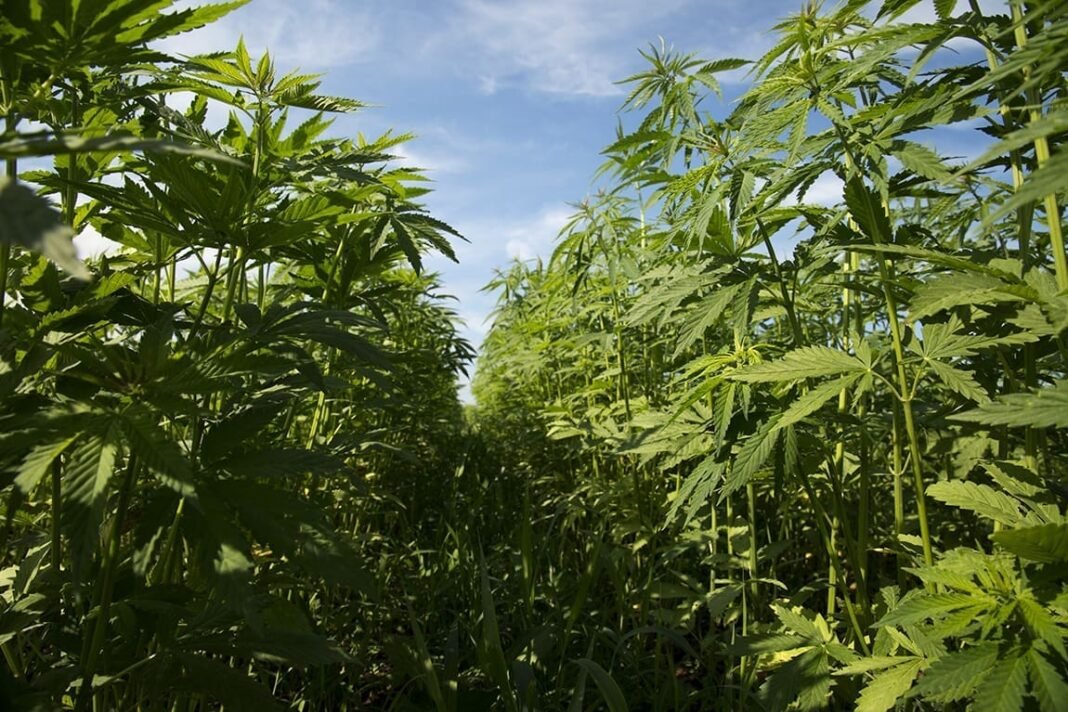

Bipartisan members of the US House have resisted attempts to prohibit hemp THC, saying that this would cause “a mortal blow” to industry. Also, they argue, it violates Congress rules, since currently, such an act is included in spending bills. Members of Congress have announced that they are working on a plan to introduce another measure in order to regulate the hemp THC market.
James Comer (R) and 26 others sent a letter to House Speaker Mike Johnson, (R) LA on Friday. They said that the House Appropriations Bill that was advancing this week with the hemp prohibition provisions still intact will destroy the growing industry since it has been legalized by the 2018 Farm Bill.
Despite the fact that the Senate eventually removed similar language in its agriculture spending bill following an objection from Sen. Rand Paul, (R-KY), stakeholders are still concerned it may end up as part of the final package sent to the President following bipartisan negotiations.
In the event that this happened, they wrote, “it would be a death blow for American farmers who supply the regulated hemp industries and small business, and it could jeopardize the economic activity of tens and billions of dollar across the United States.”
They added that there were serious concerns about the way in which this language was incorporated into these bills. The language in these bills was not discussed by the authorizing committees. Members were also unable to discuss their concerns and prefer alternative legislation.
Specifically, it says that inclusion of hemp in the House Bill “clearly contravenes” a law prohibiting the use of language to alter existing law via general appropriations legislation.
It says that “Perhaps the most worrying is the description by the proponents of the language, which states the bill won’t negatively impact the industry of industrial hemp,” referring to the comments made by certain legislators like Rep. Andy Harris(R-MD), and Sen. Mitch McConnell(R-KY), who championed this controversial proposal.
The letter continued, “On the other hand, it prevents farmers from developing dual cultivars that produce cannabinoids and fiber or grain and cannabinoids.” These genetic advancements are crucial to maximising the economic value for a single crop. They give farmers flexibility to adapt to changing market demand and increase overall profitability.
In short, because of their inherent interconnectedness, all three of these markets are vital to the future success of American Hemp Farmers. The hemp sector is not an assortment of competitive sectors but rather a connected ecosystem, where the growth of one segment encourages innovation and opportunity in other segments.
Instead of pursuing “this damaging rider” on appropriations, the members from both parties said that Congress should pass regulations for hemp-based products. These would prohibit sales to anyone under 21 years old and copycats that mimic popular brands that are not cannabis. They also suggested that Congress standardize labels requirements as well as mandate laboratory testing.
As stated in the email, similar legislation had been previously presented in the Senate. In the letter, it is also stated that legislation has been actively drafted at the House Energy and Commerce Committee.
The letter states: “By changing arbitrarily the definition of hemp legal rather than responsibly controlling the market, Congress effectively turns out the light on America’s hemp legal farmers and undermines the work that our colleagues are doing in authorizing committees as well as in state regulatory frameworks created for hemp products.”
The report concludes: “For these reason, we strongly encourage leadership to remove the language in this bill from any final FY26 Appropriations legislation and Ag-FDA Appropriations.” We will fight for American hemp growers and small business owners and refuse to allow this language to be included in any legislation.
Comer was not alone in signing the letter. Also included were Reps. Andy Barr, Thomas Massie and Nancy Mace from Kentucky. Ted Lieu of California also signed. Dan Crenshaw is another signatory.
In a release issued by the U.S. Hemp Roundtable, Comer stated that he has “first-hand witnessed the enormous potential of industrial hemp in creating quality jobs and meaningful opportunities for American workers.”
As Kentucky’s commissioner of agriculture, I led the state’s pilot industrial hemp program. And as a hemp advocate in Congress, I will continue to do so,” he stated. “I’m fully committed to leading bipartisan efforts to urge House leadership to strip harmful language from the FY26 Ag-FDA bill—and any final appropriations package—that arbitrarily redefines legal hemp.”
Democratic Senators sent an open letter to the leadership of the Senate earlier in this month, warning of the upheaval that could occur on the hemp market should products with any level of THC be banned.
“Consumer protection and protecting children while promoting national economic growth opportunities in the hemp sector can and must go together,” said Sen. Ron Wyden(D-OR), who co-authored that letter along with Sen. Jeff Merkley(D-OR). Congress must take a serious look at common sense safeguards for kids and consumers. They should also encourage innovation, rather than relying on a “one-size fits all” approach which hinders economic growth and does not keep children safe.
Recently, dozens of Kentucky hemp farmers urged the senior U.S. Senator, McConnell to stop his efforts to criminalize certain products derived from their plants.
Paul, for his part, recently cautioned that the cannabis policy movement has “swung hard on the prohibitionist side” amid the ongoing debate over intoxicating hemp products. Paul is worried that, should things not go well, the hemp product market will be decimated in the “next two weeks.”
Paul responded that his staff and he have “been working tirelessly” on a “compromise.”
They say, at least on the surface, they’re not trying to eliminate it–but I think we are talking past each other in some ways,” he said. They say, at least on the surface, they’re not trying to eliminate it—but I think we are, in some ways, talking past each other,” he said.
—
MEDCAN24 tracks hundreds of marijuana, psychedelics, and drug policy legislation in state legislatures this year. Patreon members who pledge at least $25/month gain access to interactive maps, charts, and hearing schedules so that they do not miss anything.
Find out more about our marijuana law tracker. To get access, become a Patreon supporter.
—
Meanwhile, Paul recently filed a standalone bill that would go in the opposite direction of the hemp ban, proposing to triple the concentration of THC that the crop could legally contain, while addressing multiple other concerns the industry has expressed about federal regulations.
In June, the senator presented the Hemp Economic Mobilization Plan Act (HEMP). It mirrors versions he’s sponsored over the last several sessions.
Harris, who championed the hemp THC ban in his chamber version of the agriculture spending legislation, told MEDCAN24 that he wasn’t concerned about any potential opposition to the hemp ban in the Senate—and he also disputed reports about the scope of what his legislation would do to the industry.
The Congressional Research Service (CRS) released a report in June stating that the legislation would “effectively” prohibit hemp-derived cannabinoid products. The CRS originally stated that a similar ban would also prevent the sale CBD, but for unknown reasons the report has been updated to remove that specific language.
The hemp language is largely consistent with appropriations and agriculture legislation that was introduced, but not ultimately enacted, under the last Congress.
Hemp industry participants rallied to oppose that proposal. A previous version of it was also in the subcommittee’s base bill last year. It’s virtually identical to a provision of the 2024 Farm Bill that was attached by a separate committee last May via an amendment from Rep. Mary Miller (R-IL), which was also not enacted into law.
Brendan Cleak provided the photo.
MEDCAN24 could not exist without readers’ support. Consider a Patreon subscription if our marijuana advocacy journalism is what you use to keep informed.

Sponsored Content
This informative article is brought to you by NUBO CBD →