







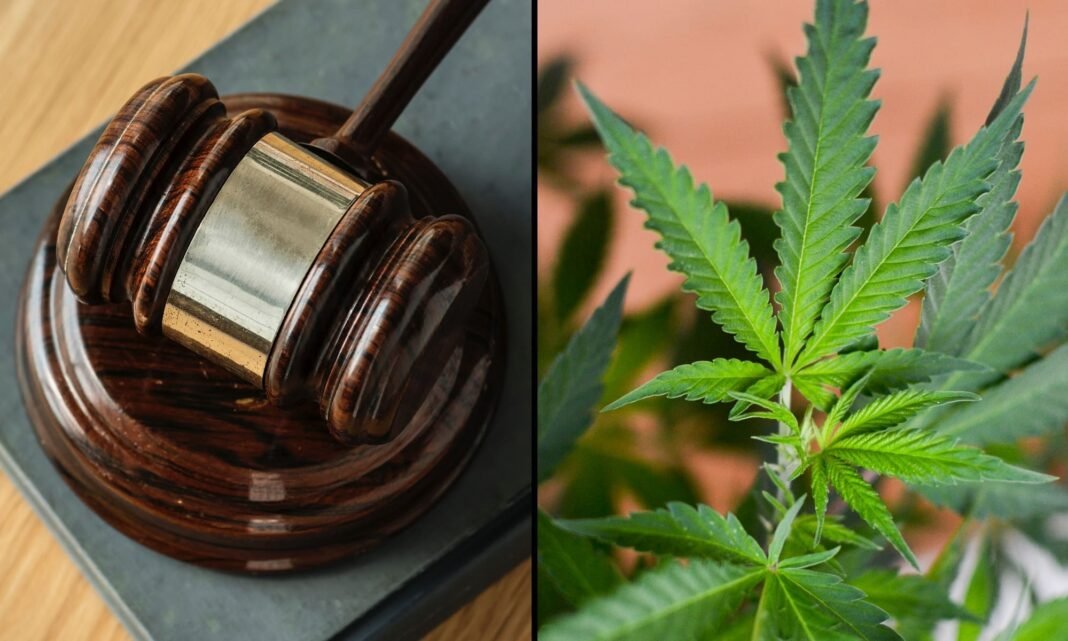

Florida courts have ruled that the police are not allowed to search vehicles based on smell alone.
The District Court of Appeal of Florida Second District, headed by Judge Nelly Khouzam on Wednesday released an opinion that reversed a previous court ruling that supported the “plain-smell doctrine,” which allowed for years cannabis smell to be used in vehicle searches.
A man’s probation was revoked in District Court after police pulled him over in a vehicle, claimed they smelled marijuana and forced his occupants out to search the car. They found cannabis and pills.
While it would have been logical to pretext a search based on the smell of cannabis in years past, when the drug was still strictly forbidden, Florida laws now have a “fundamental” change, according to the court, which referred specifically the legalization in Florida for hemp and medical marijuana.
“For generations, cannabis was illegal in all forms—thereby rendering its distinct odor immediately indicative of criminal activity. “But several legislative changes over the years fundamentally altered its definition and regulations,” said it. It is a cumulative outcome that marijuana is now legally available in many forms. This depends on the chemical composition or where it came from.
News Service of Florida first reported the opinion. “We’re obligated to implement the significant changes made by the Legislature to cannabis regulations, based on well-established constitutional principle,” it said.
“In light of significant legislative amendments to the definition and regulation of cannabis, its mere odor can no longer establish that it is ‘immediately apparent’ that the substance is contraband. The plain smell doctrine cannot establish probable cause solely based on the odor. We now align Fourth Amendment analysis of cannabis to the test for other suspected contraband. This means that the odor can be a factor that is considered in conjunction with others, under all circumstances.
It also stated that the Florida Supreme Court should examine and ultimately resolve the question, as it is of “great importance to the public”.
Multiple polls conducted in Florida before the vote last year on a ballot initiative legalizing adult use of cannabis showed that marijuana reform is supported by a majority. The initiative fell just short of passing the 60 percent threshold, as a result of opposition from both the Florida Sheriffs Association and Florida Police Chiefs Association.
Although the legalization of cannabis at state level has been a growing trend, lawmakers and courts have struggled to determine how to adjust their policing strategies to conform to laws that allow for its medical or recreational usage.
Chicago Police officials, for instance, announced in June an update of city law enforcement guidelines to discourage officers searching vehicles solely based on the smell or raw unburned marijuana.
This revised policy was developed in response to a ruling by the state Supreme Court late last year, which said that police can search a car if they detect raw marijuana. Advocates and some lawmakers say the ruling is incongruous with a separate high court decision a few months earlier that found that the smell of Burnt Cannabis The amount of money needed to buy the necessary number of cars is insufficient Cause to search a car
In May, a House committee in Illinois had an initial hearing on a Senate-passed bill that would clarify that police may not stop or detain drivers, or search their vehicles, based solely on the smell of cannabis.
—
MEDCAN24 tracks hundreds of marijuana, psychedelics, and drug policy legislation in state legislatures this year. Patreon subscribers who donate at least $25/month have access to the interactive maps and charts, as well as our hearing calendar.
Find out more about our marijuana law tracker. To gain access, become a Patreon supporter.
—
Some critics of using marijuana smell as a probable cause to stop and search vehicles argue that law enforcement disproportionately targets Black Americans, other people of colour and that allowing vehicle searches based on alleged cannabis odor could lead to increased bias.
Other states have also passed laws that allow police to search for cannabis based on the scent. Before legalization took effect in Maryland for instance, Gov. Wes Moore, a Democrat from Maryland, allowed the passage of a law prohibiting police officers from conducting searches solely based on the smell or presence of marijuana. GOP lawmakers unsuccessfully attempted to reverse that policy.
The Minnesota Supreme Court also ruled last year that police can’t use the smell of cannabis alone to justify vehicle searches—a ruling that has since been codified by the legislature and signed into law by Gov. Tim Walz (D).
New York’s Gov. Kathy Hochul (D) signed a budget bill into law that notably does not include a controversial marijuana provision she proposed that would have allowed police to use the smell of marijuana as probable cause that a driver is impaired and then force them to take a drug test.
Amendments by lawmakers removed the provision, which a coalition of 60 reform groups had argued in a letter to Hochul and top lawmakers would “repeat some of the worst harms of the War on Drugs” and allow law enforcement to “restart unconstitutional racial profiling of drivers.”
Photos courtesy of rawpixel Philip Steffan.
MEDCAN24 could not exist without readers’ support. Consider a Patreon subscription if our marijuana advocacy journalism is what you use to keep informed.

Sponsored Content
This informative article is brought to you by NUBO CBD →