







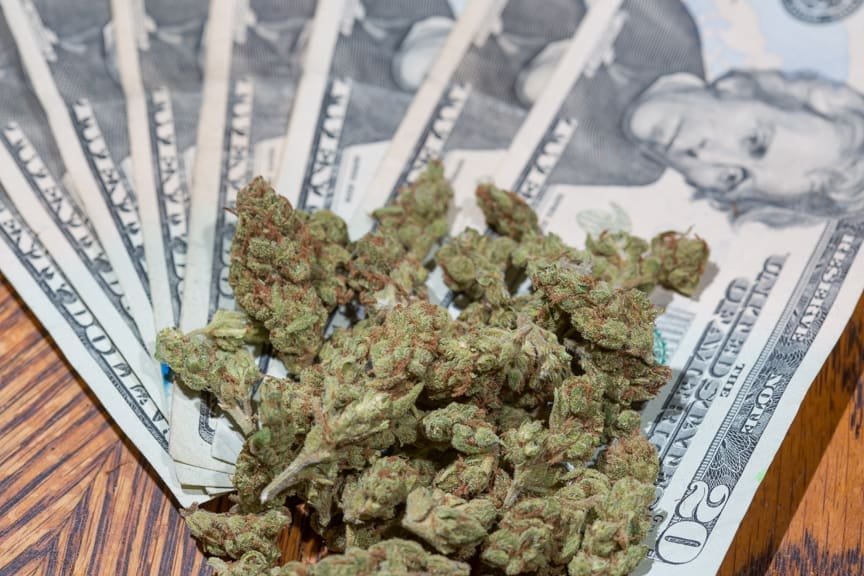

It is not possible to allocate the money until a federal law change.
By Nicole Blevins, Mountain State Spotlight
Mountain State Spotlight published the original version of this article. Get stories like this delivered to your email inbox once a week; sign up for the free newsletter at https://mountainstatespotlight.org/newsletter.
West Virginia’s medical marijuana program, which began in 2021 with the opening of its first dispensary, has so far collected $34 Million in taxes, fees for licensing and interest.
According to state law, the money must be used for a medical marijuana research program and to provide resources to people with substance abuse disorders. It also has to fund training in law enforcement.
The money is still sitting in the bank almost four years after it was received.
Cannabis remains illegal at the federal government level. Since traditional banks refused to accept the cannabis dollars of the state, they were transferred to a credit cooperative under the control and management of the office for the state treasurer.
Carrie Hodousek, spokesperson for the Treasurer’s Office said that money will not be allocated until changes are made to federal laws.
Maryland, Pennsylvania and Ohio are among the states that spend tax money on cannabis.
The federal government and banks are causing a stumbling block to the medical marijuana roll-out
In 1970 the federal government designated marijuana as Schedule I drugs, meaning it was not medically useful and had a potential to be misused. In spite of the federal classification, forty states now allow recreational and medical cannabis usage.
West Virginia’s Medical Cannabis Act of 2017 allows licensed doctors to issue cards for medical marijuana to patients who seek alternative treatments to serious illnesses.
The bill passed in West Virginia four years ago, but it was not until then that patients were able to access medical cannabis through a West Virginia marijuana dispensary.
John Perdue, then the Treasury Secretary at that time, said in 2018 that banks would not hold money for this program as they didn’t want to be held responsible for handling illegal substances.
Perdue requested an advice from Patrick Morrisey at that time to help determine how to best handle the finances of the program. Morrisey said the federal government has not pursued other states that have medical cannabis markets. However, there is no guarantee they will continue this practice.
The state had no way to collect permit fees, so it did not distribute licenses. In March 2019, lawmakers amended the law to permit a credit-union to handle the money.
Element Federal Credit Union—which was already planning to provide banking services to the state’s cannabis industry—won the bid to hold the tax dollars.
The individual banks decide if they are willing to assume this risk. Linda Bodie said it is a huge risk, because the federal government has banned this practice. We took on the risk.”
Riley Moore, former Republican delegate candidate and state treasurer in 2019 published an opinion in The Charleston Gazette-Mail criticizing Perdue’s inability to implement the program.
In his letter, he said, “It is clear that West Virginia requires a state treasurer office which is modernized, proactive, and transparent.” Moore beat Perdue at the 2020 general election.
The first dispensary was opened in November of 2021 after planting, harvesting, and converting cannabis into edible products. Tax revenue began to be generated.
Moore was state treasurer during the four-year period when the program produced millions in revenue. However, these funds were never used. Moore did not answer any questions in relation to the fund. He is currently a U.S. congressman.
They were shocked to learn that money from the sale of medical cannabis was sitting in a local credit union.
Del. “I wasn’t aware of that,” said Del. Mike Pushkin (D-Kanawha): “That was the first time I heard about it. That it wasn’t spent.”
Pushkin was involved in the creation of cannabis banking legislation for 2019. He stated that there was no discussion he participated in either during the legislative session or afterwards that indicated that the fund could stall.
Mike Woelfel (D-Cabell), who drafted the first version of the Medical Cannabis Act said that he was unaware the money had been stockpiled. After learning of the situation, he contacted the current treasurer.
Woelfel explained, “I’m sure this was brought to the Treasurer Larry Pack’s attention. He has summoned his experts to come up with a solution that will meet the requirements of the legislation and work.”
Other states are using cannabis taxes while West Virginia is sitting on its money
Maryland, Ohio, Pennsylvania and other states have also legalized the cannabis market and distributed tax revenues according to their state laws.
Ohio allocated over 35 million dollars to its General Fund, and two-thirds will go to the fund in this fiscal year. However, the remainder, which will go to Ohio’s Host Community Cannabis Fund (HCCF), has not yet been allocated to municipalities, due to lack of funding by the state legislator, explained Ohio Office of Budget and Management’s spokesperson Pete LuPiba.
Jeffrey Johnson, a spokesperson for the Pennsylvania Department of Revenue, stated that medical marijuana revenues have supported Pennsylvania’s drug and alcohol treatment programs and Commission on Crime and Delinquency. The state has not been able to establish a medical marijuana research program because of complications with federal law.
Maryland’s marijuana tax revenue is divided into three funds that help communities in need. The remainder goes towards the general budget of Maryland, to counties and for public health.
Andrew Livingston of Vicente LLP’s Director of Economics and Market Analysis, a nationwide cannabis law firm said he wasn’t aware of a problem where tax revenue from cannabis could not be spent on states that have legal markets.
How can West Virginians benefit now from funds allocated to the Fund?
Woelfel proposed the Medical Cannabis Act which contained a crucial requirement for establishing a program of medical cannabis research. This would help determine how effective the medical cannabis program is and what improvements can be made.
To him, this was the most important part.
Gailyn Markham of the State Department of Health stated that this program hasn’t been established due to a lack of funding.
The Fight Substance Abuse Fund, which is overseen by Health Department, would receive nearly $8 million. Division of Justice and Community Services, the Department of Health and the Division of Justice and Community Services, the Department of Health and the Division of Justice and Community Services, the Department of Health and the Division of Justice, and Community Services, the Department of Health and Community Services, and a Special Revenue Account for Law Enforcement Professional Training and Professional Development Programs, the Division of Justice and Community Services, and the Division of Justice and Community Services, each
Dr. Matthew Christiansen was the former State Health Officer from 2023-2024. He said he tried to ask but didn’t receive a satisfactory answer about how much money there is in this fund.
West Virginia, he said, has more addiction problems than any state in the country. He also said that there are not enough funds for recovery and treatment programs. He said that federal funding had declined but tax revenues could help to fill the gap.
In addition to federal funding, money was cut from the Office of Justice Programs of Justice Department. This office helped people facing intoxication charges or possession of drugs go into treatment and not prison.
Christiansen stated that the revenue generated by medical marijuana could also be spent in other ways.
It’s an important amount of cash. He said that the money could help a lot of people or set up programs over a long period to have a positive effect on people who are addicted. It’s not something to be sneezed at.
This fund would also allow access to resources by the tiny percentage of patients using medical cannabis who later develop cannabis addiction disorders.
Elizabeth Shahan is the executive director at West Virginia Prevention Solutions. The nonprofit organization focuses on substance abuse prevention.
This summer, the West Virginia Division of Tobacco Prevention RAZE Program closed. This program was intended to teach youth the dangers that smoking, vaping, and tobacco use can cause. A study by Drugwatch shows that West Virginia has the highest rate of teens vaping in the United States.
Shahan stated that “this fund could be used to provide evidence-based preventative education for school systems.”
Her statement said medical cannabis is a driving force for the economy in California. Business, prevention programs and cannabis patients are all working together to protect young populations from harm.
Shahan stated that “every dollar available to preventive measures should be spent on prevention.” If it’s left untouched, no one benefits.
This article first appeared on Mountain State Spotlight and is republished here under a Creative Commons Attribution-NoDerivatives 4.0 International License.
MEDCAN24 would not be possible without the support of readers. Consider pledging a monthly Patreon if our marijuana advocacy journalism is what you use to keep informed.

Sponsored Content
This informative article is brought to you by NUBO CBD →