







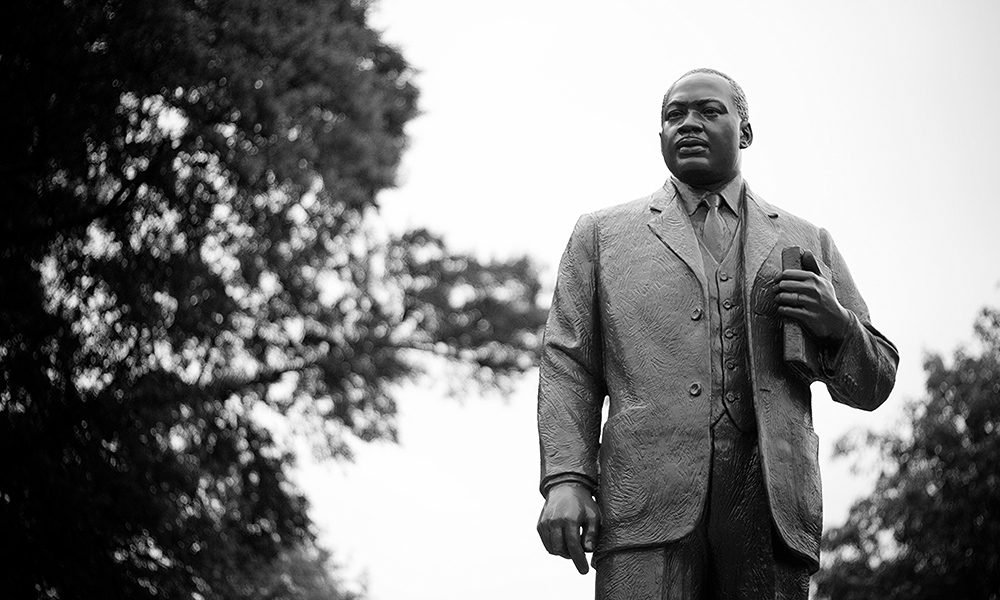

Martin Luther King Jr. could have reached 96 years of age this month, if not for an assassin’s bullet that killed him on April 4 1968. It is, of course, impossible to know what the United States would look like today if he had lived — or what he would think about the political dilemmas of our own time.
Yet, there are many parallels to be drawn between our time and his. It is clear that the nation remains bitterly divided on political grounds. And many activists and scholars argue that the racist power structure that King fought has re-congealed—this time in the guise of the “war on drugs” and mass incarceration. It is therefore important to learn from King’s legacy for those currently fighting for legal cannabis.
Repression and Revolution Cycles
Michelle Alexander is one of those leading scholars, and she’s the author who wrote 2010’s best-seller The New Jim Crow – Mass Incarceration In the Age of Colorblindness. Alexander paints an ominous picture of the long-term struggle in the United States for racial equality. She illustrates how many of the gains that King won in his life are being reversed after his death — this time in a new “race-neutral” guise that only serves to mask continued institutionalized racism.
Alexander states that there were only 350,000 inmates and jails in America in 1972. There are currently 2,000,000. In fact, the US has the most people behind bars of any nation on Earth, in both per capita If you want to use absolutes, then do so. It is ironic that the United States, which calls itself “the Land of the Free,” would be so blatantly insensitive.
Among those 2 million people in prison are 40,000 who remain incarcerated in state or federal prisons on cannabis-related convictions— about half of them for marijuana offenses alone. Add to that the number of people waiting for a court date in local jails, and you could have a figure as high as 100,000. The racial gap is glaring. A 2013 American Civil Liberties Union report, Marijuana in Black and White: Billions of Dollars Wasted on Racially Biased Arrests, crunched the national data. It found that black people are more than three times as likely as whites to be arrested for cannabis — despite consuming the plant at essentially similar rates.
It is not the only time that significant and hard-won progress in the area of race has been reversed in the US. After the Civil War, slavery was abolished. Alexander quotes W. E. B. Du Bois from his book of 1935 Black Reconstruction and America, The slave left slavery, stood briefly in the sunlight, and returned back to it.
In the South under occupation by Union troops after the Civil War, black people for the first time voted, served on juries and held elected office — until the backlash came. In 1877, the federal troops were withdrawn. In subsequent years, without federal interference, Ku Klux Klan terror enforced legal apartheid in the southern states — the system known as Jim Crow. By sharecropping, blacks were reduced to near slavery and barred from voting.
This system was not challenged until almost a hundred years after the Civil War. His book Why We Can’t Wait, an account of the 1963 Birmingham Campaign to desegregate Alabama’s biggest city, King wrote of “America’s third revolution — the Negro Revolution.”
By King’s reckoning, the country’s first revolution had been the one we actually call “the Revolution” — the War of Independence, although it left the slave-owning aristocracy of the South thoroughly in place. The second was arguably far more revolutionary — the Civil War, in which the slave system was broken. King’s Civil Rights Movement was avowedly nonviolent, but it was still a revolution — the overturning of a power structure by physical as well as moral opposition.
Despite the violent backlash, both from the police and Ku Klux Klan terrorists, the campaign ultimately swayed the nation, resulting in the passage of the Civil Rights Act of 1964 and other landmark legislation that finally ended legal apartheid in America.
But the year of King’s assassination saw the country’s national political establishment embracing the backlash — exactly as in 1877. Richard Nixon, Republican presidential candidate in 1968, first used the phrase “war on drug” during his campaign. He would later coin the term three years after, with the passage of the Controlled Substances Act. Nixon, using barely coded words, was also promoting racism.
In her book, Alexander quotes Nixon’s special counsel John Ehrlichman explicitly summing up the campaign strategy in his 1982 memoir, Witness to Power: the Nixon Years: We’ll take on the racists.” Ehrlichman unabashedly wrote how throughout the 1968 race, “subliminal appeal to the anti-black voter was always present in Nixon’s statements and speeches.”
Alexander didn’t mention another quote that Ehrlichman attributed, in which he made the same explicit connection between subliminal racism, and the antidrug drumbeat. Journalist Dan Baum in the April 2016 edition of Harper’s recalls a quote he says he got from a 1994 interview with Ehrlichman: “The Nixon campaign in 1968, and the Nixon White House after that, had two enemies: the antiwar left and black people… by getting the public to associate the hippies with marijuana and blacks with heroin, and then criminalizing both heavily, we could disrupt those communities. The evening news could vilify their leaders and raid their homes. We also arrested their leaders. Were we aware that we were lying to you about the drug? Of course we did.”
It was only the beginning of the reaction.
New Jim Crow: The Birth of a New Era
In the decade to come, the new order will be solidified. In 1973, the same year the federal Drug Enforcement Administration was created, New York state’s Rockefeller Laws imposed the nation’s first mandatory minimum sentences for drug offenses. In 1977, New York decriminalized cannabis, overturning the harsh Rockefeller Laws where personal quantities of marijuana were concerned — but the draconian provisions for cocaine and heroin remained intact.
Ronald Reagan’s election in 1980 brought back the rhetoric of the “drug-war” and the Anti-Drug Abuse Act, which imposed minimum mandatory sentences across the country. Ten years later, an ACLU report would find that the law “devastated African American and low-income communities.”
The 1986 law also instated the sentencing disparity for crack and powder cocaine — as crack was flooding black communities and landing people with the far longer sentences. The public’s perception and the media’s portrayal of this also confirmed it. Powder cocaine became a status icon for the white yuppies in the 1980s. When crack hit the streets from New York to Los Angeles, it was immediately stigmatized by association with the criminal (read: black) underclass.
In this period, the militarization and expansion of the police was also accelerated. The War on Drugs went from a “political slogan” to a real war, according to Alexander. Military Cooperation with Law Enforcement Act 1981 started to weaken the barrier that separated the police from the military since the Reconstruction.
The DEA joined with local police forces to instate Operation Pipeline, a program of traffic stops and vehicle searches that was protested by the ACLU as based on systematic “racial profiling.”
This was enabled by a series of bad Supreme Court decisions — Terry vs Ohio The year 1968 was a decade of change. Florida vs. Bostick The year 1991 was a landmark for the nation. Ohio vs. Robinette in 1996 — that dramatically eroded the Fourth Amendment. Alexander writes that these decisions enabled “consent searches” — in which the motorist (or pedestrian, or home resident) verbally consents to the search, but actually does so under police intimidation.
All-white juries were more likely to convict black people, of course — and prosecutors were still able to strike non-whites from serving as jurors despite the 1986 Supreme Court decision Batson V. Kentucky, This prohibited discrimination based on race when selecting juries. Alexander writes that “the only change is that the prosecutors now have to come up with an excuse that’s race neutral for these strikes.”
Mass incarceration has a vicious circle. It is a system that feeds on itself. Many states exclude convicted felons from jury service, and Maine and Vermont are the only two that allow prisoners to vote.
This system did not change when Democrats returned to power. Bill Clinton’s presidency saw federal prison funding increase by 170%, reaching $19 billion. Federal spending for public housing dropped 60%. The prison construction industry would begin to plateau in the early 2000s. However, in 2008 the prison population reached new highs.
Alexander writes that “ninety-percent of drug offenders in prison in several states are black or Hispanic, but the mass imprisonment of people of color is explained as a racial neutral adaptation, a response to the demands and needs of the political climate.” The New Jim Crow is born.
This was completely out of proportion with any threat that illegal drugs could pose. In the 1980s there were 22,000 deaths due to drunken driving per year. This was among the 100,000 alcohol related deaths. Alexander said: “The death rate related to alcohol is increasing.” The total amount of illegal drugs The number of fatalities caused by drunken driving was much smaller.”
Among the numberless stories of police terror in the name of drug enforcement, one recounted by Alexander is that of Alberta Spruill—a 57-year-old Harlem woman who died of a heart attack in May 2003 after police officers broke down her door and threw a concussion grenade into her apartment. There were no drugs in the apartment. The cops were acting on a bad tip from snitches snared on a marijuana rap.
A Fourth Revolution?
Over the past decade there has been progress against the War on Drugs, thanks in part to an increasing public awareness. In 2009, following a hard-fought activist campaign, the Rockefeller Laws were finally overturned in New York. Eleven states have now legalized cannabis, and nearly all have at least some kind of provision for medical use of cannabis — significantly lifting the pressure on one federally controlled substance.
There are still clear signs, even in spite of progress made by the new law that it’s not enough. From New York City (where cannabis arrests have been de-emphasized by policy) to Colorado (where cannabis is now legal), overall arrests for pot are significantly reduced — but the stark racial disparity persists in those arrests that continue under various loopholes.
Michelle Alexander ends her article with a list of legal reforms that are needed, but then says they’re not enough: “Mandatory sentencing laws for drug offenses must be repealed.” Marijuana ought to be legalized (and perhaps other drugs as well)… The list could go on, of course, but the point has been made. It is important to ask if we are serious in ending the control system.
She quotes Martin Luther King from his book of collected addresses. The Testament of Hope: White America must realize that radical structural changes are needed to achieve justice for the black population. “The comfortable, entrenched and privileged can’t continue to be terrified by the idea of a change.”
Other quotes from King shed similar light on our current situation, where the limits of legal progress become clear. You can also find out more about the following: his April 1963 Letter from Birmingham Jail, King justified his civil disobedience in these words: “An unjust law is a code that a numerical or power majority group compels a minority group to obey but does not make binding on itself.”
This recalls both the relative impunity for white coke-snorters in the ’80s as black communities were militarized in the name of drug enforcement — and the white entrepreneurs now disproportionately getting rich off legal cannabis, while black users remain disproportionately criminalized.
In Why We Can’t Wait, King wrote of how the country needed a “Bill of Rights for the Disadvantaged” — anticipating the current demands for drug war reparations, wedding legal cannabis to addressing the harms caused by prohibition and the related matrix of social injustice.
The notion that cannabis legalization is necessary but not sufficient recalls King’s 1967 report to the staff of the Southern Christian Leadership Conference, the main coordinating body of the civil rights campaign.
In the “Report to SCLC Staff,” he noted how the 1965 Selma to Montgomery March culminated in passage of the Voting Rights Act later that year — a critical victory. Yet, he wrote: “We have moved from the era of civil rights to the era of human rights, an era where we are called upon to raise certain basic questions about the whole society. We have been in a reform movement… But after Selma and the voting rights bill, we moved into a new era, which must be the era of revolution. It is important to recognize that we cannot solve our problems until a major redistribution in economic and political power takes place.
In the near future, cannabis advocates will have to face similar consequences if legalization of the drug is going to be successful in reversing the negative social effects that were caused by the prohibition.
Sponsored Content
This informative article is brought to you by NUBO CBD →