




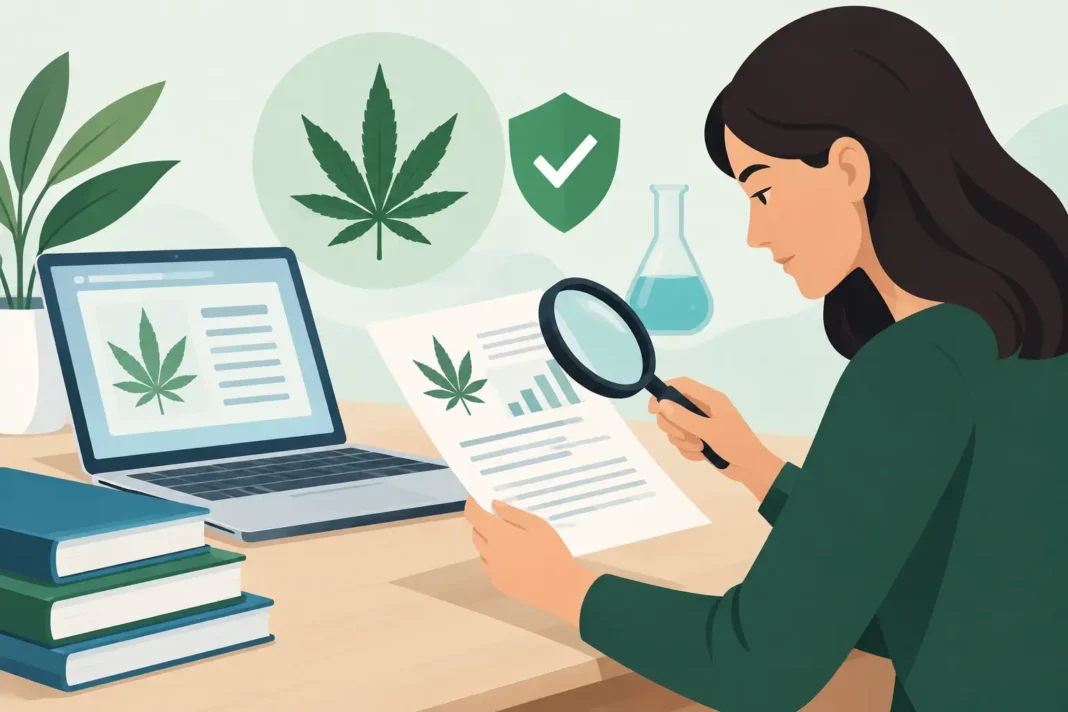

A cannabis headline can travel from a university press release to investor decks, patient groups and parliamentary debate before anyone asks what the study actually found. Knowing how to verify cannabis studies is therefore more than a research skill. It is a practical safeguard against overstated medical claims, shaky market assumptions and policy arguments built on thin evidence.
Cannabis research is also unusually easy to misread. Studies may examine a purified cannabinoid rather than a whole-plant medicine, test an oral pharmaceutical preparation rather than an inhaled product, or involve a small group of patients under tightly controlled conditions. Those details decide whether a finding is meaningful for the real-world question being discussed.
Start with the original study, not the headline
The first task is to identify the paper itself. A news story, company announcement or social media post may accurately quote a result while omitting the limitations that give it proper context. Look for the study title, authors, journal, publication date and digital object identifier, often called a DOI. These details make it possible to establish whether the work exists, where it appeared and whether the cited claim matches the published result.
A peer-reviewed journal is usually a stronger starting point than a press release, conference abstract or preprint. But peer review is a filter, not a seal of certainty. Journals vary in editorial standards, and even respected publications can print studies that later face correction, criticism or retraction.
Preprints deserve particular care. They can offer a useful early signal in a fast-moving field, especially during periods of regulatory change or emerging clinical interest. They have not, however, completed formal peer review. Treat them as preliminary evidence, not a settled basis for patient advice, investment decisions or public policy.
Check the date as well. A study published a decade ago may still be valid, but it may predate major changes in product standardisation, prescribing practice or the understanding of cannabinoid interactions. In cannabis, a finding from an era of poorly defined products may not transfer cleanly to current medical formulations.
How to verify cannabis studies by reading the methods
The methods section is where a bold claim either gains weight or begins to narrow. Start with the research question. Did investigators ask whether a specific medicine reduces neuropathic pain, whether THC affects driving performance, or whether legalisation changed prescribing patterns? A study can be well designed and still be irrelevant to the claim attached to it.
Next, identify the study type. Randomised controlled trials generally offer the clearest evidence of whether a treatment caused an outcome, particularly when they are blinded and include an appropriate comparator. Observational studies can reveal associations and real-world patterns, but they cannot reliably prove causation. Laboratory, animal and cell studies are valuable for investigating mechanisms, yet they are not evidence that a treatment works in people.
The intervention matters as much as the design. Read exactly what participants received: THC, CBD, a defined THC:CBD extract, a synthetic cannabinoid, a pharmaceutical medicine or an unregulated commercial product. Note the dose, route of administration, duration and any permitted changes during the trial. It is not scientifically sound to apply findings on high-dose purified CBD to all CBD products, or findings on a standardised oral extract to smoked cannabis.
Also examine who took part. A trial involving 40 adults with treatment-resistant epilepsy at specialist centres cannot automatically answer questions about anxiety, chronic pain or general consumer use. Age, sex, prior cannabis exposure, concurrent medication, severity of illness and geographic setting can all affect outcomes and safety.
Sample size is a useful warning light, though not a verdict on its own. Small studies may be appropriate for early-stage research or rare conditions, but their findings are less precise and more vulnerable to chance. Ask whether the result is clinically meaningful, not merely statistically significant. A modest change on a symptom scale may clear a statistical threshold without producing a difference that patients would notice in daily life.
Look beyond the primary result
A reliable reading separates the study’s primary outcome from the most attractive secondary finding. Researchers normally specify their main endpoint before a trial begins, such as change in seizure frequency or pain intensity after a set period. If that outcome was not met, but a subgroup or secondary measure produced a positive result, the finding may be worth further investigation. It should not be presented as definitive proof.
Pay attention to effect size and confidence intervals. An effect size indicates how large the difference was. Confidence intervals show the range of results compatible with the data. Wide intervals often mean the estimate remains uncertain, even if the headline reports a positive outcome.
Adverse events deserve equal billing. For THC-containing medicines, sedation, dizziness, cognitive effects and psychiatric vulnerability may be material considerations depending on dose and patient population. For CBD, interactions with other medicines can be clinically significant. A study that reports benefit without explaining discontinuation rates, side effects or serious adverse events is giving only half the picture.
The same principle applies to industry claims. A product may be associated with improved sleep scores, for example, but readers should ask whether the study measured next-day impairment, tolerance, withdrawal, product consistency and use alongside alcohol or other medicines. A favourable endpoint does not erase a safety question.
Check registration, funding and conflicts
For clinical trials, compare the published paper with its trial registration. Registries record the planned endpoints, eligibility criteria and study size before results are known. Differences between the registry and the final paper are not automatically misconduct – protocols can change for legitimate reasons – but they should be explained clearly. Unexplained outcome switching can make a positive result look more convincing than it is.
Funding is another essential part of verification. Cannabis research is expensive, and commercial support does not invalidate a study. Pharmaceutical and cannabis companies often have the resources needed to run formal trials. The relevant question is whether funding, author affiliations and conflicts of interest are disclosed, and whether the study design and reporting leave room for selective interpretation.
Look for four disclosures: who paid for the research, whether the sponsor supplied the product, whether authors have consulting or ownership interests, and whether the sponsor had a role in analysis or publication. Publicly funded work can have limitations too. Funding source is context, not a shortcut to accepting or rejecting findings.
Place one study in the wider evidence base
The strongest cannabis claims rarely rest on a single paper. Check whether systematic reviews or meta-analyses have assessed the same question. These reviews gather multiple studies using stated criteria, helping readers see whether a result is consistent or an outlier. Their quality still depends on the studies included, so a review dominated by small, biased trials cannot create certainty from weak material.
Guidelines from professional bodies can add another layer of context, particularly for medical use. They tend to weigh benefit, harm, quality of evidence and practical prescribing issues rather than spotlighting one encouraging result. Yet guidelines can lag behind new evidence, which is why the publication date and scope matter.
Be alert to the difference between absence of evidence and evidence of no benefit. Many cannabis indications remain under-researched because legal restrictions, product variation and funding barriers have limited large trials. That does not justify a therapeutic claim. It means the honest answer may be that the question remains unresolved.
Red flags that deserve a pause
No single warning sign proves a study is worthless, but several together should lower confidence. Pause before sharing when you see:
- A headline claiming a cure, breakthrough or universal benefit from one small study.
- A finding in mice, cells or a survey presented as proof of a clinical effect in patients.
- Vague references to “cannabis” without details of the formulation, cannabinoid content, dose or route of administration.
- Results promoted through a press release with no accessible paper, journal details or named authors.
- Claims built around a subgroup analysis while the primary endpoint was negative.
- No clear disclosure of funding, conflicts, adverse events or participant drop-out.
For investors and operators, this discipline has commercial value. Early research can move sentiment around a cannabinoid, delivery technology or therapeutic category, but the distance between a promising signal and an approved, reimbursed or scalable product is substantial. Clinical validity, manufacturing consistency, intellectual property, regulation and market access all sit between the paper and the revenue forecast.
For patients and clinicians, the stakes are more immediate. A study may support a conversation with a prescriber, but it cannot replace individual assessment of diagnosis, current medicines, driving requirements, pregnancy considerations or psychiatric history. The evidence for one regulated product in one condition is not a blank cheque for self-directed treatment.
The useful habit is simple: follow the claim back to the paper, read what was actually tested, and ask how far the result can reasonably travel. In a sector where science, regulation and commerce often collide, that extra ten minutes can prevent a compelling headline from becoming a costly misunderstanding.