



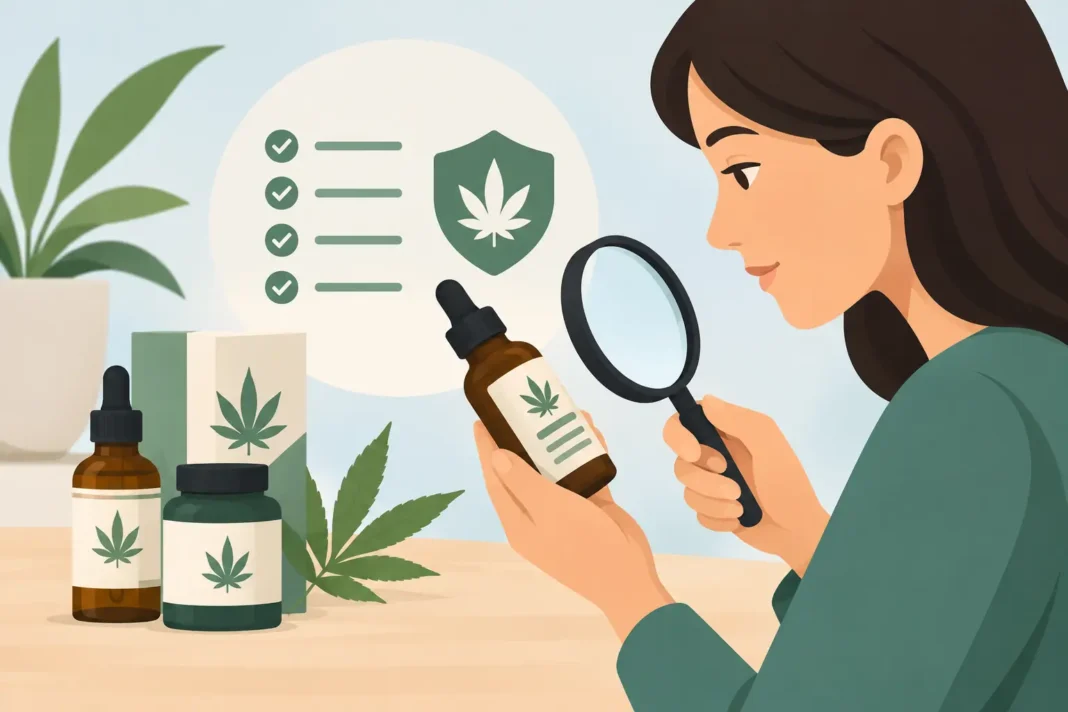

A CBD bottle can look premium, carry a reassuring green leaf and still tell a buyer very little about what is inside. To evaluate CBD product labels properly, readers need to separate marketing language from the information that establishes identity, dosage, traceability and legal risk. That distinction matters in a market where products move quickly, rules vary across Europe and laboratory quality is not uniform.
For consumers, clinicians, retailers and investors alike, the label is the first due-diligence document. It should not replace independent testing or regulatory checks, but it can reveal whether a product deserves further scrutiny before money changes hands.
Start with the amount of CBD, not the bottle size
The clearest figure on a CBD label should be the total cannabidiol content, expressed in milligrams. A 10 ml oil containing 1,000 mg of CBD is materially different from a 30 ml bottle containing the same 1,000 mg. Both may promote “1,000 mg CBD”, but the concentration per millilitre and per serving is not the same.
Look for both total CBD and a sensible serving calculation. If a label says 1,000 mg per bottle but does not state the number of drops, millilitres or capsules that make up a serving, it is difficult to judge dose consistency. For oils, a milligram-per-millilitre figure is particularly useful. For gummies and capsules, the milligrams per unit should be prominent.
Be cautious when the label leads with “hemp extract” or “hemp oil” without making the CBD amount clear. Hemp seed oil can be a legitimate food or cosmetic ingredient, but it is not automatically a meaningful source of cannabidiol. The terminology is often used in ways that blur this distinction.
How to evaluate CBD product labels for cannabinoid type
The product should identify whether it contains CBD isolate, broad-spectrum extract or full-spectrum extract. These terms are commercially common, but their value depends on whether the manufacturer explains what the formulation actually contains.
CBD isolate generally indicates cannabidiol with other cannabis compounds removed to a high degree. Broad-spectrum products are commonly sold as containing multiple plant compounds while excluding detectable THC. Full-spectrum products may retain a wider cannabinoid and terpene profile, including trace THC. Neither category automatically makes a product better. The relevant question is whether the formulation suits the buyer’s needs and is supported by testing.
A full-spectrum claim warrants particular care for people subject to workplace drug testing, professional driving rules or strict clinical advice. Even low THC exposure can create practical risk, especially where use is regular and product quality is uncertain. “THC-free” is also not a substitute for evidence. A credible label should direct the buyer to batch-specific results rather than rely on a front-of-pack claim.
A batch number is a basic test of accountability
A lot or batch number links the item in hand to a specific production run. Without one, a certificate of analysis can be generic marketing material rather than proof of what is in that bottle, packet or jar.
The label should also carry the responsible business name and address, a best-before or expiry date where relevant, storage directions and a contact route for consumer questions. These details are ordinary requirements in established consumer sectors. Their absence should be treated as a warning, not a minor design oversight.
A QR code can be useful, but only if it leads to a report that matches the product’s batch number and date. A code that opens a homepage, a broad laboratory statement or an expired report does not establish product-specific quality. In a fast-moving CBD supply chain, traceability is the difference between a verifiable claim and a decorative one.
Read the certificate of analysis with the label
The certificate of analysis, often called a COA, is where the label’s central claims should be tested. At a minimum, it should identify the laboratory, sample or batch number, testing date and measured CBD and THC results. Ideally, it also covers contaminants relevant to a plant-derived extract: pesticides, heavy metals, residual solvents and microbiological contamination.
The strongest reports come from an independent laboratory and show usable figures, not merely a green “pass” badge. Buyers do not need to become analytical chemists, but they should check whether the CBD result is reasonably close to the stated amount. Small variation can occur, especially in complex extracts. A substantial gap, however, raises questions about manufacturing controls or the age of the report.
Contaminant testing is particularly relevant for inhaled products. Vapes introduce a separate set of safety questions around ingredients, hardware and heating. A CBD label that provides only a cannabinoid figure is not enough to assess an inhalation product responsibly.
Ingredients expose what front-of-pack claims hide
Turn the pack over. The ingredients list often provides a more honest picture than the front label.
For oils, check the carrier oil, such as MCT, hemp seed, olive or another edible oil, and consider allergies and dietary preferences. For gummies, assess sugar content, gelatine or pectin, flavourings and any colouring agents. For topicals, distinguish a cosmetic claim from an implied health claim and look for fragrance allergens where applicable.
Some labels use a long list of botanicals, vitamins or adaptogens to imply a more powerful formulation. That can complicate the product rather than improve it. Multiple active ingredients make it harder to identify what may be causing an adverse effect or interacting with medicines. A simpler, clearly dosed product may be the more transparent choice.
Warnings matter as well. Responsible packaging should advise caution for people who are pregnant or breastfeeding, those taking prescription medicines and anyone with a medical condition. CBD can affect the way some medicines are metabolised. A label that promises treatment outcomes while omitting basic cautions is signalling the wrong priorities.
Treat health promises as a compliance test
In Great Britain and much of Europe, CBD businesses face close scrutiny over medicinal claims, novel food requirements and consumer-protection rules. A product sold as a food supplement should not claim to diagnose, treat, prevent or cure disease. Phrases such as “clinically proven to treat anxiety”, “replaces pain medication” or “cures insomnia” are not evidence of quality. They are often a sign that the seller is operating beyond what the product category permits.
That does not mean consumers report no benefit from CBD, or that research has stopped. It means the evidence base, product standardisation and regulatory route matter. Prescription cannabis medicines and over-the-counter CBD products are not interchangeable categories, even when their marketing borrows similar medical language.
For UK food products, buyers should also be alert to the evolving novel food framework. The regulatory status of CBD ingestibles is not reliably established by a logo, a retailer listing or a vague statement that a product is “legal”. National rules and enforcement priorities vary across Europe, and compliance can change as authorities update their positions.
Claims such as organic, natural and premium need proof
“Natural” has broad appeal but little precision. It does not tell a buyer how much CBD the product contains, whether it has been tested or how it was made. The same is true of “pharmaceutical grade” when no relevant certification or regulatory context is provided.
Organic claims should identify a recognised certification basis where one applies. “Made in the UK” may refer only to bottling or packaging rather than cultivation and extraction. “European-grown” may be accurate but still reveal nothing about contaminant controls. These phrases are not inherently misleading, but they should prompt follow-up questions rather than end them.
A practical label check before purchase
When comparing products, the fastest useful screen is to confirm the CBD amount, cannabinoid type, batch number, full ingredients and route to a current batch-specific COA. Then consider whether the dosage format fits the intended use and whether the business avoids unsupported therapeutic claims.
Price can also be assessed more clearly once the total CBD content is known. Comparing cost per milligram is more informative than comparing bottle prices alone. Yet the cheapest price per milligram is not always the best value if testing is incomplete, the label is vague or the product contains ingredients a buyer would rather avoid.
CBD regulation remains a moving target, but basic transparency should not be. A clear label, a matching laboratory report and restrained claims will not answer every question about a CBD product. They do, however, give buyers a firmer basis for deciding which brands merit trust and which are better left on the shelf.