







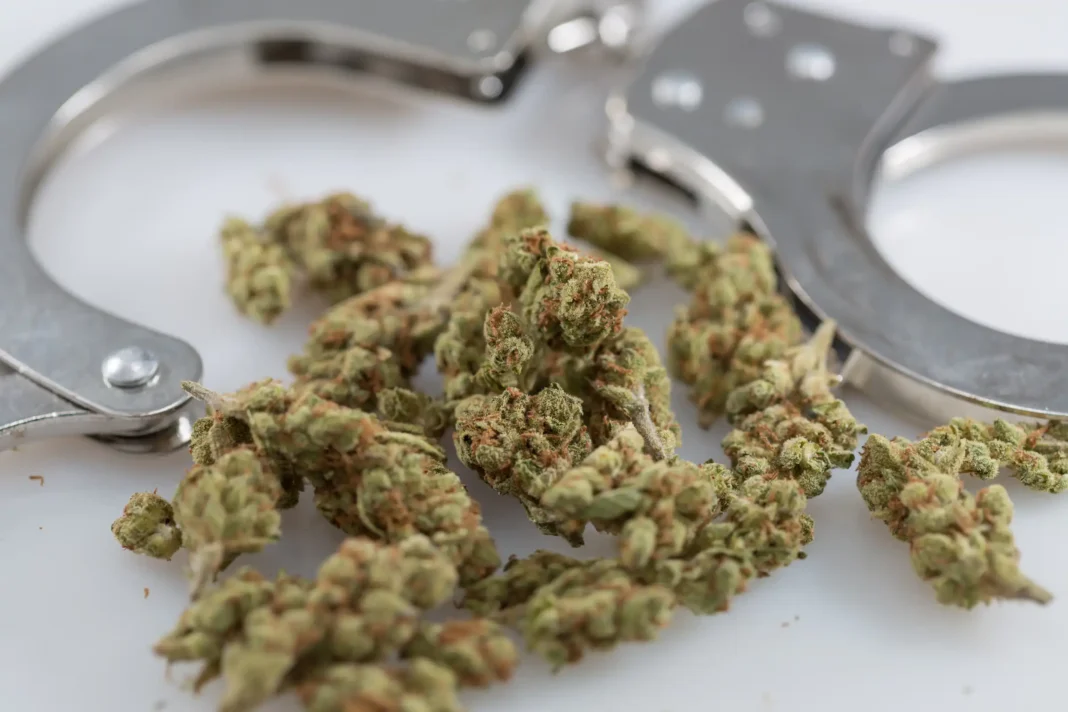

Legalizing marijuana for adult use is linked to gradual reductions in violent crime—while medical cannabis legalization is associated with lower rates of property crime—according to a new study.
Researchers at Jack Welch College of Business and Technology (JWCBT), Barnard College, National Chengchi University and Longwood University investigated the correlation between the different reform versions and the crime trend.
This study published in Economic Modelling identified an unusual divide in the effects of legalizing marijuana for medical and recreational purposes. Analytical models revealed that different types of controlled access seemed to be associated to different patterns of criminal activity.
Study authors write that new policies could have unexpected spillovers. This is especially true when legalizing an activity can alter the incentive for crime in other areas. Marijuana’s legalization is a good way to study such impacts, especially given that medical and recreational marijuana laws are adopted in a staggered manner across the 50 U.S. states. states.”
We found that recreational legalization reduced violent crimes, but medical legalization decreased property crime.
The initial analysis suggested that the legalization of adult-use marijuana could lead to an increase in property crime. However, after researchers added state-specific data and synthetically specified time trends, this effect was “negative” and “statistically nonsignificant”.
According to the study, “overall findings show that crime estimates are sensitive to assumptions about identification and don’t provide strong evidence for an increase in crime after legalization,” underlining the importance of careful design of empirical studies in the evaluation of policy.
The researchers noted that there is a slow but steady impact of the cannabis reformation on crime. Its effects “appear powerfully after several years.” Authors said that for advocates who are pushing legalization they need to be careful in their framing of the issue as the crime rate doesn’t drop instantly.
The researchers said, “What we see from the multi-step process is an aerial view of how legalization works: recreational and medical legalization operate in different ways and have significant lag effects.” Our main difference-in-differences model shows that the reduction of violent crime is a result of medical legalization, while property crime decreases with recreational legalization.
These effects confirm the Becker hypotheses that criminality is reduced by legalization. In building up to the synthesized difference in differences model, we found that there might also be lags. The diverse and potentially time-varying impacts of medical and recreational legalization raise a cautionary note to policymakers: those considering legalization should wait a few years before pronouncing on the cost–benefit impact, focus on the specific type of legalization, and study closely the outcomes from similar states.”
It’s not immediately clear from the research why medical and recreational marijuana legalization would lead to diverging crime trends, but the broader impact of the reform on crime has been studied before.
A study last year concluded, that contrary to the warnings of some critics about decriminalizing marijuana, this policy change actually led to a reduction in violent crimes as police focused their attention on more pressing matters.
Separately, a 2024 study of violence among intimate partners concluded that the legalization of marijuana for adult consumption “results a substantial reduction in rates of violent intimate relationships.”
A 2021 study, meanwhile, found that reductions of crime generally after marijuana legalization was being significantly understated because the FBI data is inconsistent and comes from voluntary participation by local agencies.
In 2020, researchers looked at how adult-use marijuana legalization in Washington and Colorado affected crime rates in neighboring states, and the resulting study determined that passage of recreational cannabis laws may have actually reduced certain major crimes in nearby jurisdictions.
The previous year, a federally funded study found that legalizing marijuana has little to no impact on rates of violent or property crime. A policy shift in the state did appear to be linked with a steady decline in burglaries.
A 2018 study from the think tank RAND said county-level data from California suggested that there was “no relationship between county laws that legally permit dispensaries and reported violent crime,” the researchers wrote. There was also a negative and significant correlation between the dispensary rates and allowances, though this could be due to “pre-existing patterns.”
That same year, researchers at Victoria University of Wellington and Harvard University found that medical marijuana laws essentially have a null effect of crime rates, with one big exception: A nearly 20 percent reduction in violent and property crimes in California following the legalization of medical cannabis there.
Sponsored Content
This informative article is brought to you by NUBO CBD →