







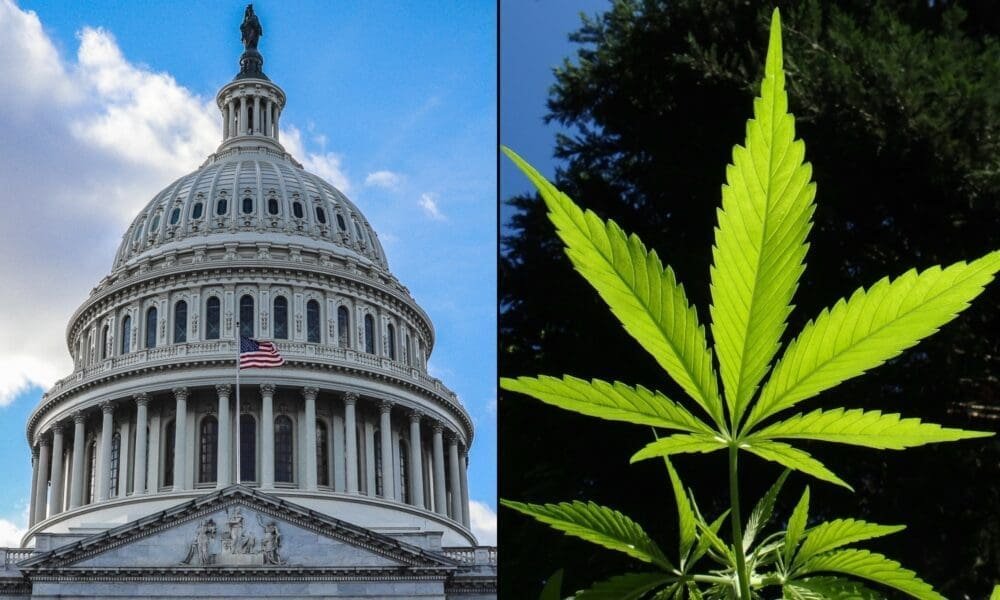

A GOP congressman pushing for a federal hemp THC ban in a spending bill that’s advancing in the House says he’s not concerned about any potential opposition in the Senate—and he’s also disputing reports about the scope of what his legislation would do to the industry.
Rep. Andy Harris told MEDCAN24 Wednesday, “The bottom line is you have bad actors that are using a loophole within the Farm Bill in order to sell psychoactive drugs,” and that was “not their intention.”
The congressman was making reference to an agriculture bill of a vast scale that President Donald Trump passed during his term, legalizing hemp and its derivatives on a federal level.
After being approved by the House Appropriations Committee, the bill for 2026 that bans hemp-based products containing any amount of THC has now been sent to the House Floor. It could then be considered by the Senate.
Harris was asked if he was concerned about opposition to the hemp legislation in the opposing chamber. He replied, “I do not think that I am.”
He said that “I believe we carefully drafted the document,” adding, “I do think that there were some misunderstandings about how it was worded that people claimed, in some way, that any amount measurable [of THC] This would make it impossible to sell. The law didn’t say that.”
While a document attached to the bill was changed to clarify that Congress does not mean to restrict non-intoxicating, consumable cannabinoids, like CBD, it is the actual text that hasn’t changed.
This section defines the cannabis crop in federal law so that it is still prohibited to sell any products that contain “quantifiable amounts” of THC, or other cannabinoids with similar (or marketed as having similar) effects on animals or humans.
Harris—who serves as chair of the House Appropriations Subcommittee on Agriculture, Rural Development, Food and Drug Administration, and Related Agencies—also noted in the interview with MEDCAN24 that there “was no opposition [to the hemp provisions] That was discussed in committee.
He also briefly weighed in on the Texas governor’s recent veto of a bill to recriminalize hemp products with any THC—simply stating that he’s “not paying attention to what a single state is doing” while he focuses on enacting the proposed federal ban.
The language in the congressional bill, meanwhile, would still effectively eliminate the most commonly marketed hemp products within the industry, as even non-intoxicating CBD items that are sold across the country typically contain trace amounts of THC. Under the current law, these products can be sold if they do not contain more than 0.3% THC in dry weight.
Harris’ proposed policy would change this dramatically. The proposed policy would maintain “industrial hemp’s” legal status under a new definition, which allows the sale and cultivation of hemp for fibre, whole grain oil, cake, nuts, hulls, microgreens, or “other edible products made from hemp leaves intended for human consumption.”
The Congressional Research Service (CRS) released a report last week stating that the legislation would “effectively” prohibit hemp-derived cannabinoid products. The CRS originally stated that a similar ban would also prevent the sale CBD, but for unknown reasons the report has been updated to remove that specific language.
The hemp language is largely consistent with appropriations and agriculture legislation that was introduced, but not ultimately enacted, under the last Congress.
Hemp industry participants rallied to oppose that proposal. A previous version of the bill was also included as part of the subcommittee’s base bill last year. It’s virtually identical to a provision of the 2024 Farm Bill that was attached by a separate committee last May via an amendment from Rep. Mary Miller (R-IL), which was also not enacted into law.
The new version of the spending bill for 2026 has some changes, such as a change in what is considered a “quantifiable amount” of THC for hemp products.
The new definition of a quantitative amount states that it is “based upon substance, form or manufacture (determined by Secretary of Health and Human Services and Secretary of Agriculture)” as opposed to the previous one which stated a simple “amount determined by Secretary and Secretary of Health and Human Services”.
It is now specified in the proposed legislation that hemp doesn’t include any “drugs that are the subject of an approved application under paragraph (c) or subsection (j) section 505 Federal Food, Drug, and Cosmetic Act (2 U.S.C. This appears to be a way of making an exception for FDA-approved drugs like Epidiolex that is synthesized using CBD.
A leading alcohol industry association, meanwhile, has called on Congress to dial back language in the House spending bill that would ban most consumable hemp products, instead proposing to maintain the legalization of naturally derived cannabinoids from the crop and only prohibit synthetic items.
Wine & Spirits Wholesalers of America (WSWA) President and CEO Francis Creighton said in a press release that “proponents and opponents alike have agreed that this language amounts to a ban.”
He said that by pushing an industry in rapid evolution back into the dark, Congress was creating chaos on the market, undermining the state’s initiatives, and punishing the responsible parties. “We ask the House of Representatives to reconsider their approach. States are able to regulate intoxicating substances safely and efficiently through systems which preserve public trust and consumer safety. “It’s time Congress followed their lead and did not interfere with their authority.”
Members of WSWA also met with lawmakers and staffers in April to advocate for three key policy priorities that the group says is based on “sound principles of alcohol distribution.” These include the banning of synthetic THC and the establishment of a federal testing system and product labeling.
Separately, key GOP congressional lawmakers—including one member who supports marijuana legalization—don’t seem especially concerned about provisions in the bill despite concern from stakeholders that it would put much of the hemp industry in jeopardy by banning most consumable products derived from the plant.
—
MEDCAN24 has been tracking the hundreds of bills relating to cannabis, psychedelics or drug policies that have passed through state legislatures as well as Congress in this past year. Patreon members who pledge at least $25 per month get full access to the interactive maps, charts, and hearing schedule.
Find out more about our marijuana law tracker. To get access, become a Patreon supporter.
—
Jonathan Miller, general counsel of the U.S. Hemp Roundtable, told congressional lawmakers in April that the market is “begging” for federal regulations around cannabis products.
Rep. James Comer, R-KY, also asked about FDA’s inaction on regulations. He asked sarcastically if “a gazillion of bureaucrats who work at home” would be required to regulate CBD and other cannabinoids.
A report from Bloomberg Intelligence (BI) last year called cannabis a “significant threat” to the alcohol industry, citing survey data that suggests more people are using cannabis as a substitute for alcoholic beverages such a beer and wine.
Last November, meanwhile, a beer industry trade group put out a statement of guiding principles to address what it called “the proliferation of largely unregulated intoxicating hemp and cannabis products,” warning of risks to consumers and communities resulting from THC consumption.
The LCB contributed reporting from Washington, D.C.
The House votes to allow VA doctors to recommend medical marijuana for veterans and support psychedelics research
MEDCAN24 could not exist without readers’ support. Please consider making a Patreon monthly pledge if you depend on our cannabis journalism for information.

Sponsored Content
This informative article is brought to you by NUBO CBD →