







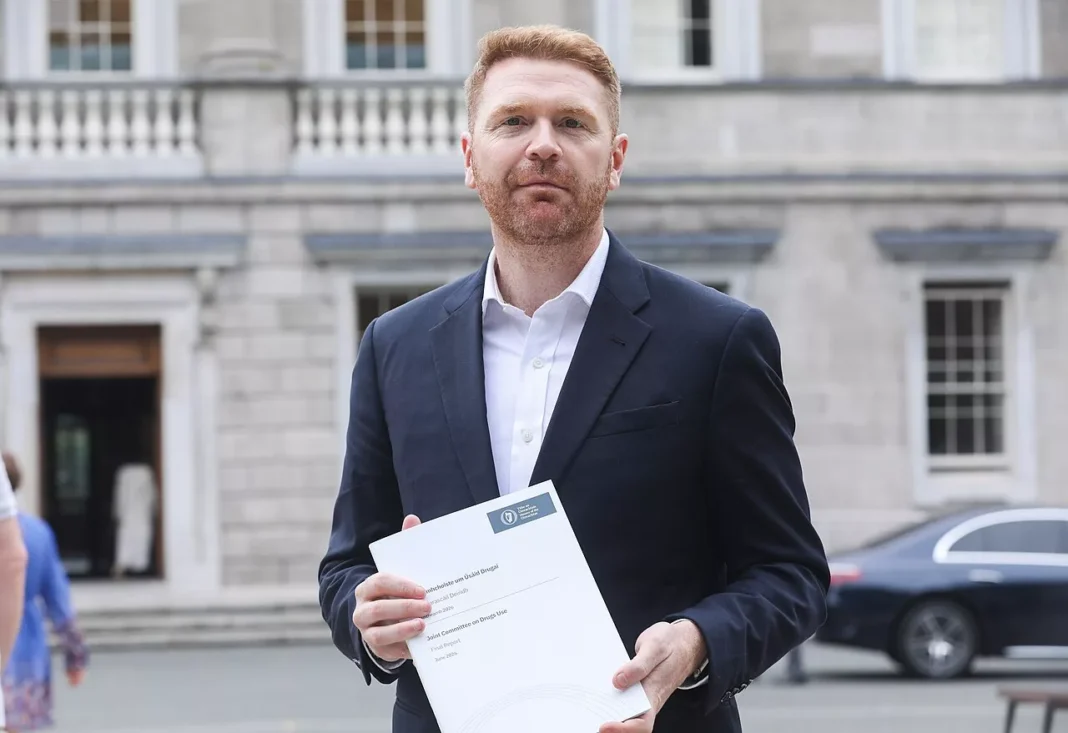

Ireland’s Oireachtas Joint Committee on Drugs Use recommended that all personal drug possession be decriminalised, and called on the Government to repeal Section 3. Misuse of Drugs Act of 1977
More than two years after it was established, with the sole task of evaluating the recommendations of the landmark Citizens’ Assembly on Drug Use ‘as quickly as possible’, the Oireachtas committee has now published the most comprehensive parliamentary statement yet on drug reform in Ireland.
The 161 committee recommendations are the result of 13 months of hearings from both domestic and international witness. They represent the most thorough parliamentary review of drug policies in history.
The government, however, has indicated that despite a multi-year-long process, widespread public support and a 134-page document, it does not intend to decriminalize.
Its near immediate rejection by the ruling coalition, the largest party of which included a commitment to ‘decriminalise drug possession for personal use’ in its election manifesto in 2024, will come as a major but likely anticipated blow to advocates.
The report makes recommendations
The ‘Final Report’ from the Joint Committee on Drugs Use is broad in scope, covering everything from family, community support and intergenerational trauma alongside its core legal and policy reform recommendations.
The headline recommendation is: Recommendation 126-2Calls for repeal of Section 3 Misuse of Drugs Act, 1977This includes charges of personal possession. In its place, the committee recommends a system in which anyone found in possession of drugs for personal use is ‘offered all supports and health resources that are required’, with no criminal sanction attached.
The report defines decriminalisation as the removal of criminal status ‘in law and in practice’, explicitly ruling out the government’s current diversion model, which still makes possession a criminal offence and leaves health service referral at the discretion of the Garda.
The committee fell just one vote shy of fully regulating and legalising cannabis. But by the smallest of margins. Recommendation No. 125 ultimately calls for a ‘health-led’ response and a ‘continued discussion and debate on the Government’s policy response to the possession of cannabinoids.’
Also, it was recommended to expand the Medical Cannabis Access Programme. As well, the committee recommended that MCAP be expanded. MEDCAN24 In April 2026 it was reported that the program had enrolled only 74 patients, since 2021 when its first patient. This figure has been criticized by patient advocacy groups and doctors alike.
In the entire report, detailed financial calculations were used to support each proposal. For example, they calculate that keeping one person in custody costs approximately €100,000 per year, roughly twice the annual cost of residential addiction treatment. Ireland spent €338 million on drug-related services in 2024, yet just 1% of the total health budget reaches addiction services.
The report represents the culmination of several formal processes that have produced a variety of evidences, recommendations and limited action by government.
Citizens’ Assembly on Drugs Use was established in 2022. Its recommendations were published in 2024. They called for an approach to drug possession that is based on health rather than on criminal justice.
The committee process began in May 2024, when the 33rd Dáil established a Joint Committee on Drugs Use to examine the Citizens’ Assembly’s recommendations. In October 2024, it published a report containing 59 recommendations. Following the November 2024 general election, the incoming 34th Dáil reconstituted the committee in May 2025, extending its work before publishing the final 161-recommendation report last week.
READ MORE…
Response of the government
The government’s position was made clear within hours after the publication of the report. Speaking in Westport, Co Mayo, on 26 June, Taoiseach Micheál Martin told the Irish Independent there was ‘probably an over-focus on just looking at the decriminalisation issue’, adding that the state had been ‘following the health-led approach predominantly over the last two decades.’
Minister of State for Drugs Jennifer Murnane O’Connor clarified: ‘No change is proposed to the Misuse of Drugs Act.’
The report in The Irish Times, ‘senior coalition figures’ said on June 29 that decriminalisation will not be implemented in the lifetime of the current government.
‘We will not be doing this,’ one said. Tánaiste Simon Harris, who as Health Minister in 2019 announced government approval for a health-led approach to drug possession that remains unlegislated, is also understood to be strongly opposed to the proposed reforms.
In a Dáil contribution reported by the Irish Examiner, Harris warned that ‘middle Ireland’ was facilitating gangland crime by ‘snorting coke, popping pills, and smoking joints.’ Justice Minister Jim O’Callaghan called for caution against policies that could ‘increase the incidence of drug taking’, invoking British Columbia’s decriminalisation experiment, which covered all drugs used in public, not cannabis specifically, as a cautionary reference.
Gary Gannon TD said that this description has been controversial and that it had prompted him to express his disapproval. Irish Examiner that the cohort Harris described was not the one facing criminal sanction, adding that adding that both ministers had brought ‘genuinely both a classist element and a lack of understanding’ to the debate.
“People who are snorting cocaine or popping pills don’t get criminal sanctions,” said he.
“Decriminalisation will mostly benefit people who are the most vulnerable… The justice minister seemed to be conflating legalisation with decriminalisation.”
Primary source data from the committee tests government’s claims of a current health-led strategy. Figures from An Garda Síochána, submitted to the committee during its hearings, show Section 3 possession charges rising from 6,618 in 2021 to 8,287 in 2025.
Next up
Despite the swift response from the governing coalition, the findings were welcomed by Labour, the Social Democrats, the Green Party, and Sinn Féin, all of whom called on the government to implement its recommendations.
Labour MEP Marie Sherlock told the committee that she was a member of. The Irish Times“The War on Drugs has Failed.” It is time for the Government to admit that… Our report cannot become another document that sits on a shelf.”
If it happens, will depends on a political will which at the moment is lacking. Write in Hot PressTony Duffin, an expert in harm reduction, noted that the report was one of at least seven official strategies, reviews, and consultations regarding drug policy conducted since 2017.
He wrote: “The structure of the policy is significant.” The paperwork itself isn’t the problem. Implementation is the issue.
Writing on LinkedIn, Dr Michael Barron, Independent Chair of the Irish Coalition for Drug Reform, called the report ‘a careful piece of work, grounded in evidence and clear in its conclusions’, adding: “Ireland has produced thoughtful reports on drug policy before. Too often, the challenge was to translate recommendations into actual action.
The government’s National Drugs Strategy is due in July 2026, but given both the timing and the response so far, the odds on ‘turning recommendations into action’ have rarely been longer.
The Joint Committee on Drugs Use of Ireland’s Oireachtas has called for the repeal of Section 3 in the Drugs Act to decriminalise the possession of any drugs. Misuse of Drugs Act of 1977
More than two years after it was established, with the sole task of evaluating the recommendations of the landmark Citizens’ Assembly on Drug Use ‘as quickly as possible’, the Oireachtas committee has now published the most comprehensive parliamentary statement yet on drug reform in Ireland.
The 161 committee recommendations are the result of 13 months of testimony by domestic and international witnesses. They represent the most thorough parliamentary review of drug policies in history.
But despite this multi-year, public-backed process and the 134 page report, the Government has signalled its intention to not implement decriminalisation.
Its near immediate rejection by the ruling coalition, the largest party of which included a commitment to ‘decriminalise drug possession for personal use’ in its election manifesto in 2024, will come as a major but likely anticipated blow to advocates.
The report makes recommendations
The ‘Final Report’ from the Joint Committee on Drugs Use is broad in scope, covering everything from family, community support and intergenerational trauma alongside its core legal and policy reform recommendations.
The headline recommendation is: Recommendation Number 126Calls for repealing Section 3 of The Misuse of Drugs Act, 1977This includes charges for possession by a person. In its place, the committee recommends a system in which anyone found in possession of drugs for personal use is ‘offered all supports and health resources that are required’, with no criminal sanction attached.
The report defines decriminalisation as the removal of criminal status ‘in law and in practice’, explicitly ruling out the government’s current diversion model, which still makes possession a criminal offence and leaves health service referral at the discretion of the Garda.
The committee fell just one vote shy of fully regulating and legalising cannabis. But by the smallest of margins. Recommendation No. 125 ultimately calls for a ‘health-led’ response and a ‘continued discussion and debate on the Government’s policy response to the possession of cannabinoids.’
Also, it was recommended to expand the Medical Cannabis Access Programme. The committee also recommended expanding the Medical Cannabis Access Programme (MCAP). MEDCAN24 Reports in April 2026 show that since the first patient was enrolled in 2021, only 74 people have been added to the programme. The figure has attracted criticism from both patient advocates and physicians.
In the entire report, detailed financial calculations were used to support each proposal. For example, they calculate that keeping one person in custody costs approximately €100,000 per year, roughly twice the annual cost of residential addiction treatment. Ireland spent €338 million on drug-related services in 2024, yet just 1% of the total health budget reaches addiction services.
The report represents the culmination of several formal processes that have produced evidence, made recommendations and resulted in limited action by government.
Citizens’ Assembly on Drugs Use was established in 2022. Its recommendations were published in 2024. They called for an approach to drug possession that is based on health rather than on criminal justice.
The committee process began in May 2024, when the 33rd Dáil established a Joint Committee on Drugs Use to examine the Citizens’ Assembly’s recommendations. The committee published a report with 59 interim recommendations in October of 2024. Following the November 2024 general election, the incoming 34th Dáil reconstituted the committee in May 2025, extending its work before publishing the final 161-recommendation report last week.
READ MORE…
Response of the government
The government’s position was made clear within hours after the publication of the report. Speaking in Westport, Co Mayo, on 26 June, Taoiseach Micheál Martin told the Irish Independent there was ‘probably an over-focus on just looking at the decriminalisation issue’, adding that the state had been ‘following the health-led approach predominantly over the last two decades.’
Minister of State for Drugs Jennifer Murnane O’Connor clarified: ‘No change is proposed to the Misuse of Drugs Act.’
The report in The Irish Times, ‘senior coalition figures’ said on June 29 that decriminalisation will not be implemented in the lifetime of the current government.
‘We will not be doing this,’ one said. Tánaiste Simon Harris, who as Health Minister in 2019 announced government approval for a health-led approach to drug possession that remains unlegislated, is also understood to be strongly opposed to the proposed reforms.
In a Dáil contribution reported by the Irish Examiner, Harris warned that ‘middle Ireland’ was facilitating gangland crime by ‘snorting coke, popping pills, and smoking joints.’ Justice Minister Jim O’Callaghan called for caution against policies that could ‘increase the incidence of drug taking’, invoking British Columbia’s decriminalisation experiment, which covered all drugs used in public, not cannabis specifically, as a cautionary reference.
Gary Gannon TD said that this description has been controversial and that it had prompted him to express his disapproval. Irish Examiner that the cohort Harris described was not the one facing criminal sanction, adding that adding that both ministers had brought ‘genuinely both a classist element and a lack of understanding’ to the debate.
He said: “The people who snort coke or pop pills are not those receiving criminal sanctions.”
“Decriminalisation will mostly benefit people who are the most vulnerable… The justice minister seemed to be conflating legalisation with decriminalisation.”
Primary source data from the committee tests government’s claims of a current health-led strategy. Figures from An Garda Síochána, submitted to the committee during its hearings, show Section 3 possession charges rising from 6,618 in 2021 to 8,287 in 2025.
Next up
Despite the swift response from the governing coalition, the findings were welcomed by Labour, the Social Democrats, the Green Party, and Sinn Féin, all of whom called on the government to implement its recommendations.
Labour MP Marie Sherlock, who is also a committee-member, said The Irish Times“The War on Drugs has Failed.” It is time for the Government to admit that… Our report cannot become another document that sits on a shelf.”
If it happens, will depends on a political will which at the moment is lacking. Write in Hot PressTony Duffin, an expert in harm reduction, noted that the report was one of at least seven official strategies, reviews, and consultations regarding drug policy conducted since 2017.
He wrote: “The structure of the policy is significant.” The paperwork itself isn’t the problem. Implementation is the issue.
Writing on LinkedIn, Dr Michael Barron, Independent Chair of the Irish Coalition for Drug Reform, called the report ‘a careful piece of work, grounded in evidence and clear in its conclusions’, adding: “Ireland has produced thoughtful reports on drug policy before. It has been a challenge to turn recommendations into actions.
The government’s National Drugs Strategy is due in July 2026, but given both the timing and the response so far, the odds on ‘turning recommendations into action’ have rarely been longer.
Cannabis Law Resources In Poland
Browse essential legal pages on cannabis sales and cultivation in Poland. You can use these resources to learn about the requirements for certifications, permissions and compliance.
-
Polish News Registration and Interests of Cannabis Businesses
-
Permissions for Cannabis Sales in Poland
-
Authorization for Importing or Manufacturing Medical Products
-
Permission for Manufacturing or Importing Medical Products
-
Certificate of Good Manufacturing Practices (GMP)
-
Registration of Medical Products in Poland