

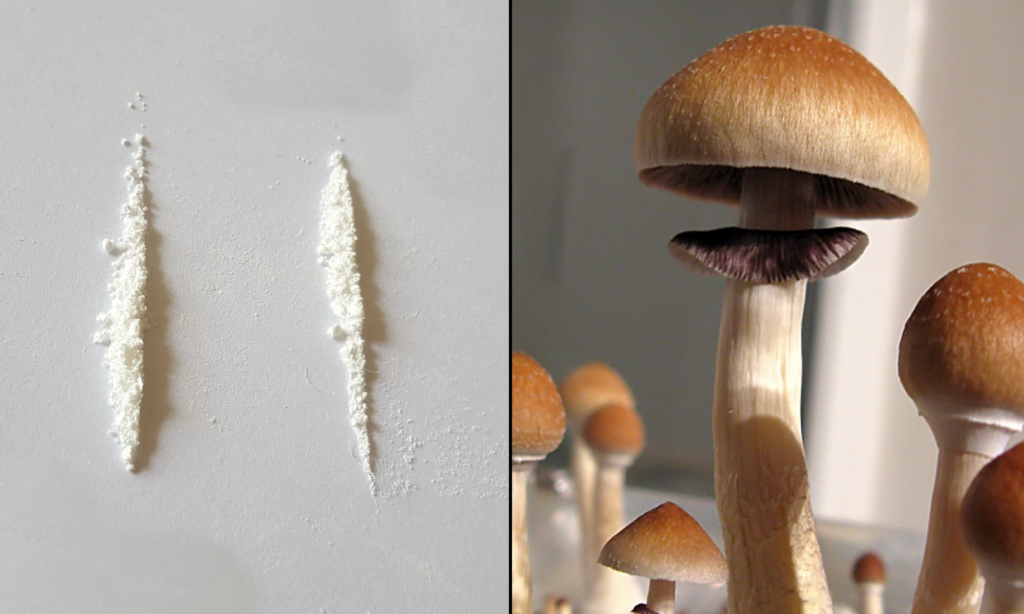

The American Medical Association published a new report that found a combination of psilocybin and psychotherapy to be a treatment “safe and effective” for those with cocaine use disorder (CUD).
It is especially encouraging that the findings on the use of psychedelics, which were published by JAMA Substance Use and Addiction, Thursday, have shown promise, given the fact “that no medications have proven to be effective in treating CUD.”
Researchers at Johns Hopkins University, the University of Alabama and the Karolinska Institute have found that psilocybin assisted therapy may be a way to solve this “elusive” issue.
In the placebo-controlled, randomized quadruple blind clinical trial, 36 patients who had cocaine use disorder met diagnostic criteria and were then screened. They received cognitive-behavioral psychotherapy one month before, and another one-month after, an “all day investigational drugs treatment session”.
Participants were given either 25mg of psilocybin for every kilogram of their body weight, or a placebo.
Researchers discovered that in comparison to the placebo group “psilocybin treatment participants demonstrated significantly higher percentages and rates of days without cocaine.
The urinalysis test was used to verify the participants’ abstinence.
The findings show that psilocybin may be a new treatment option for those with cocaine addiction.
Researchers said that although pharmacotherapies are available for many substance-use disorders, stimulant-use disorders still remain untreatable. The study authors said that this randomized clinical test is the “first, as far as we know, to demonstrate psilocybin combined with psychotherapy could be both safe and effective for the treatment of CUD.”
They wrote that the findings of the study are “potentially important advances in the treatment for CUD. This is a condition where there are limited psychosocial and pharmacotherapies available.”
Researchers recruited participants that were Black, and of lower socioeconomic class.
Researchers wrote that the representation of vulnerable population in clinical psychedelic trial has been a critical ongoing concern. They also noted that, according to a recent review “participants in US based psychedelic tests typically had a higher social economic status than the overall population.”
The study stated that “the present study shows that psilocybin can be implemented in the treatment of Blacks and those who are socioeconomically depressed, but have been understudied by psychedelic researchers.”
The study found that, overall, “psilocybin appears to be both safe and effective for treating cocaine addiction disorder in individuals who are from vulnerable and underrepresented populations.” However further research is needed to “replicate and extend these findings.”
The study is published just two months after AMA’s separate report that concluded that a dose of psilocybin, combined with therapy, was associated with “significantly higher long-term cessation” from tobacco compared to patches. Researchers said that this indicates that the psychedelic drug “holds promise in treating tobacco addiction”.
Americans show increasing interest in exploring therapeutic potentials of substances like Psilocybin as policy reforms in state legislators in U.S. states and Congress progress. To that point, a RAND Corporation analysis recently found that nearly 10 million American adults microdosed psychedelic drugs such as psilocybin, LSD or MDMA in 2025.
A scientific review published by AMA last year that use of psilocybin has “surged” in the U.S. in recent years amid the decriminalization movement and in light of “promising clinical trial results” on its therapeutic potential. However, the report also noted that the current federal laws prevent researchers from gaining an understanding of the true effects of the substance.
Meanwhile, another study from last year found that psilocybin-assisted psychotherapy “showed significant reductions in alcohol consumption and high smoking cessation rates” and has potential to lessen opioid dependence.
In 2024, meanwhile, two other studies—including one with contributions from a top federal drug official—examined psychedelics and alcohol use disorder (AUD).
The first study concluded that one dose of psilocybin was “safe and effective” in treating alcoholism in patients with AUD, while the second concludes that psychedelics such as psilocybin or LSD have “demonstrated potential in treating drug abuse and AUD”.
The National Institutes of Health that year also announced that it would put $2.4 million toward funding studies on the use of psychedelics to treat methamphetamine use disorders—funding that came as federal health officials noted sharp increases in deaths from methamphetamine and other psychostimulants in recent years, with fatal overdoses involving the substances rising nearly fivefold between 2015 and 2022.
In 2023, the National Institute on Drug Abuse (NIDA) announced a $1.5 million funding round to further study psychedelics and addiction.
The Trump administration recently took steps to investigate the therapeutic potential of psychedelics like ibogaine. Ibogaine has been hailed as a possible life-saving option for those suffering from mental illnesses such as substance abuse disorder and post-traumatic disorder.
MEDCAN24 tracks hundreds of marijuana, psychedelics, and drug policy legislation in state legislatures this year. Patreon members who pledge at least $25/month gain access to interactive maps, charts and a hearing calendar.
More research suggests that psychedelics may also be able to unlock new promising pathways for treating addiction. A first-of-its-kind analysis in 2023 offered novel insights into exactly how psychedelic-assisted therapy works for people with alcohol use disorder.
In 2024, the National Center for Complementary and Integrative Health (NCCIH), which is part of the National Institutes of Health (NIH), identified the treatment of alcohol use disorder as one of a number of possible benefits of psilocybin, despite the substance remaining a Schedule I controlled substance under U.S. law.
A 2022 study was highlighted by the agency, which “suggested psilocybin could be beneficial for alcohol abuse disorder.” Research found those in psilocybin assisted therapy consumed less alcohol over a period of 32 weeks compared to the control group. NCCIH noted that this “suggests [psilocybin] may be beneficial for alcohol abuse disorder.”
Dominic Milton Trott provided the image.
Sponsored Content
This informative article is brought to you by NUBO CBD →