






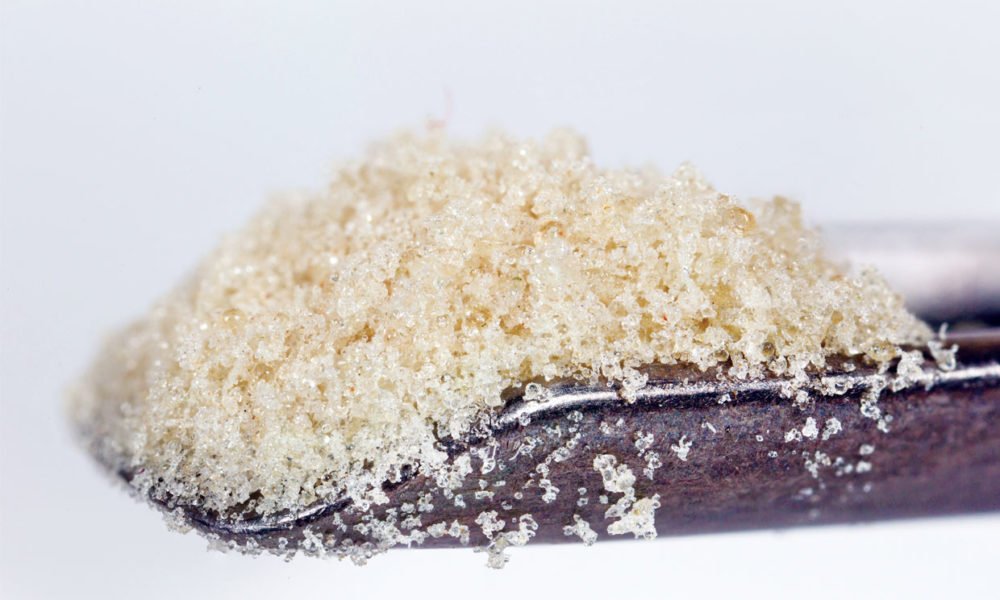

It is the main goal of all extraction methods to separate cannabinoid rich resins from inert plant material. Dry CO2, used in the dry-ice kief process, literally freezes resin glands, making it easy to remove them from the foliage. The frozen glands are then collected by a sieve with a mesh size of 120 to 220 microns.
Dry-ice separation is the most popular method for small-scale CO2 extracting.
Some Notes about Dry Ice
Dry ice actually is CO2 solidified. The CO2 gas has a low freezing temperature, so it’s kept in special freezers which are even colder.
When not kept in a frozen state, dry ice doesn’t melt — it “sublimes” or “sublimates.” It transforms from a solid into a gas directly, without having to go through the liquid phase. This feature makes it the ideal CO2 separator, combined with its ultra-cold temperature.
Remember that dry ice, because it is so icy, can cause frostbite if you touch it. Wear gloves, and use eye protection.
Getting Started
This step-by-step method is great for processing large amounts of small leaves and buds, which would otherwise be wasted. In simple experiments, this method yields 15 to 18 percent of the source material’s weight in the final product —kief.
This final product depends on the buds that were used. The best kief is made from resinous buds. Leafs and buds of lower quality produce a lesser-quality kief. Although the final product may be graded in different ways, the best quality will always come from the first few shakes. These smaller sieves (120, 160, etc.) The smaller meshes (120, 162, etc.) allow less green material to pass through. Larger mesh (200, 220, etc.) It lets through a great deal!
Always shake on a flat, large mirror, or a smooth, large surface. It is easy to remove kief from such a surface.
Dry-Ice Kief Separation Process
Step 1 Put a few pieces of dry ice into the container. It would also work with a can. Then add about three times the amount of leaves and buds and mix the dry ice with it. This will freeze the resin glands. Don’t crush the cannabis. It should remain as whole as possible.
Step 2 To cover the opening, use a Bubble Bag or something similar that uses a mesh of 160-micron. It is important to secure the sieve end so that it can be pulled tight over the opening.
Step 3 Shake the mixture of CO2 and cannabis in the can, holding the right side up. The dry ice will break apart into small pieces that freeze the cannabis.
Step 4 Flip the container over so that the sieve faces the mirror. Shake the bottle for up to five minutes or a few moments. The CO2 will sublimate and the resin glands should slide down the sieve to the mirror.
The first two shakes will yield top quality resin glands. Powder gradually turns into green leaves. Shake the container to make sure the highest quality kief goes through the sieve. Then, collect this grade before going on to the following one. You can repeat the process however many times you like and separate jars are needed for each potency grade.
Step 5 Dry ice can be removed by scraping it off. Remove any dry ice that remains on the sieve, and inside the container. Scrape the kief onto the glass mirror. This kief can be stored in glass containers for later use. It is a lower-quality hash that contains contaminants. However, the cannabinoids will be concentrated when it’s cooked.
Original published by the print edition Cannabis Now
Sponsored Content
This informative article is brought to you by NUBO CBD →