







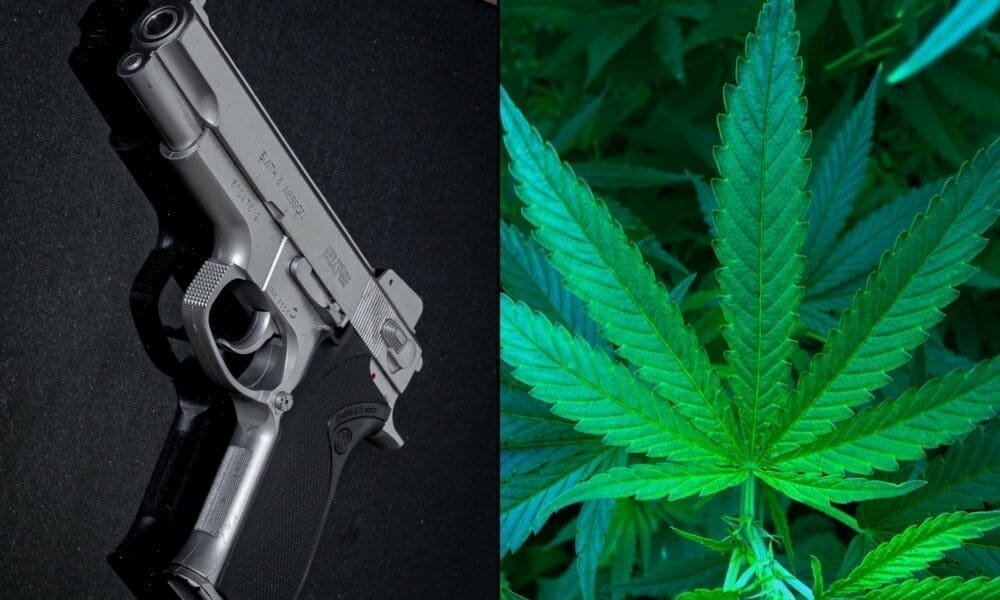

An appeals panel on Tuesday, in yet another ruling that questions the U.S. Government’s blanket prohibition on gun possession by marijuana consumers, vacated an accused’s conviction pursuant to Section 922(g), and remanded it back to district court. They noted that a trial with a jury could be required to establish whether or not cannabis caused the defendants to pose a threat to other people.
In a 14-page opinion, a three-judge panel for the U.S. Court of Appeals for the Eighth Circuit noted that after an Iowa district court initially decided the case, the appeals court issued new guidance in a February ruling that said the prohibition on gun ownership by drug users is justified only in certain circumstances—not always.
In returning the current case—U.S. v. Cordova Perez—to the Southern District of Iowa, judges said the lower court failed to make a determination as is now required in the Eighth Circuit as to whether defendant Aldo Ali Cordova Perez Jr.’s marijuana use made him a credible threat to public safety.
According to the ruling, Circuit Judge Jane L. Kelly – an Obama nominee – wrote that “the proper question to ask is whether Cordova’s Perez marijuana use led him to behave in an aggressive or outwardly erratic manner which, when viewed in context, could be perceived by others as being disturbing or dangerous.”
Although the court ruling stated that “no such causal findings were made in this case,” the decision suggests that evidence of a link between cannabis and violence or conduct with a weapon may not always be required.
“If marijuana caused Cordova Perez to act or drive in an erratic way, for example, he might be disarmed constitutionally under § 922(g)(3) even if his outward behavior was not violent in the same way as, perhaps, the ‘combative hostility’ sometimes associated with ‘a drug like PCP,'” the opinion says.
Even if Cordova-Perez used marijuana regularly without incident, it says “marijuana may have caused a single episode of erratic behavior or danger.”
Judges also said in the new opinion that the lower court’s decision in the case didn’t make any factual findings that the defendant’s “marijuana use—either that day or more broadly—caused him to ‘induce terror, or pose a credible threat to the physical safety of others with a firearm.'”
“Nor did the district court ask if Cordova Perez’s marijuana use placed him in a category of people ‘present[ing] “There is a specific danger of misuse’ that justifies disarmament regardless of the individual showing of danger,” adds the decision.
A similar finding is required under existing precedent, which states that for a gun law to be considered constitutional it must have a sufficiently close relationship to historic restrictions. For example, the prohibition of firearm ownership by those with mental disorders.
The panel stated that “we have already held without further, drug use in general or marijuana use specifically does not automatically extinguish an individual’s Second Amendment rights.” CooperThe Eight Circuit own decision from February.
The judges said that just stating that drug users are dangerous isn’t enough to disarm them categorically.
In the latest ruling, it is said that district courts are best placed to review Cordova’s case in its current form, given how they deal with facts rather than laws. Cooper“:
“Accordingly, we vacate the judgment and remand for the district court to determine—either individually or categorically, and either on the trial record or, to the extent necessary, via an evidentiary hearing—whether Cordova Perez’s marijuana use: 1) caused him to ‘act like someone who is both mentally ill and dangerous’; or 2) would or did make him ‘induce terror, or pose a credible threat to the physical safety of others with a firearm.'”
The report adds, “Further fact finding to establish Cordova’s marijuana relationship may require that the trial be held before a juror rather than by a judge.”
Judges wrote that “retrial could be required” if the factual issues on remand were not resolved by the jury.
The new Eighth Circuit decision appears to be different from the recent Third Circuit ruling, in that it says that 922(g),(3) does not “require” any specific application.[s] An individualized factual conclusion” was made, explaining that the determination wouldn’t need to be done if government can prove that one drug makes a whole class of people dangerous.
In contrast, in an opinion published earlier this month by the Third Circuit, district courts were required to make “individualized judgements” when determining whether or not 922(g),(3) was constitutionally applicable to a particular defendant.
A panel of appeals ruled that while it is not necessary for a person to have “harmed anyone, threatened harm or otherwise behaved dangerously” to be disarmed, the long history in gun laws requires “district court judges to make individualized judgements and determine whether disarming the drug user would help to mitigate the danger he poses to others.”
Judges in that case noted that historical restrictions on gun ownership under “drunkenness and lunacy laws” in the U.S. “were still always based on an ‘individualized assessment’ rather than a categorical judgment.”
“Future courts considering §922(g)(3) challenges,” the Third Circuit added, “should also consider these factors in determining whether someone’s drug use suggests that he “likely poses an increased risk of physical danger to others if armed.”
A number of federal courts in recent months have cast doubt on the legality of § 922(g)(3), finding generally that while the ban on gun ownership among drug users may not be entirely unconstitutional, there’s scant historical precedent for such a broad restriction of Second Amendment rights on an entire a category of people.
In a new report, Congressional Research Service explains the current state of law. “A growing number” of federal courts now find constitutional problems with the application of some portions of the gun prohibition.
It is possible that the U.S. Supreme Court will soon take up this matter. U.S. Justices were recently asked to consider a request for review made by the U.S. D. John Sauer of the Solicitor’s Office argued, that even though recent decisions by appeals courts have called the constitutionality the ban on firearms into question the restriction remains lawful.
In that case, the filing of the Government stated: “Section (922(g),(3) conforms to the Second Amendment.” U.S. v. Hemani, maintains. “This provision targets a class of individuals who present a clear risk of misuse of firearms, namely habitual drug users.”
It is possible to resume firearm possession if you stop using illegal drugs.
The word “habitual users” of illicit drugs does not appear at 922(g). According to the language in the law, anyone who is “an unlawful user or addict of any controlled substance”, cannot purchase or own firearms or ammo.
The DOJ has asked the High Court to consider the case. Hemani Two other similar cases are awaiting the court’s decision: U.S. v. Cooper You can also find out more about the following: U.S. v. Baxter Both of which hinge also on the constitutionality 922(g).
The following are some of the ways to get in touch with us Cooper, an Eighth Circuit U.S. Court of Appeals panel dismissed a three-year prison sentence against a person convicted for possession of a firearm while being an active user of marijuana. Judges in that case ruled that government’s prohibition on gun ownership by drug users is justified only in certain circumstances—not always.
Nowhere in our history does it say that we can disarm ourselves simply by saying so [the defendant] The ruling noted that “belongs to the category of drug users categorically designated dangerous by Congress.”
The following are some of the ways to get in touch with us BaxterEighth Circuit has ruled that 922 (g)(3) is unconstitutional in its application to these facts.
In that case, the judges wrote that “there were not enough factual findings” in the records for this Court to examine Baxter’s Second Amendment challenge. They wrote that they “reverse the district courts ruling on Baxter’s Second Amendment as applied challenge” and sent the case back to district court.
Recently, the government asked the court for more time in order to determine whether or not to appeal other cases. The DOJ’s appeal was filed in CooperThe court was asked to “slow walk” the case and requested that justices hold the petition until it is decided. United States v. Hemani…“You should dispose of the petition in the appropriate manner.”
The high court’s decision could cause DOJ to focus on it Hemani In particular, the defendant has a history of using cannabis and cocaine. He’s also sold drugs before. Perhaps he believes that his drug use makes him a more sympathetic figure for gun owners. The defendants in other cases had only been found with a firearm as well as marijuana.
The Supreme Court will decide the case. Hemani If the court finds 922(g),(3) to be constitutional, this could lead to a government victory in all remaining cases.
One risk to the government appealing the lower court rulings are that if the Supreme Court does take the case, justices may in fact rule unfavorably to the government, possibly cementing that § 922(g)(3) is—in at least some cases—unconstitutional.
A federal judge in Rhode Island decided earlier this year that the ban, as it applied to the two defendants was unconstitutional. He wrote that the government had failed to prove that its “sweeping” ban on gun ownership for marijuana users is based in precedent.
Fifth Circuit Daniels ruling—in a three-judge panel ruled that the firearms ban was unconstitutional as applied—came on the heels of a string of other judicial decisions casting doubt on the legality of the ban.
A federal judge in El Paso, for instance, ruled late last year that the government’s ongoing ban on gun ownership by habitual marijuana users is unconstitutional in the case of a defendant who earlier pleaded guilty to the criminal charge. The court permitted the defendant to withdraw his plea, and then ordered the dismissal of the criminal charges against him.
Another panel of judges, on the U.S. Court of Appeals for the Tenth Circuit, heard oral arguments in November in the government’s appeal of a district court ruling that deemed the gun ban unconstitutional.
In a number of the ongoing cases, DOJ has argued that the prohibition on gun ownership by marijuana users is also supported by a recent U.S. Supreme Court decision, U.S.The Court of Appeals ruled in favor of the Government’s right to restrict the Second Amendment Rights for those with domestic violence restraint orders.
DOJ has made such arguments, for example, in favor of the firearms ban in a case in a case in the U.S. Court of Appeals for the Eleventh Circuit. A group of Florida medical marijuana patients argues that they have been denied their Second Amendment right because they can’t legally buy firearms while using cannabis for medicine.
Under President Joe Biden, the DOJ has consistently claimed that patients with medical marijuana who own firearms are “a threat to public safety”, “pose an increased risk of suicide” as well as more likely than others “to commit crime in order to fund their drug addiction”.
The Trump administration has not yet decided how it will handle the case. At a NRA conference in 2023, Trump suggested there might be a link between the use of “genetically engineered” marijuana and mass shootings. In 2023, Trump suggested that there might be a link between the use of “genetically engineered” marijuana and mass shootings.
We need to investigate whether psychiatric medication, including genetically-engineered cannabis and other drugs, can cause psychotic breakdowns that result in gun violence.
DOJ has claimed in multiple federal cases over the past several years that the statute banning cannabis consumers from owning or possessing guns is constitutional because it’s consistent with the nation’s history of disarming “dangerous” individuals.
The Justice Department, in 2023, told the U.S. Court of Appeals of the Third Circuit, that precedents “comfortably support” the ban. Cannabis consumers with guns pose a unique danger to society, the Biden administration claimed, in part because they’re “unlikely” to store their weapon properly.
Hunter Biden, the son of Biden and former Vice President Joe Biden, was convicted last year by a federal court of violating law when he bought and possessed a gun as a crack cocaine user. Two Republican congressmen challenged the basis of that conviction, with one pointing out that there are “millions of marijuana users” who own guns but should not be prosecuted.
This situation has created confusion for medical marijuana patients as well as state legislators and advocacy groups. The National Rifle Association’s (NRA) lobbying arm said recently that the court rulings on the cannabis and guns issue have “led to a confusing regulatory landscape” that have impacted Americans’ Second Amendment rights.
Cannabis policy is not a priority for the group. They do not take a position on the issue. The group said that many of these people were law abiding and productive community members who wanted to exercise the right to own and carry arms.
Some states, however, have passed laws that either restrict gun rights or attempt to protect them in relation to marijuana. Recently a Pennsylvania lawmaker introduced a bill meant to remove state barriers to medical marijuana patients carrying firearms.
Colorado activists also attempted to qualify an initiative for November’s ballot that would have protected the Second Amendment rights of marijuana consumers in that state, but the campaign’s signature-gathering drive ultimately fell short.
As 2024 drew to a close, the ATF issued a warning to Kentucky residents that, if they choose to participate in the state’s medical marijuana program that’s set to launch imminently, they will be prohibited from buying or possessing firearms under federal law.
Officials said people with firearms who become cannabis patients in states that allow it are not “expected” to turn those guns over, but those who want to “follow federal law” and “not be in violation” of the law must “decide to divest” themselves of their firearms.
Since then, bipartisan state lawmakers have introduced legislation that would urge Kentucky’s representatives in Congress to amend federal law to clarify that users of medical marijuana may legally possess firearms, though no action has since been taken on that bill.
Kentucky Gov. Andy Beshear (D) said in January that he supported the legislature’s effort to urge the state’s congressional delegation to call for federal reforms to protect the Second Amendment rights of medical marijuana patients, but the governor added that he’d like to see even more sweeping change on the federal level.
Beshear, at a recent press conference said: “I don’t think that focusing on this problem is the way to go. I believe that changing the schedule for marijuana would be the better solution.” What we must change is federal marijuana policy.
You can read the complete Eighth Circuit decision in U.S. v. Cordova Perez below:
Sponsored Content
This informative article is brought to you by NUBO CBD →