







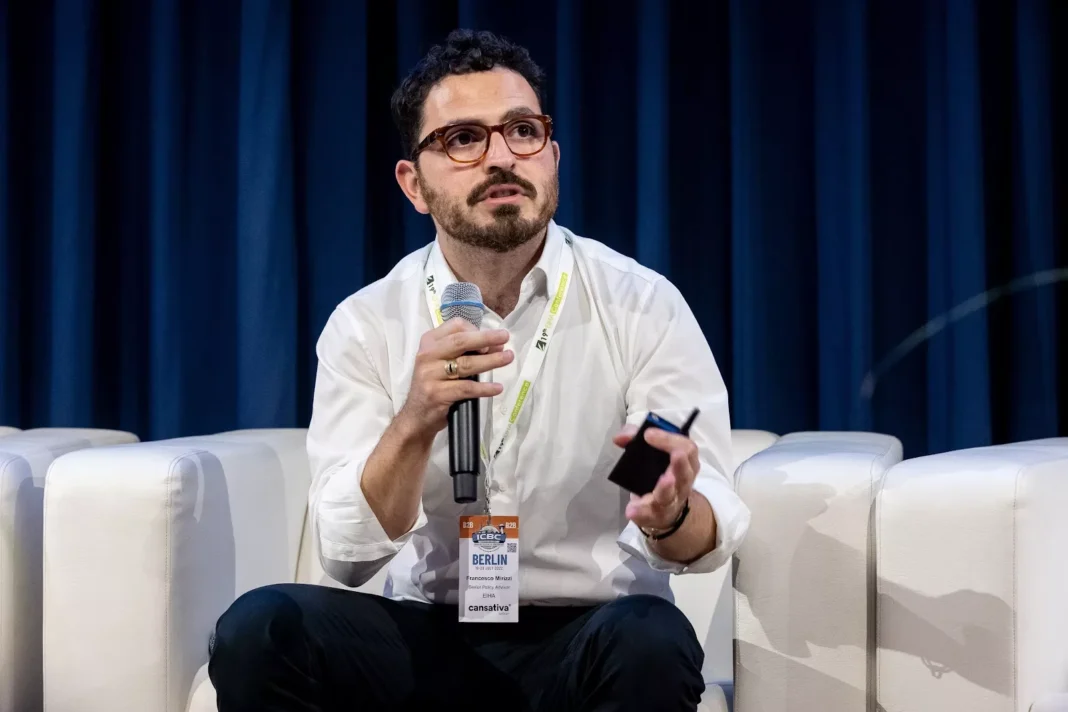

THE new MD of the European Industrial Hemp Association (EIHA) says it is preparing to challenge Europe’s on-going efforts to undermine the continent’s CBD industry – whilst also keeping a close eye on developments in the UK.
Francesco Mirizzi, who had served as the Senior Policy Advisor for the Trade Body over the past five years, was appointed Managing Director just a few short weeks ago.
The start of his tenure has been marked with the controversial determination by the European Food Safety Authority (EFSA) of a safe dose of two milligrams (mg) per day of CBD for an adult of 70kg – or, less than one-tenth of a drop of water.
He told MEDCAN24: “Let’s start on a positive note; this is the first time that EFSA has acknowledged there is a safe level of CBD…in a way that is good.
Restrictive Uncertainty
The price is too low, it makes no sense and cannot be achieved.
The uncertainty factor that EFSA has applied to data from novel food applications in the industry is at its highest level.
“This is the same data we have access to and if a lower uncertainty factor were to be applied by EFSA then a more sensible ADI (average daily intake) of 17.5mg – the one which we recommend – can be achieved.”
EFSA has applied an uncertainty factor of 400 – twice as strict as the usual standard of 200 – in its recently-announced public consultation which runs until October 14. In contrast, Canada’s upper daily limit of 200mg is double the amount in Australia.
We will challenge this use of a very conservative factor. Our science is with us. “Our approach in developing the ADI we recommend is based upon a thorough examination of toxicological data.
The EFSA is too focused on the precautionary principles and can justify any level they want.
When we meet with EFSA, we’ll try to explain why they are using the data so cautiously and in a restrictive way.
One of the requests of EIHA will be to see if EFSA will be flexible enough to allow its Novel Food application to proceed with the higher limit.
UK CBD Conundrum
EIHA is expected to speak to the European Commission before its meeting with EFSA in November. It hopes to convince the Commission that it needs to ease up on its strict approach.
In June 2022, the EC halted the processing of CBD Novel Food Applications due to safety concerns. Concerns were expressed over potential liver damage, nervous system and pregnancy harm.
Nevertheless, EIHA’s Novel Food application in the UK is one of only three applications to make it through to the end of the long and arduous procedure.
EIHA is pushing to increase the UK’s daily recommended dose, which is 10mg.
UK Food Standards Agency has announced that a public consultation will take place for 12 weeks to review three authorization applications. These represent approximately 3,000 CBD-isolate products.
The UK has a more reasonable and positive approach. “The FSA promotes dialog with applicants, while EFSA has a much more closed approach,” he continues.
If approved this presents a conundrum for the industry as approved products will be corralled into the established 10mg limit while the thousands of products that are still ‘pending’ in the Novel Food approval process, with higher CBD levels, will still be on the market.
Mr Mirizzi added: “In that situation we will have products that are ‘legal’ with lower ADI’s than those other products that are still on the market. We will have to talk about this with the FSA.
CBD Novel Food Agenda will limit sales of natural, whole plant extracts. Industry bodies have stated that these are traditional food and should not be included in the agenda.
The EIHA’s earlier attempts to continue this approved food pathway via an Article 4 submission have stalled, and are unlikely to be revived in the near future.
Hemp Overhaul
As a result of the regulators interventions EIHA says the CBD industry has ‘shrunk’ to a degree although he contends the larger companies are still performing well in the market, and suggests that any shrinking in the size of the market may be due to the passing of the ‘peak, CBD-hype phase’.
Since Mr Mirizzi was appointed, the EC took steps to reform hemp regulation.
The entire plant of hemp, including its flowers as well as the seeds and stems could be recognized by 2027 and THC levels could reach 0.5%.
We have been advocating these changes for the past five years. At first, we needed to increase awareness of the hemp’s potential and we think we’ve done pretty well.
There will be more discussions between the Parliament and Commission but they now appear to have a common goal and are now clearly determined to recognize the entire hemp plant.
He admits that countries such as Italy may find it more difficult to accept this new policy, given that they recently approved hemp flowers. But he argues that Italy has been looking for a means of escaping these shackles that it has imposed on itself, and argues that the EC’s mechanism could provide a path out.
Without being too optimistic, we think this trend will continue. We believe these changes will occur in 2027 if not earlier.
Sponsored Content
This informative article is brought to you by NUBO CBD →