







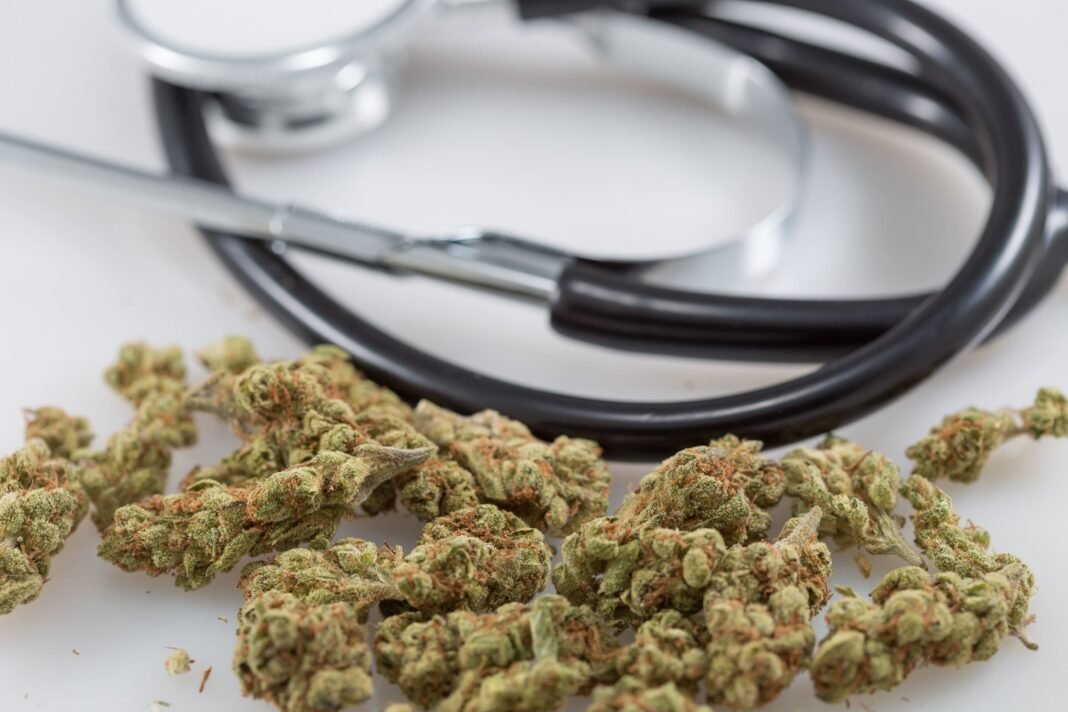

Wisconsin Senators will take up next week a bill, led by Republicans and aimed at legalizing medical marijuana.
Mary Felzkowski, Senate President (R), who has sponsored previous medical cannabis bills in the past session, officially introduced this new legislation with Sen. Patrick Testin on Wednesday. It’s been two weeks since the GOP leader first previewed his proposal. He also presented a version of the Assembly that was drafted by Assemblymember Patrick Snyder and several other House members.
The Senate Health Committee will be hearing it next week.
Wisconsin GOP Assembly Speaker, said last week, that he hopes legislators in Wisconsin can “find a common ground” to pass legislation legalizing marijuana for medical purposes. He added, however, that the cannabis bill submitted by the Republican Senate leadership is unlikely to be passed in his chamber as it’s “way too general and wide-ranging.”
As the 2025 session was set to get underway, Felzkowski said she was “hoping to have a conversation” in the legislature about legalizing medical marijuana this year—though the Republican Assembly speaker still represented “an obstacle,” she added.
These are some of the main provisions in the latest medical cannabis bill from the Senate President that is set to go to committee.
- Patients with qualifying conditions include those who have cancer, HIV/AIDS or inflammatory bowel diseases, Parkinson’s or Alzheimer’s Disease, or amyotrophic lateral sclerosis or multiple sclerosis.
- The forms of cannabis that are allowed for medical use include oils, concentrates tinctures edibles pills topical gels creams vapors patches liquids and nebulizers. The use of cannabis in any form which could be consumed as smoke would be prohibited.
- The cultivation of home crops is prohibited.
- Three caregivers can be designated by the patient to buy and possess cannabis medical products for them.
- Registrations for patients and caregivers will last two years, and can be renewed. A $20 annual fee will be charged, and registrations can be cancelled if someone is found guilty of a drug offense or a criminal conviction.
- Pharmacists would have to be employed by dispensaries to provide consultations with patients and caregivers, as well as to recommend daily doses. The first medical marijuana supply for a patient could be up to 30 days, and subsequent supplies could reach up to 90 days.
- The state Prescription Drug Monitoring Program would require that the use of medical marijuana by patients be documented.
- This bill will protect the parental rights of patients who use medical marijuana and their caregivers from housing discrimination. However, it allows employers to refuse or fire workers because they are using medical marijuana.
- Only patients and caregivers can possess medical marijuana at home or while traveling to and from dispensaries. If you do not have an ID card, or possess medical marijuana in locations that aren’t allowed by law, there will be a civil fine of $25.
- Sales taxes on medical cannabis will be waived.
- The State would issue licenses to businesses involved in cultivation, processing and laboratory work, as well as dispensaries, but only if they met certain requirements for residency, eligibility and fees.
- The Department of Health Services will establish a new Office of Medical cannabis Regulation to supervise the registry of patients and caregivers and the dispensaries. Director would be appointed to the office by Governor.
- Department of Agriculture, Trade and Consumer Protection will oversee and regulate the cultivation, testing and processing of cannabis.
- Localities will not be allowed to restrict or regulate the zoning of medical cannabis businesses.
Meanwhile, a Republican candidate for governor of Wisconsin said in July that he was “open to considering different opportunities” when it comes to legalizing medical or adult-use marijuana in the state, though he has provided little in the way of specifics so far.
The Democratic Party is led by the current Governor. Tony Evers, a Democrat who is in favor of legalizing marijuana, won’t be running for reelection. But he said in June that if his party can take control of the legislature, the state can “finally” legalize marijuana so that residents don’t have to go to neighboring Illinois to visit its adult-use market.
Separately in June, a poll from Marquette Law School found that two in three Wisconsin voters support legalizing marijuana.
The poll found that public support for legalizing cannabis has increased steadily since 2013, when the institute began tracking the opinion of the general population. 67 percent now back the change in policy. This is 17 points more than 2013’s results.
At 88 per cent, Democrats favor the legalization of cannabis. Independents are second at 79 per cent. A majority of Republicans (56%), however, said that they are still against legalizing adult-use cannabis.
Underscoring the importance of party control, the state’s Republican-controlled Senate and Assembly this summer rejected another attempt to legalize marijuana, defeating amendments to budget legislation that would have ended prohibition in the state and established new medical and recreational cannabis programs.
Evers has routinely attempted to change that policy as part of his budget requests—and Democratic leaders have similarly pushed for reform.
Republicans in the legislature also cut the marijuana provisions from a state budget proposal in May, as they’ve done in past sessions.
Despite Republicans’ move to cut legalization from the budget legislation, party leaders recently acknowledged that the debate over medical marijuana legalization is “not going to go away,” and there’s hope it can be resolved this session.
—
MEDCAN24 tracks hundreds of marijuana, psychedelics, and drug policy legislation in state legislatures this year. Patreon members who pledge at least $25/month gain access to interactive maps, charts, and a hearing calendar.
Find out more about our marijuana law tracker. To get access, become a Patreon supporter.
—
Tyler August, Assembly Majority Rep. (R), said that in February: “I do not think that anyone would be naive to believe marijuana or THC products were absent from Wisconsin. They are available across state borders. I think this is something we should address.” I’m optimistic that we will be able to.”
“If it’s going to be called medical marijuana it has to treated as a drug.” “But the marijuana debate won’t go away,” said Sen. Dan Feyen, the assistant majority leader at that time. “The margins of victory are smaller.”
There have been repeated attempts to legalize medical marijuana in the legislature over recent years, including the introduction of legislation from Assembly Speaker Robin Vos (R) that called for a limited program facilitated through state-run dispensaries. It was not popular amongst his Republican counterparts, though, and the bill eventually stalled last year.
Evers previewed his plan to include marijuana legalization in his budget in January, while also arguing that residents of the state should be allowed to propose new laws by putting binding questions on the ballot—citing the fact that issues such as cannabis reform enjoy sizable bipartisan support while the GOP-controlled legislature has repeatedly refused to act.
Previously, in 2022, the governor signed an executive order to convene a special legislative session with the specific goal of giving people the right to put citizen initiatives on the ballot, raising hopes among advocates that cannabis legalization could eventually be decided by voters. The GOP-controlled legislature, however, did not approve the proposal.
Evers said in December that marijuana reform is one of several key priorities the state should pursue in the 2025 session, as lawmakers work with a budget surplus.
Days after he made the remarks, a survey found the reform would be welcomed by voters in rural parts of the state. Nearly two-thirds of respondents (65%) said that they supported legalizing cannabis.
Last May, the governor said he was “hopeful” that the November 2024 election would lead to Democratic control of the legislature, in part because he argued it would position the state to finally legalize cannabis.
He stated at the time, “We have been hard working over the last 5 years. We’ve had several budgets. “I’m aware that there are many states around us with legal recreational marijuana. And we will keep doing this.”
A Wisconsin Democratic Assemblymember tried to force a vote on a medical cannabis compromise proposal last year, as an amendment to an unrelated kratom bill, but he told MEDCAN24 he suspects leadership intentionally pulled that legislation from the agenda at the last minute to avoid a showdown on the issue.
Meanwhile, the state Department of Revenue released a fiscal estimate of the economic impact of a legalization bill from then-Sen. Melissa Agard (D) in 2023, projecting that the reform would generate nearly $170 million annually in tax revenue.
A legislative analysis requested by lawmakers estimated that Wisconsin residents spent more than $121 million on cannabis in Illinois alone in 2022, contributing $36 million in tax revenue to the neighboring state.
Evers and other Democrats have since at least last January insisted that they would be willing to enact a modest medical marijuana program, even if they’d prefer more comprehensive reform.
MEDCAN24 would not be possible without the support of readers. Consider a Patreon subscription if our marijuana advocacy journalism is what you use to keep informed.

Sponsored Content
This informative article is brought to you by NUBO CBD →