







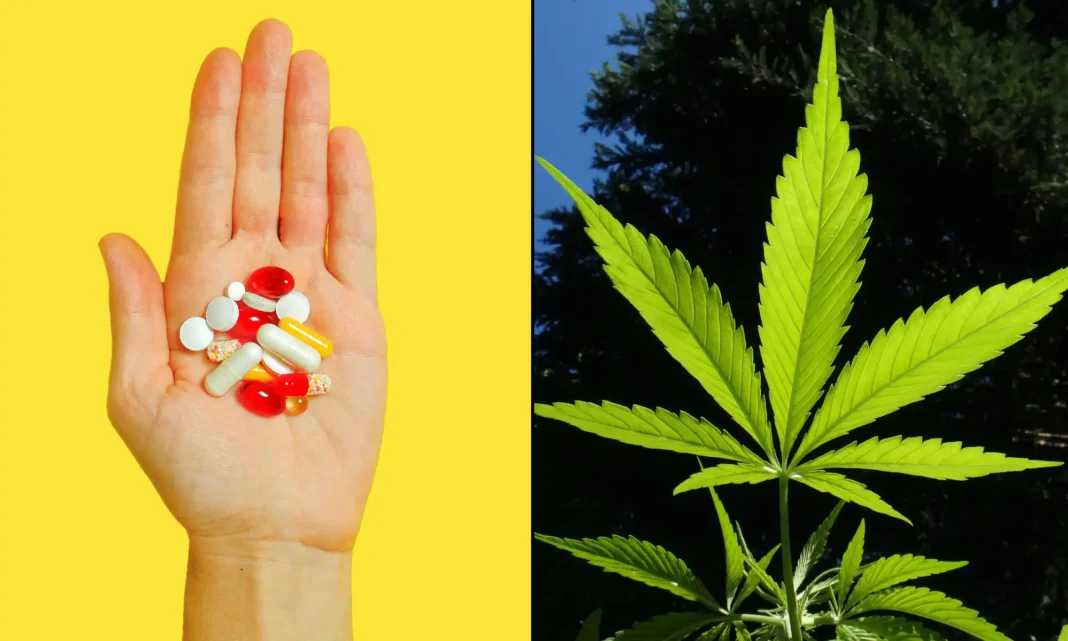

About one in three Americans who use CBD say they take it as an alternative or supplement to at least one medication—particularly painkillers—according to a new federally funded study.
The National Institute on Drug Abuse funded the research, and it was published in Frontiers in Public Health.
About 35 percent reported that they had used CBD throughout their lives. CBD, an non-intoxicating form of cannabinoid has gained in popularity in the U.S. since hemp and derivatives were legalized by federal law in 2018. Participants in the study were asked questions about the frequency and method of CBD consumption, along with whether CBD is used to supplement other conventional drugs or as an alternative.
In the lifetime CBD consumer group, 32% use CBD as an adjunct or substitute for one medicine, but adjunct usage is more prevalent.
Many adults in the US use CBD to treat a variety of ailments.
The “conditions that are most commonly targeted” by those who report taking cannabidiol as a therapeutic drug include musculoskeletal disorders and connective tissues such as joint discomfort (10.1%), psychiatric conditions such as anxiety (7.4%) and general disorders and administration site disorders (6.8%).
Study authors reported that “ibuprofen or Tylenol are frequently replaced by other medications, such as over-the counter analgesics.” Only a tiny percentage of CBD users have ever reported a problem that they believe was caused by CBD (2.4%).
The researchers noted that CBD use was widespread among US adults, particularly in the case of pain medication. The study concluded that “These patterns demonstrate the need to improve evidence, clearer guidance, and more accurate dosing and product quality information, as well as co-use of CBD with other medications.”
“A key finding is the widespread use of CBD in combination with prescription or over-the-counter medications, highlighting a potential for adverse drug–drug interactions,” the researchers noted.
While questions about the safety and effectiveness of CBD in combination with other medications remain, the researchers say that common medicines such as opioids or psychotropics used to treat pain and anxiety can also cause severe negative effects.
It says that CBD may be considered a positive benefit if it helps reduce anxiety, and to discontinue or decrease a drug with greater side effects, or a higher risk for dependence.
The FDA has approved only one synthetic CBD product for severe epilepsy. “This should not be taken as a proof that there is no therapeutic potential in other areas, but rather reflects in part, the difficulties of producing regulatory-grade data in an environment where cannabis was federally regulated for a long time and clinical research faced significant structural barriers,” said the authors.
Recent federal actions underlined this, they added, noting that President Donald Trump had signed in December an executive ordering directing a federal reclassification for marijuana, and outlining plans to include CBD coverage within certain federal health care programs.
According to the study, the order was “explicitly framing the gap between medical cannabis and CBD use, yet limited clinical evidence, as leaving clinicians and patients without adequate guidance.” It also directed agencies that they reduce obstacles and increase medical marijuana and CBD-related research. This will hopefully allow for a rigorous clinical evaluation for CBD and medical cannabis in terms of promising outcomes.
Despite the fact that CBD became legal in the United States during Trump’s term as president under the 2018 Farm Bill legislation, there is a separate law that the President signed last year. This bill includes provisions that, according to stakeholders, would eliminate the cannabis market through limiting the THC level.
CBD isolates would not necessarily be affected by the new law, which takes effect on November. However, it is rare that CBD contains such small amounts of THC to satisfy the federal definition for legal hemp.
The latest study on cannabidiol is not the only one that shows people use marijuana or its components as an alternative drug.
A recent American Medical Association study published with federal funding added to the evidence by showing that marijuana could be an alternative treatment for chronic pain.
According to AMA research, legalizing marijuana as a medical or recreational drug is associated with a “significant reduction in opioid usage among patients with cancer.”
A separate paper published in October similarly found that medical marijuana legalization is “associated with significant reductions in opioid prescribing.”
In August, meanwhile, Australian researchers published a study showing that marijuana can serve as an effective substitute for opioids in pain management treatment.
Another study published earlier this year in the journal Drug and Alcohol Review found that, among drug users who experience chronic pain, daily cannabis use was linked to a higher likelihood of quitting the use of opioids—especially among men.
Research published late last year also found that legalizing medical cannabis appeared to significantly reduce monetary payments from opioid manufacturers to doctors who specialize in pain, with authors finding “evidence that this decrease is due to medical marijuana becoming available as a substitute” for prescription painkillers.
Recent research has also shown a drop in the number of fatal opioid overdoses among jurisdictions that have legalized marijuana for adults. That study found a “consistent negative relationship” between legalization and fatal overdoses, with more significant effects in states that legalized cannabis earlier in the opioid crisis. According to the authors, recreational marijuana legalization is “associated with an approximate 3.5 death reduction per 100,000 persons.”
This report stated that “our findings suggest that broader access to recreational marijuana could help combat the opioid epidemic.” The report stated that “previous research shows marijuana can be used to reduce opioid prescriptions and may reduce overdose mortality.”
Another recently published report into prescription opioid use in Utah following the state’s legalization of medical marijuana found that the availability of legal cannabis both reduced opioid use by patients with chronic pain and helped drive down prescription overdose deaths statewide. It concluded that the results showed “cannabis plays a significant role in pain management, and the reduction of opioid consumption.”
Sponsored Content
This informative article is brought to you by NUBO CBD →