





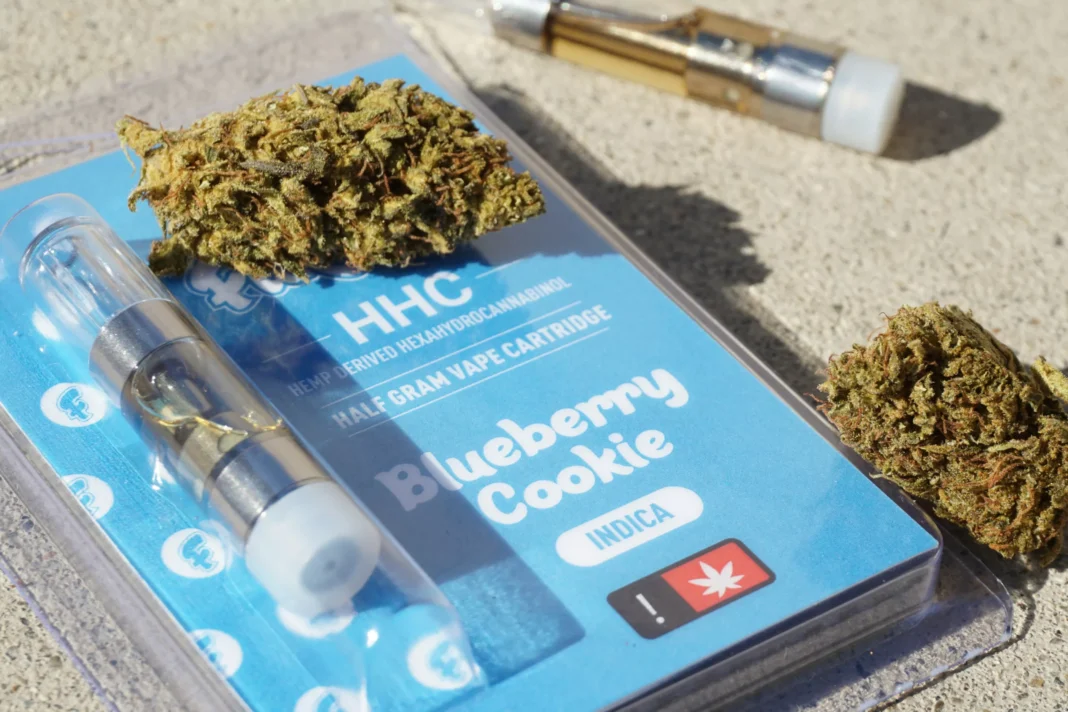

The DEA HHC ban 2026 has officially designated hexahydrocannabinol as a Schedule I controlled substance. This formalization comes just days after the US House passed the 2026 Farm Bill, which offers no alternatives to the HHC prohibition. For hemp and CBD businesses, the path forward remains uncertain.
It marks the latest meaningful effort to bring the largely unregulated ‘intoxicating hemp’ industry to heel following its explosion across the country in the last few years.
The DEA’s official designation of HHC comes just days after House passed Farm, Food and National Security Act, Act 2026, despite the considerable pressure from the hemp industry, this act does not do much to reduce the proposed language to reform the regulation of hemp.
The Trump administration continues to substantiate its position as the US hemp sector pushes for amendments that will prevent overreach, protect industrial hemp and CBD industry and also help to limit the scope of the hemp plant.
HHC is a controlled substance.
In May 2004, the DEA assigned hexahydrocannabinol its own Schedule I code. This formalised the government’s position, which has been stated for years, that this semi-synthetic cannabis cannabinoid was not hemp.
Terrance Cole, DEA administrator signed the HHC regulation on April 22, 2026. It assigned drug code 7220 to hexahydrocannabinol, separating it from the umbrella tetrahydrocannabinols listing it had previously sat under.
It was made clear that the agency does not intend to change HHC’s status as a Schedule I drug, since the substance has always been controlled under this classification. However, the new code allows the DEA the ability to set specific production quotas, for manufacturers who are registered and working on research purposes.
A vote in March 2025 at the UN Commission on Drugs and Narcotics added HHC into Schedule II of 1971 Convention on Psychotropic Substances. (CND Decision No. 68/5). This decision was required to be reflected in the US list under treaty obligations. Federal Register does not indicate that only the US abstained from this vote.
The DEA’s position is that HHC ‘does not occur naturally in the cannabis plant and can only be obtained synthetically, and therefore does not fall under the definition of hemp.’
The House passes the 2026 Farm Bill
Days earlier (May 01), the House of Representatives passed the 2026 Farm Bill in a 224–200, replacing the 2018 omnibus agriculture law that largely enabled the so called ‘intoxicating hemp’ market to flourish by defining hemp solely on delta-9 THC content.
The advocates were counting on the bipartisan amendment introduced by James Comer, R-KY, and Morgan Griffith, R-VA, to give operators another year to create a better framework that protects jobs, and can more precisely identify bad actors.
In his testimony before the Rules Committee, Rep. Comer noted that the hemp industry supports ‘320,000 American jobs, generates $28.4 billion in market activity, and contributes $1.5 billion in state tax revenue,’ and warned that without action, ‘an entire industry [could be] The emergence of a new generation is largely eliminated.
Clarify that the Farm Bill doesn’t delay or change the November crackdown against intoxicating products made from hemp. It defines hemp and sets a total THC limit of 0.4mg per container, while excluding synthetic cannabinoids and those converted to them.
It is the Section 781 in the Government Funding Bill signed by the President on 12 November, 2025. This legislation was not passed through an open discussion but rather buried within a continuing resolution which ended the 41-day shutdown of the federal government.
This was after the industry believed that it had already won. The Senate removed the roughly similar language proposed by Senate Minority leader Mitch McConnell, which was estimated to impact 90-95% hemp products from the Agriculture and FDA appropriations act in August 2025 after Sen. Rand Paul had threatened to block funding for the larger bill without it. The three-month reprieve was granted by the Senate.
The 2026 Farm Bill represents a completely separate entity. Its hemp provisions reinforce and embed what the November CR already did at the farming level, thus formally separating ‘industrial hemp’ (fibre, grain, seed) from cannabinoid-linked production, and shifting farm-level testing from a delta-9 THC standard to a total THC measure that closes the THCA loophole.
While both pieces of legislation attempt to accurately differentiate between ‘intoxicating hemp’ substances, industrial hemp, and non-intoxicating cannabinoid products like CBD, its effects have implications for all three.
Deb Tharp of the cannabis industry explained when the CR signed that almost all CBD distillates and crudes routinely exceeded 0.3% by weight total THC, even though the finished product did not. ‘Even if your end product is non-intoxicating CBD,’ Tharp said, ‘the stuff in your big stainless steel tank on the way there is suddenly on the wrong side of federal law.’
There is still a Senate version to be released, as well as competing legislative frameworks.
Rep. Andy Barr’s Lawful Hemp Protection Act narrows the cannabinoid industry while protecting a niche for CBD that is used to promote wellness.
The Cannabinoid Safety and Regulation Act, sponsored by Sen. Ron Wyden, envisions an even broader system of federal regulation. Another bill by Sens. Rand Paul, Amy Klobuchar, and Joni Ernst have introduced separate bills that would let states opt out completely of the federal prohibition. Ernst, however, has withdrawn from being a sponsor without any explanation.
The ban will take effect 12 November 2026. In the meantime, Congress must agree to a reasonable framework. If not, then the government may erect a regulatory structure and let the law be enforced by the state, just as they did in December with marijuana.
Sponsored Content
This informative article is brought to you by NUBO CBD →