





Here’s how to make hemp paper at home: cut hemp scraps into tiny pieces, soak them, blend them with water (and some recycled cotton or paper for easier pulp), pour the pulp into a tub, pull a sheet with a screen frame called a mould and deckle, then press it and let it dry flat. Soft hemp scraps work in a kitchen blender; raw hemp stalk fiber needs to be cooked first.
Hemp has a long history as a fiber crop, and making a few sheets of paper is one of the most satisfying hemp crafts you can try in 2026. This guide covers the tools, a 9-step method, a table of fiber choices, the mistakes beginners make, and the safety rules for the optional cooking step.
Key takeaways
- A kitchen blender cuts fibers rather than beating them, so it handles soft hemp scraps and recycled paper better than tough raw hemp, according to Hand Papermaking.
- Raw hemp bast usually needs cooking. Hand Papermaking recommends trying soda ash before lye, with gloves, eye protection and good ventilation.
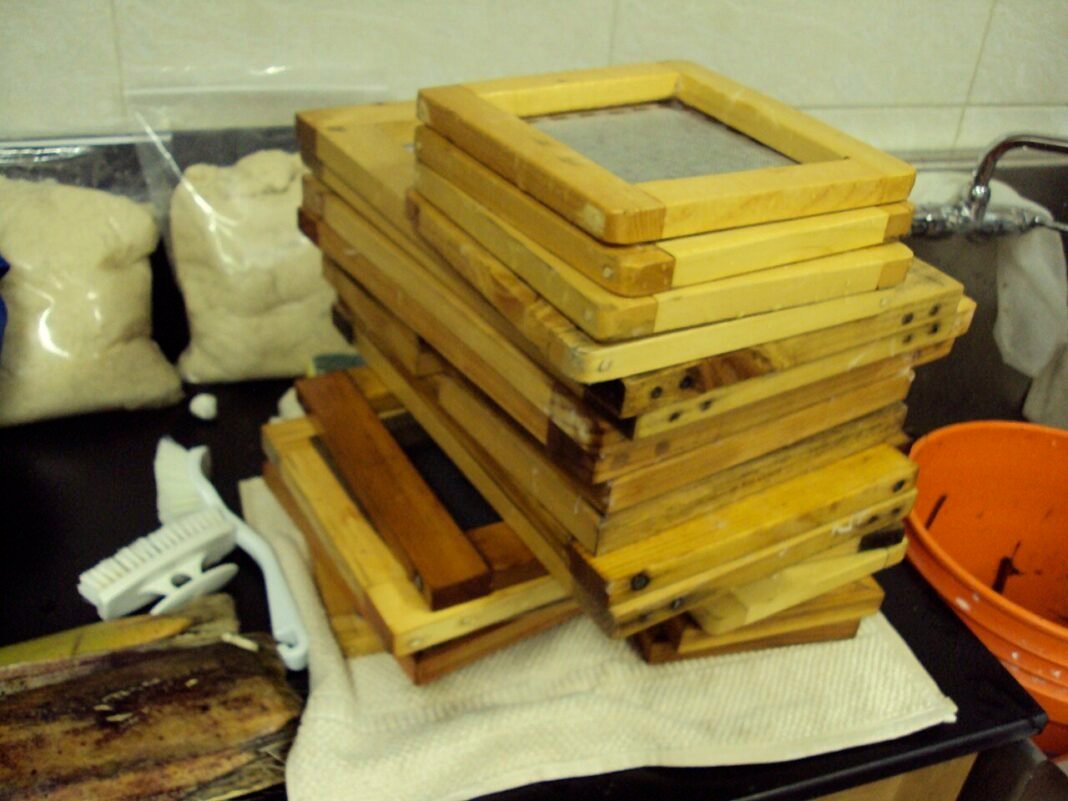
- A mould and deckle can be as simple as two matching picture frames with window screen stretched over one.
- Press firmly and dry the sheets flat or stuck to glass to keep them from curling.
- The story that the Declaration of Independence was written on hemp paper is a myth: the signed copy is on parchment.
This guide contains affiliate links. If you buy through them, Hempland.net may earn a commission at no extra cost to you.
What is hemp paper?
Hemp paper is paper made with fibers from the hemp plant. The Congressional Research Service lists paper among the many uses of hemp fiber, next to textiles, rope, building materials and composites, and notes that the woody core (hurds) is also used in papermaking (CRS). The same report says hemp was widely grown in the United States from the colonial period into the mid-1800s, when twine and paper from hemp were in common use.

Hemp fiber is still a working crop today. USDA’s National Hemp Report estimated 2024 U.S. fiber hemp production at 60.4 million pounds, up 23 percent from 2023 (USDA NASS). At home, though, you don’t need a field. Leftover hemp twine, hemp fabric scraps or hemp fiber from a papermaking supplier is plenty for a stack of sheets.
Hemp paper myths vs facts
You’ll see claims online that famous documents were written on hemp. PolitiFact rated the claim that the Declaration of Independence was written on hemp paper False, citing Monticello and the Papers of Thomas Jefferson, which say Jefferson’s draft was most likely on Dutch linen rag paper (PolitiFact). The National Archives confirms the signed Declaration was engrossed on a sheet of parchment (National Archives).
What is true: early Western paper was made from cloth rags. The Library of Congress explains that older books were printed on paper made from rags rather than wood pulp, and that finished sheets were hung on hemp cords to dry (Library of Congress). Further back, the University of Washington Libraries notes that nobody knows exactly which fiber Ts’ai Lun used when paper was invented in China, though hemp waste is one of the materials historians suspect (University of Washington Libraries).

Choose your hemp fiber
The fiber you start with decides how much work you’ll do. Hand Papermaking’s beginner column says natural-fiber rags, including hemp, linen and cotton, make the best paper, but that long, tough fibers like hemp really need a Hollander beater to turn into fine pulp (Hand Papermaking). With a blender, the trick is to start with soft, short pieces and mix in an easier fiber.
| Hemp source | Prep needed | Blender friendly? | Result |
|---|---|---|---|
| Hemp or hemp-cotton fabric scraps | Cut into 1 cm squares, soak overnight | Yes, in small batches | Strong, slightly textured sheets |
| Hemp twine | Unravel, cut into very short lengths, soak | Somewhat; long bits wrap the blade | Speckled, rustic sheets |
| Hemp pulp or half-stuff from a papermaking supplier | Rehydrate per supplier | Yes | Smoothest, most even sheets |
| Raw hemp bast (stalk fiber) | Cut, soak, cook with soda ash, rinse | Only after cooking | Authentic, fibrous paper; most work |
| Recycled cotton rag paper (mixer fiber) | Tear and soak | Yes | Helps hemp sheets hold together |
For a first try, aim for about one quarter to one half hemp, with the rest torn cotton rag paper or good-quality scrap paper. Hand Papermaking warns that newspaper makes weak, poor paper because its short, acidic wood fibers break down, so skip it if you can.

Tools and materials
| Item | Why you need it |
|---|---|
| Hemp fiber (see table above) | The main ingredient |
| Blender kept only for crafts | Turns soaked fiber into pulp. Hand Papermaking says not to use the same blender for paper and food. |
| Mould and deckle | A screened frame (mould) plus an open frame on top (deckle) that sets the sheet size |
| Plastic tub (vat) larger than the mould | Holds the pulp and water |
| Felts, old wool blanket pieces or heavy interfacing | Couching surface that absorbs water |
| Two flat boards and clamps or heavy books | Pressing the stack |
| Sponge and towels | Soaking up extra water |
| Optional: stainless or enamel pot, soda ash, gloves, goggles | Only for cooking raw hemp fiber |
How to make hemp paper: 9 steps
- Cut the fiber small. Snip fabric into 1 cm squares and twine into pieces no longer than about 1 cm. Short pieces blend more easily and won’t wrap around the blade.
- Soak overnight. Cover the fiber with water and leave it for 12 to 24 hours. Hand Papermaking also soaks fibers overnight before cooking.
- Cook raw hemp only if needed. Raw bast fiber usually needs a soda ash cook to soften it (see the safety section below). Fabric, twine and supplier pulp can skip this step.
- Blend the pulp. Fill the blender about two-thirds with water, add a small handful of soaked fiber, and blend in short bursts of 15 to 30 seconds until no clumps remain. Add torn cotton paper to the batch to bind it. Work in several small batches rather than one big one.
- Fill the vat. Pour the pulp into a tub half full of water and stir. A thin slurry makes thin sheets; add more pulp for thicker ones.
- Pull a sheet. Hold the deckle on top of the mould, dip the pair at a slant into the far side of the vat, scoop toward you, and lift it out level. Give it a gentle shake side to side and front to back so the fibers lock together, the way the Library of Congress describes the old vatman working. Let it drain, then lift the deckle straight up.
- Couch the sheet. Turn the mould over onto a damp felt in one rolling motion and press the back of the screen with a sponge to release the sheet. Peel the mould away from one edge. Add a new felt on top before the next sheet.
- Press the stack. Put the stack of felts and sheets between two boards and press with clamps, a book press or your own body weight. Catherine Nash’s papermaking notes say that, in general, the stronger the press, the stronger the paper (Nash).
- Dry flat. Dry sheets under weight between blotters, or restraint-dry them by smoothing each damp sheet onto glass, a window or an untreated board. Hand Papermaking notes that glass gives the smoothest surface and that paper sticks to treated boards (Hand Papermaking). Peel when fully dry, usually after a day or two.
This short demo from Total Hemp Co. shows hemp fiber being turned into paper on a hemp farm:
Make or sell hemp crafts and materials?
Hempland readers love hands-on hemp projects. Ask us about sponsored articles or advertising for hemp fiber, paper or craft products.
Advertise with us
Safety tips for cooking hemp fiber
Most beginners can skip cooking by using fabric, twine or supplier pulp. If you want to work with raw hemp, follow these rules from Hand Papermaking (Cooking with Caustic):
- Use soda ash (sodium carbonate) before you ever try lye. It’s milder, but PubChem’s hazard data still lists serious eye irritation, and some notices list breathing irritation (PubChem).
- Wear rubber gloves and eye protection, and cook in a well-ventilated space or outdoors.
- Use a stainless steel, glass or unchipped enamel pot, and keep the setup separate from your food cooking gear.
- Always add the caustic to water, never water to the caustic. Nash warns that adding water to caustic can splash violently.
- Hand Papermaking’s guide uses soda ash at about 20% of the dry fiber weight, or a cooking pH of 10 to 11, and simmers 1 to 4 hours, checking every 30 minutes.
- Rinse the fiber until the water runs clear and the pH is neutral. Nash says that can take up to 8 changes of water.
- Keep children and pets away from the pot, the caustic and the blender.

Common mistakes
- Long fibers in the blender. Uncut twine wraps the blade and can burn out the motor. Cut everything short.
- Shaking too hard. Big shakes leave holes and thin spots. Keep the motion small and even.
- Lifting the deckle at an angle. Drips from the frame leave spots on the wet sheet. Lift it straight up.
- Too much newspaper. It makes weak, yellowing sheets. Use cotton rag paper or good scrap paper as your mixer fiber.
- Drying on varnished wood. Sheets stick. Use glass, a window or untreated boards.
- Pulp down the sink. Pulp can clog drains. Strain leftovers and freeze them for next time or put them in the trash.
Ideas for using your hemp paper
Thick homemade sheets are best for cards, gift tags, bookmarks, journal covers and art prints. Press dried hemp leaves (where legal), seeds or flower petals into a wet sheet for decoration. Don’t use homemade sheets as rolling papers: they’re thick, and you can’t know what’s in the pulp. For more hemp projects, try our guides on how to make a hemp bracelet and how to make hempcrete, or read the history behind the 1914 hemp paper ten-dollar bill story.
Helen Hiebert, a well-known papermaker, explains how moulds and deckles work:
Products We Recommend
If you’re setting up a blender just for papermaking, this one has the power to break down soaked fiber in small batches.
 Image: Amazon (hotlinked, not hosted by Hempland.net)
Ninja Professional Blender (1000W, 72 oz)
A 1000-watt countertop blender with a large 72 oz pitcher, according to the listing. Keep it as a dedicated craft blender and blend pulp in small, watery batches.
Check Price on Amazon
Have a hemp craft question?
Stuck on a step or want us to cover another hemp project? Send us a message and we’ll do our best to help.
Contact Hempland
FAQ
Can you make hemp paper with a blender?
Yes, if you use soft, short pieces such as hemp fabric scraps, cut twine or supplier pulp, and mix in some cotton rag paper. Raw hemp stalk fiber usually needs cooking first because a blender cuts rather than beats the fibers.
What can I use instead of a mould and deckle?
Two picture frames of the same size work well. Stretch window screen or fiberglass mesh tightly over one frame and staple it; the open frame sits on top as the deckle.
Is hemp paper stronger than regular paper?
Hemp has long, strong fibers, which is why it has been prized for rope and textiles. At home, strength depends more on how well you prepare and press the pulp than on the plant alone.
Was the Declaration of Independence written on hemp paper?
No. PolitiFact rated that claim False. The signed copy is on parchment, and the drafts were most likely on linen rag paper.
How long does homemade paper take to dry?
Usually a day or two, depending on thickness and humidity. Sheets dried under weight or on glass stay flatter.
Sources
- Cooking with Caustic, Hand Papermaking (accessed November 2026)
- Selecting Source Fibers, Hand Papermaking (accessed November 2026)
- Couching and Drying Surfaces, Hand Papermaking (accessed November 2026)
- Plant Fibers That Can Be Processed By Hand Beating or In a Blender, Catherine Nash, Papermaking Resources (accessed November 2026)
- Sodium Carbonate (GHS classification), PubChem, NIH National Library of Medicine (accessed November 2026)
- Papermaking: A Rags to Riches Story, Library of Congress (accessed November 2026)
- Historical Book Arts: Paper, University of Washington Libraries (accessed November 2026)
- Kai Degner falsely says Declaration of Independence was penned on hemp, PolitiFact (accessed November 2026)
- The Declaration of Independence: A History, National Archives (accessed November 2026)
- Hemp as an Agricultural Commodity (RL32725), Congressional Research Service (accessed November 2026)
- National Hemp Report (April 2025), USDA National Agricultural Statistics Service (accessed November 2026)
Image credits and disclaimer
- Featured image: “Modern papermaking moulds and deckles” by Michellecornelison, CC BY-SA 4.0, via Wikimedia Commons.
- Hemp fiber photo: “Hemp fiber” by SpessiG, CC0, via Wikimedia Commons.
- Drying paper photo: “Drying handmade paper” by SomeoneDreaming, CC BY-SA 4.0, via Wikimedia Commons.
- Product images in the recommendation cards are shown from Amazon.
Image disclaimer: Images in this post are displayed from their original sources (such as Amazon, Wikimedia Commons or Unsplash) and are not hosted on Hempland.net. Product images belong to their respective brands and retailers, and other images belong to their credited creators and are used under their stated licenses. Hempland.net claims no ownership of these images. About the images: because they are hotlinked from third-party sources, they may change or disappear, and they are for illustration only and may not show the exact product, plant or method described. If you own an image and would like it credited differently or removed, please contact us.
Medical and legal disclaimer: This article is for general information and educational purposes only and reflects details available as of November 2026. It is not medical, legal or financial advice. Cannabis laws vary by country and state and are changing in 2026, and cannabis products are intended only for adults 21+ where legal. Grow only where home cultivation is legal and follow local plant limits. Talk to a qualified healthcare professional before using cannabis, THC or CBD, especially if you are pregnant, breastfeeding, take medication or have a health condition. Do not drive or operate machinery after using THC. Any steps described are followed at your own risk. Mention of a company or product is not an endorsement. As an Amazon Associate we earn from qualifying purchases. Hempland.net makes no warranties about the completeness or accuracy of this information and is not liable for any loss or damage arising from its use.

Sponsored Content
This informative article is brought to you by NUBO CBD →