





Here’s how to use hemp seed oil: use it cold, in salad dressings, dips, smoothies and drizzled over finished dishes, rather than for frying; store it in the fridge in a dark bottle; and if you want to try it on skin, apply a few drops to damp skin after a small patch test. Hemp seed oil is a nutty, green food oil pressed from hemp seeds, and it isn’t the same as CBD oil.
This 2026 guide covers kitchen uses with simple steps, skin and hair tips, storage, what the research says, common mistakes and safety notes.
Key takeaways
- Oklahoma State University Extension says hemp seed oil has a lower smoke point than common cooking oils and isn’t a good choice for frying. Cold uses work best.
- It’s rich in polyunsaturated fats, with about a 3:1 ratio of omega-6 to omega-3, plus some GLA.
- Keep it cold and dark. A 2024 shelf-life study found refrigerated, foil-wrapped amber glass protected it best.
- FDA says hemp seeds don’t naturally contain THC or CBD, and hemp seed oil can’t make you high.
- Skin research is limited. One small trial found eating hemp seed oil eased dry, itchy skin in eczema patients.
This guide contains affiliate links. If you buy through them, Hempland.net may earn a commission at no extra cost to you.
What hemp seed oil is (and isn’t)
Hemp seed oil is pressed from the seeds of hemp plants. In December 2018, the FDA completed its review of three GRAS notices for hulled hemp seed, hemp seed protein powder and hemp seed oil, saying they contain only trace THC and CBD from processing and are not capable of making people “high” (FDA). The FDA also states that hemp seeds do not naturally contain THC or CBD (FDA Q&A). So hemp seed oil is a food oil, while CBD oil is made from the plant’s flowers and leaves. For a side-by-side comparison, see hemp oil vs CBD oil.

Hemp seed oil at a glance
| Property | What sources say |
|---|---|
| Polyunsaturated fat | 70 to 90% of fatty acids (OSU Extension) |
| Linoleic acid (omega-6) | 50 to 70% (OSU Extension) |
| Omega-6 to omega-3 ratio | About 3:1 (OSU Extension); 2:1 to 3:1 (Rodriguez-Leyva and Pierce) |
| GLA (gamma-linolenic acid) | 0.5 to 6% (OSU Extension) |
| Best uses | Cold uses such as dressings; not for high-heat cooking or frying |
| Storage | Prone to oxidation; keep away from light and heat |
Sources: Oklahoma State University Extension and Rodriguez-Leyva and Pierce, Nutrition and Metabolism.
How to use hemp seed oil in food
OSU Extension calls cold applications such as salad dressings “the best way” to use hemp seed oil. Here’s an easy starting recipe and a few more ideas.
Simple hemp seed oil vinaigrette
- Add 3 tablespoons hemp seed oil, 1 tablespoon vinegar or lemon juice, 1 teaspoon Dijon mustard and a pinch of salt to a jar or dressing shaker.
- Add a little honey or maple syrup if you like a sweeter dressing.
- Close the lid and shake for 15 to 20 seconds until creamy.
- Taste and adjust. If the nutty flavor is too strong, swap in olive oil for half the hemp oil.
- Pour over greens just before serving. Refrigerate leftovers and use within a few days.
More ways to use it
- Drizzle on finished dishes: soups, pasta, grain bowls, roasted vegetables or baked potatoes, after cooking.
- Dips and spreads: stir a spoonful into hummus, pesto or guacamole.
- Smoothies: blend in a teaspoon.
- Bread dip: mix with olive oil, salt and herbs.
- With hemp seeds: pair it with hemp hearts on salads. See how to eat hemp seeds.
Manitoba Harvest shows a few quick ways to use hemp oil in this video:

Questions about hemp foods?

Send us your hemp kitchen questions and we may answer them in a future guide. Hemp food brands can also ask about sponsored recipes and advertising.
Contact Hempland
How to use hemp seed oil on skin and hair
Hemp seed oil appears in soaps, creams, lotions and lip balms, OSU Extension notes. A 2020 review of more than 70 plant oils for skin care points out that hemp oil stands out among linoleic-rich oils for having relatively low oleic and high alpha-linolenic content (Moore et al., Frontiers in Pharmacology). That doesn’t prove it treats any skin condition. If you want to try it:
- Patch test first. Put a drop on a small area of skin, such as your inner arm, and wait a day. Stop if you see redness, itching or bumps.
- Apply to damp skin. After a shower, warm 2 or 3 drops between your palms and press them onto your skin.
- Mix it in. Add a drop or two to your usual unscented moisturizer if pure oil feels too heavy.
- For hair ends: rub one or two drops between your palms and smooth them over dry ends. Start small so hair doesn’t look greasy. Our post on hemp oil for hair has more ideas.
- Keep a separate bottle for skin care so you don’t contaminate your kitchen oil.
The best-known study is about eating the oil, not applying it. In a 20-week single-blind crossover trial, people with atopic dermatitis who ate hemp seed oil reported less skin dryness and itchiness than when they ate olive oil, and used less skin medication (Callaway et al., Journal of Dermatological Treatment). The study was small, so talk to a dermatologist before using it for a skin condition.
How to store hemp seed oil
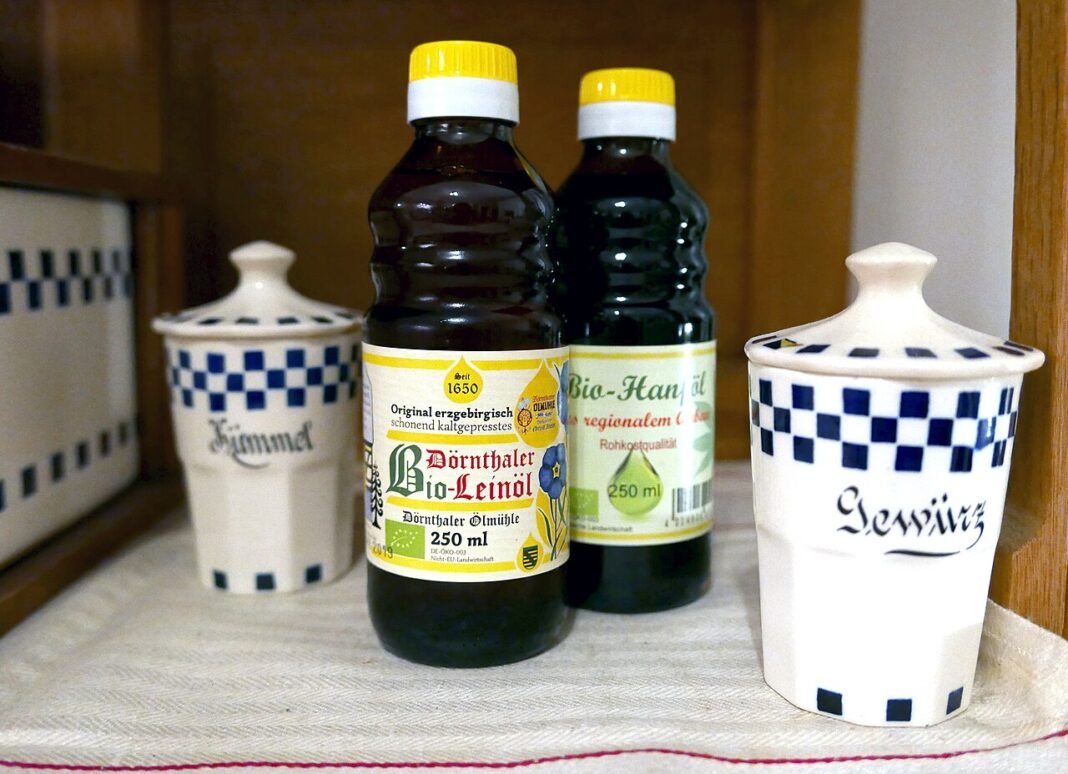
Hemp seed oil spoils faster than many oils because it’s so high in polyunsaturated fat. A 2024 study stored cold-pressed hemp seed oil for 270 days in different containers and found that amber glass wrapped in foil, kept refrigerated in the dark, offered the highest protection (Bonazza et al., Molecules).
- Buy smaller bottles in dark glass and check the best-by date.
- Refrigerate after opening and keep the cap tight.
- Smell it before using. Fresh oil smells nutty and grassy. A bitter, paint-like or fishy smell means it has gone rancid.

The salad pictured is dressed with olive oil; it shows the kind of cold dish where hemp seed oil works well.
Common mistakes
- Frying with it. High heat damages the oil and its flavor. Add it after cooking.
- Storing it in a warm cupboard. Light and heat speed up oxidation.
- Confusing it with CBD oil. Hemp seed oil isn’t a source of CBD. Check labels for “hemp seed oil” or “cannabis sativa seed oil.”
- Using too much at once. Its strong flavor can take over a dish. Start with a teaspoon or blend it with milder oil.
- Skipping the patch test. Any oil can irritate some people’s skin.
Safety notes
- Hemp seed oil is a food, but it’s still fat and calories. Use it in normal food amounts.
- Talk to a healthcare professional before using any oil as a supplement if you take blood thinners, are pregnant or breastfeeding, or have a medical condition.
- Stop using it on skin if irritation develops, and keep it away from your eyes.
- If you’re buying CBD products, that’s a separate category with different rules. See how to read a COA before you buy.
Products We Recommend
Two picks for using hemp seed oil in the kitchen:
 Image: Amazon (hotlinked, not hosted by Hempland.net)
Nutiva Organic Cold-Pressed Hemp Seed Oil
An organic, cold-pressed, unrefined hemp seed oil for dressings, dips and drizzling over finished dishes. Refrigerate after opening.
Check Price on Amazon
 Image: Amazon (hotlinked, not hosted by Hempland.net)
OXO Good Grips Salad Dressing Shaker
A leak-resistant shaker with measurement markings, handy for mixing the vinaigrette above and storing it in the fridge.
Check Price on Amazon
Are you a hemp food or skin care brand?
Reach Hempland readers who want practical ways to use hemp products. Ask us about sponsored content, product features and ad placements.
Advertise with us
FAQ
Can you cook with hemp seed oil?
Use it for cold or low-heat dishes. OSU Extension says it isn’t a good choice for high-temperature cooking or frying, so drizzle it on after cooking.
Does hemp seed oil get you high?
No. The FDA says hemp seeds don’t naturally contain THC or CBD, and the hemp seed ingredients it reviewed aren’t capable of making people high.
Is hemp seed oil good for your skin?
It’s a common skin care ingredient, but evidence is limited. A small trial found eating hemp seed oil helped dry, itchy skin in eczema patients. Patch test first and ask a dermatologist about skin conditions.
How long does hemp seed oil last?
Check the best-by date and refrigerate it after opening. Throw it out if it smells bitter or paint-like.
How much hemp seed oil should I use a day?
None of the sources above set an official daily amount. Use it like any other food oil, as part of a balanced diet, and ask a doctor or dietitian if you have health questions.
Sources
- Hemp Seed Oil Properties (FAPC-235), Oklahoma State University Extension (accessed November 2026)
- FDA Responds to Three GRAS Notices for Hemp Seed-Derived Ingredients for Use in Human Food, U.S. Food and Drug Administration (accessed November 2026)
- FDA Regulation of Cannabis and Cannabis-Derived Products, Including Cannabidiol (CBD), U.S. Food and Drug Administration (accessed November 2026)
- Efficacy of dietary hempseed oil in patients with atopic dermatitis, Journal of Dermatological Treatment, via PubMed (accessed November 2026)
- The cardiac and haemostatic effects of dietary hempseed, Nutrition and Metabolism, via PMC (accessed November 2026)
- Monitoring the Shelf Life of Hemp Seed Oil Stored at Two Temperatures in Different Materials via NIR Spectroscopy, Molecules, via PMC (accessed November 2026)
- The Enigma of Bioactivity and Toxicity of Botanical Oils for Skin Care, Frontiers in Pharmacology, via PMC (accessed November 2026)
Image credits and disclaimer
Image disclaimer: Images in this post are displayed from their original sources (such as Amazon, Wikimedia Commons or Unsplash) and are not hosted on Hempland.net. Product images belong to their respective brands and retailers, and other images belong to their credited creators and are used under their stated licenses. Hempland.net claims no ownership of these images. About the images: because they are hotlinked from third-party sources, they may change or disappear, and they are for illustration only and may not show the exact product, plant or method described. If you own an image and would like it credited differently or removed, please contact us.
Medical and legal disclaimer: This article is for general information and educational purposes only and reflects details available as of November 2026. It is not medical, legal or financial advice. Cannabis laws vary by country and state and are changing in 2026, and cannabis products are intended only for adults 21+ where legal. Grow only where home cultivation is legal and follow local plant limits. Talk to a qualified healthcare professional before using cannabis, THC or CBD, especially if you are pregnant, breastfeeding, take medication or have a health condition. Do not drive or operate machinery after using THC. Any steps described are followed at your own risk. Mention of a company or product is not an endorsement. As an Amazon Associate we earn from qualifying purchases. Hempland.net makes no warranties about the completeness or accuracy of this information and is not liable for any loss or damage arising from its use.

Sponsored Content
This informative article is brought to you by NUBO CBD →