







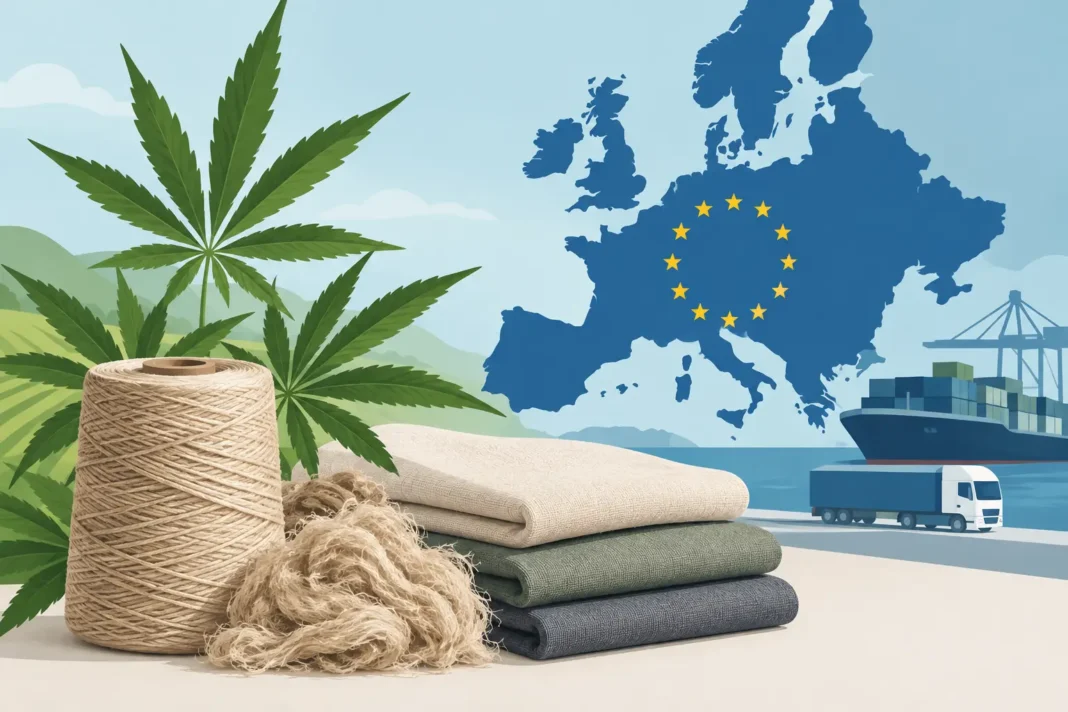

A European fashion brand can source a hemp-blend shirt today, but producing consistent fabric at commercial volume remains a far more difficult proposition. Hemp textiles sit at the intersection of agricultural policy, industrial processing and consumer demand – and the weakest link is often not the crop, but the supply chain that turns stalks into reliable yarn.
For cannabis-sector businesses, that distinction matters. Industrial hemp is increasingly discussed as a lower-impact material opportunity, yet the market will not be built by marketing claims alone. Fibre grades, retting methods, spinning capacity, traceability and national rules on cultivation all shape whether hemp becomes a meaningful European manufacturing input or remains a premium niche.
Why hemp textiles are back on the industry agenda
Hemp fibre has a long history in rope, sailcloth and workwear. Its modern return is being driven by a different set of pressures: fashion groups are looking for alternatives to conventional cotton and synthetic fibres; regulators and consumers are asking harder questions about environmental footprints; and European policymakers are showing renewed interest in bio-based industries that can create value from regional agriculture.
The plant offers a credible starting point. Hemp can produce a long bast fibre from the outer portion of its stalk, while the woody core, or hurd, can be directed to building materials, animal bedding or other industrial uses. In theory, that supports a more complete use of the crop than a single-output model.
But “hemp fabric” is not one material with one performance profile. Fibre length, fineness and strength vary by cultivar, growing conditions and processing. A coarse canvas, a soft jersey blend and a tailored woven cloth demand different inputs and manufacturing techniques. Brands that treat hemp as a simple substitute for cotton risk underestimating the technical work involved.
The processing gap is the central commercial issue
Europe can grow hemp, but cultivation is only the first stage. To make quality textile fibre, stalks must be harvested, retted to separate fibre from woody material, decorticated, cleaned, aligned and prepared for spinning. Each stage affects consistency. Delays, unsuitable machinery or poor handling can reduce a potentially valuable fibre into material more suitable for insulation or composites.
This is why processing infrastructure is becoming the defining question. Much of the global textile supply chain has been designed around cotton, polyester, flax and wool. Specialist equipment and experienced operators for hemp remain less common, particularly where manufacturers want fine yarns at repeatable volumes. Some European projects are rebuilding local capability, but investment must be sustained beyond pilot harvests and limited-edition collections.
Blending is currently one practical response. Hemp may be mixed with cotton, organic cotton, lyocell, wool or recycled fibres to improve softness, spinning behaviour or cost. That can make garments easier to wear and manufacture, although it also complicates claims about recyclability and composition. A hemp blend should be labelled clearly; consumers and procurement teams need to know what proportion of the finished textile is actually hemp.
The quality question also has financial consequences. A fashion buyer can tolerate a small run with variation. Uniform suppliers, hospitality groups and large retailers generally cannot. They need predictable shade, handle, shrinkage and delivery schedules. Until processors can meet those specifications consistently, hemp will struggle to move beyond specialist product lines.
Fibre provenance is becoming a procurement issue
As sustainability reporting requirements develop, brands are under greater pressure to understand where raw materials originate and how they are processed. Hemp has an advantage when cultivation and processing can be documented within a regional supply chain. It can offer a clearer narrative than fibre shipped through multiple opaque intermediaries.
That advantage is not automatic. “European-grown” does not necessarily mean European-spun, woven or sewn. Fibre may still travel substantial distances for refining and garment production. Businesses making environmental claims should distinguish between crop origin, fibre processing, fabric manufacture and final assembly rather than relying on broad language about local production.
Regulation shapes the market before the loom starts
Industrial hemp regulation remains uneven across Europe, despite a broad policy interest in the crop. Rules can differ on permitted varieties, THC thresholds, licensing, harvesting, transport and the treatment of flowers and leaves. Textile fibre generally comes from stalks, but a whole-crop business model may still be affected by restrictions surrounding other parts of the plant.
For operators, the practical lesson is simple: textile plans cannot be separated from cannabis compliance. A farmer may need to use approved seed varieties and maintain records. A processor may need clarity on handling material that includes leaves or floral residue. A brand importing fibre or fabric must also understand product documentation, customs classifications and chemical compliance obligations.
The legal status of hemp-derived consumer goods is often less contentious than cannabinoid products, but confusion persists in public discussion and among commercial partners. Clear contracts, testing where appropriate and accurate product information reduce avoidable risk. They also help distinguish an industrial fibre operation from businesses focused on CBD or other hemp-derived ingredients.
For policymakers, the opportunity is broader than allowing cultivation. If the objective is to develop domestic value chains, rules should be intelligible to growers and processors, while investment programmes should recognise the expensive middle of the chain: decortication, fibre refinement, spinning trials and quality assurance. Without that industrial base, Europe may export low-value biomass and import finished textiles.
Environmental claims need evidence, not shorthand
Hemp’s environmental reputation is a major part of its commercial appeal. It is often presented as requiring less water or fewer chemical inputs than competing crops, and as a material that can support soil-conscious crop rotations. Those outcomes can be possible, but they are not guaranteed across every region, farm system or finished product.
Water demand depends on rainfall, soil and irrigation practice. Chemical use depends on local pest pressure and crop management. The footprint of a shirt also includes retting, energy use, bleaching, dyeing, transport, garment construction and consumer care. A durable hemp garment worn for years may perform very differently from a lightly worn item that is heavily processed to achieve a particular finish.
This does not weaken the case for hemp. It strengthens it by moving the discussion from slogans to measurable performance. Life-cycle assessments, traceable sourcing and credible certification can give buyers a more reliable basis for comparison. They can also protect responsible businesses from the backlash that follows vague “green” claims.
Where the strongest opportunities may emerge
The most realistic near-term market is not necessarily mass-market fashion. Hemp’s durability, breathability and distinctive texture can suit workwear, upholstery, home textiles, bags, footwear components and premium casual clothing. In these categories, material character can be an asset rather than a flaw to be engineered away.
Construction and composite applications may also absorb coarser fractions that do not meet apparel standards. This matters because viable economics often depend on using more than the top-grade fibre. A processor that can sell textile fibre, hurd and shorter fibres into different markets is less exposed to the volatility of any single customer segment.
For cannabis companies seeking diversification, textiles should therefore be approached as a manufacturing and agricultural proposition, not an extension of lifestyle branding. The required partners are likely to include growers, agronomists, machinery specialists, mills, designers, logistics firms and compliance advisers. A recognisable hemp label is useful, but it cannot replace industrial competence.
What to watch next
Three developments will indicate whether the sector is maturing: investment in regional processing plants, long-term purchase agreements between growers and textile buyers, and more transparent data on fibre performance and environmental impact. Announcements of new hemp acreage matter, but acreage without an outlet can create its own problem.
The European hemp story will be decided in factories as much as fields. Businesses that build dependable processing, honest traceability and products suited to hemp’s real characteristics will have a stronger position than those selling the crop as a cure-all. For readers tracking the cannabis economy, that is the signal worth following: not just whether hemp is being grown, but whether it is being turned into material customers can specify, trust and reorder.