





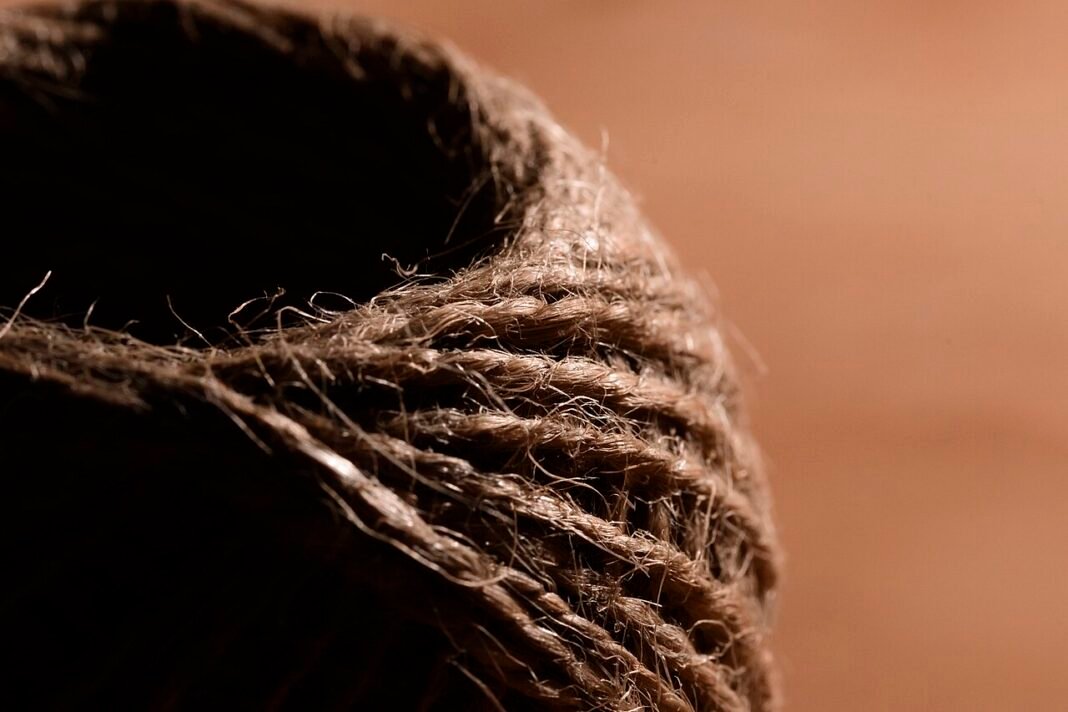

Here’s how to make hemp rope by hand: take a bundle of hemp fiber or twine, twist one half away from you until it kinks, then fold the other half over it in the opposite direction and repeat, so the two twisted strands lock around each other. That two-ply “reverse wrap” makes strong cord, and you can twist three of those cords together for a thicker rope.
For centuries, almost every rope on every sailing ship was made from hemp. You don’t need a quarter-mile ropewalk to make your own, though. This 2026 guide covers why hemp works so well, the tools and materials, two hand methods, how to join in new fiber, how to finish and care for natural rope, and a little history. Making rope from hemp fiber or twine you buy is legal and needs no license.
Key takeaways
- Rope holds together because each strand is twisted one way and the strands are twisted around each other the opposite way.
- Hemp’s long bast fibers are strong and were the standard material for naval rope.
- The two-ply reverse wrap needs only your hands and makes strong cord in minutes.
- Stagger your joins so two splices never land in the same spot.
- Keep natural rope dry and ventilated. Homemade rope is for crafts and light jobs, never climbing or lifting people.
Why hemp makes good rope
Hemp’s useful fibers grow in the outer layer of the stalk. A 2022 review explains that bundles of bast fiber in the phloem give the stalk its strength, that bast fiber is roughly 40 to 80% cellulose by dry mass, and that long hemp fibers are about as tough as flax (Materials, 2022). Penn State Extension notes hemp came to North America in the early 1600s and was used for rope, grain bags, Conestoga wagon covers and clothing (Penn State Extension).
The U.S. Navy relied on it. The National Park Service says that at the Charlestown Navy Yard ropewalk in Boston, which opened in 1838 and ran 1,325 feet, workers made rope up to a quarter mile long, and hemp was “the material of choice” because its long stalks could be separated into many long, strong fibers (National Park Service). A sailing ship like USS Constitution needed more than 40 miles of rope (National Park Service). During World War II, the USDA even made the film Hemp for Victory to promote hemp fiber for military use (USDA National Agricultural Library).


How twisting turns fiber into rope
A single twisted strand wants to untwist. Rope makers use that. If you twist two strands the same way and then let them wrap around each other the opposite way, each strand’s urge to untwist pushes it tighter around the other. Archaeologists describe a classic cord made of two S-twist strands plied with a Z-twist, noting the Z-twist keeps the two strands from unraveling (Texas Beyond History, University of Texas).
Big rope works the same way, just with more layers. The NPS describes three steps at the ropewalk: spinning fiber into yarn, twisting yarns into strands, and laying strands into rope, with each layer twisted opposite to the one before.
Materials and tools
| Item | Notes |
|---|---|
| Hemp fiber (line hemp or roving) or hemp twine | Twine is easiest for beginners. Raw fiber gives a rustic look |
| Spray bottle of water | Lightly dampening fiber makes it grip and twist evenly |
| Sharp scissors | Trimming fiber ends and finished rope |
| A hook, door handle or clamp | Anchors one end for longer cords |
| A hand drill with a hook bit (optional) | Speeds up twisting for three-strand rope |
| Grooved wooden block or a “top” (optional) | Keeps three strands laying evenly |
| Thin twine or tape | Whipping the ends so they don’t fray |
If you’re starting from your own hemp stalks, the fiber has to be retted and separated first. The review above lists dew retting, water retting and mechanical decortication among the methods, and warns that wet stems drying in the field can mold. Our guide to how to grow hemp covers growing it, which requires a state, tribal or USDA license.
How to make hemp rope with the reverse wrap: step by step
- Prepare a bundle. Take a pencil-thick bundle of fiber, or 4 to 6 strands of twine, about 2 to 3 feet long. Mist it lightly so it holds together.
- Find the off-center point. Fold the bundle at a point about one third of the way along, not exactly in the middle. Uneven ends mean your first join comes at different places on each strand.
- Make the starting kink. Pinch the fold between the thumb and finger of your left hand. With your right hand, twist the top strand away from you until it kinks into a small loop.
- Twist the far strand. Take the strand farther from you and twist it tightly away from you (clockwise when you look down its length).
- Wrap it toward you. Bring that twisted strand over the other one, toward you. It now becomes the near strand.
- Repeat. Twist the new far strand away from you, then wrap it over toward you. Move your pinch up every couple of turns so the twist stays tight.
- Keep the twist even. Aim for the same number of twists per inch. Loose spots become weak spots.
- Join in new fiber. When one strand gets about 2 inches from its end, lay a new bundle alongside it, overlapping a few inches, and keep twisting the two together as one strand.
- Finish the end. Tie an overhand knot or wrap a few turns of thin twine tightly around the end (whipping), then trim.
- Roll it. Roll the finished cord under your palm on a table to set the twist and smooth stray fibers.
Creek Stewart shows the reverse wrap by hand:

Sell hemp twine, fiber or textiles?
Hemp crafters read Hempland every week. Ask us about sponsored tutorials, product features and advertising for your hemp brand.
Advertise with us
How to make three-strand hemp rope
For thicker rope, make three equal cords (or three bundles of twisted yarn) first. Then:
- Tie the three strands together at one end and hang them on a hook.
- Twist each strand separately in the same direction, by hand or with a drill and hook, until they start to kink when you relax the tension.
- Hold the three free ends together, keeping them taut. A grooved block between the strands helps keep them apart.
- Slowly release or walk the block toward the hook. The strands will twist around each other in the opposite direction on their own.
- Guide them so the lay stays even, then tie or whip the end.
- Stretch the rope gently and let it rest for a day so the twist settles.

Projects to try
| Project | Method | Thickness |
|---|---|---|
| Garden plant ties | Two-ply reverse wrap | Thin |
| Bracelets and necklaces | Two-ply, or knotted twine | Thin |
| Jar handles and plant hangers | Two-ply or three-strand | Medium |
| Decorative coils and wall hangings | Three-strand | Medium to thick |
| Pet toys | Three-strand, tightly made, knotted ends | Thick; supervise use |
For a knotted project, see how to make a hemp bracelet. If you like hemp crafts, try how to make hemp paper too.
How to care for natural rope
Natural fiber rope can rot. A U.S. Navy training manual warns that fiber line deteriorates rapidly with prolonged dampness, so it should be stored in a dry, unheated, well-ventilated area in loose coils on a wood grating about 6 inches off the floor. Let wet rope dry fully before you put it away. It also warns that fiber rope shrinks when wet, so a tight line can overstrain, and that mildewed rope gives off a musty smell (U.S. Navy training manual). Check the inside of older rope by gently untwisting a section. Store it out of strong sun, too.
Common mistakes
- Folding exactly in the middle. Both joins land at the same spot and make a weak point.
- Twisting unevenly. Loose sections slip and fray.
- Forgetting to switch directions. If you twist and wrap the same way, it all unravels.
- Working with soaking wet fiber. Lightly damp is good; wet fiber dries loose and can mold.
- Skipping the finish. Unwhipped ends unravel fast.
Safety and legal notes
- Homemade rope isn’t rated for loads. Never use it for climbing, swings, towing, lifting or anything that could hurt someone if it fails.
- Hemp dust can irritate eyes and lungs. Work in a ventilated space and consider a dust mask when processing raw fiber.
- Keep sharp tools and drills away from kids, and supervise children who help.
- Under the 2018 Farm Bill, USDA oversees U.S. hemp production, and you need a state, tribal or USDA license to grow it (USDA AMS). Buying hemp fiber or twine to make rope needs no license. A new federal hemp definition passed in 2025 changes rules for cannabinoid products starting in late 2026, but it targets THC, not fiber. Check for updates if you plan to grow.
UVM Extension shows how hemp fiber is processed by hand before it’s spun:
Got a hemp craft question?
Stuck on a twist or working with raw fiber? Send us a message and we’ll do our best to help.
Contact Hempland
FAQ
Is hemp rope strong?
Yes. Hemp’s long bast fibers are tough and were the traditional choice for ship rigging. Homemade rope still isn’t safety-rated, though.
Can I make rope from hemp twine?
Yes. Twisting several strands of twine with the reverse wrap is the easiest way to start.
What’s the difference between cord and rope?
Cord is usually thinner, often two-ply. Rope is thicker and often three strands, each made of twisted yarns.
How do I stop hemp rope from fraying?
Whip the ends with thin twine, tie a knot, or dip the very tip in a little melted beeswax.
Does hemp rope rot?
It can if stored wet. Dry it thoroughly and keep it in a ventilated place off damp floors.
Sources
Image credits and disclaimer
Image disclaimer: Images in this post are displayed from their original sources (such as Amazon, Wikimedia Commons or Unsplash) and are not hosted on Hempland.net. Product images belong to their respective brands and retailers, and other images belong to their credited creators and are used under their stated licenses. Hempland.net claims no ownership of these images. About the images: because they are hotlinked from third-party sources, they may change or disappear, and they are for illustration only and may not show the exact product, plant or method described. If you own an image and would like it credited differently or removed, please contact us.
Medical and legal disclaimer: This article is for general information and educational purposes only and reflects details available as of November 2026. It is not medical, legal or financial advice. Cannabis laws vary by country and state and are changing in 2026, and cannabis products are intended only for adults 21+ where legal. Grow only where home cultivation is legal and follow local plant limits. Talk to a qualified healthcare professional before using cannabis, THC or CBD, especially if you are pregnant, breastfeeding, take medication or have a health condition. Do not drive or operate machinery after using THC. Any steps described are followed at your own risk. Mention of a company or product is not an endorsement. Hempland.net makes no warranties about the completeness or accuracy of this information and is not liable for any loss or damage arising from its use.

Sponsored Content
This informative article is brought to you by NUBO CBD →