







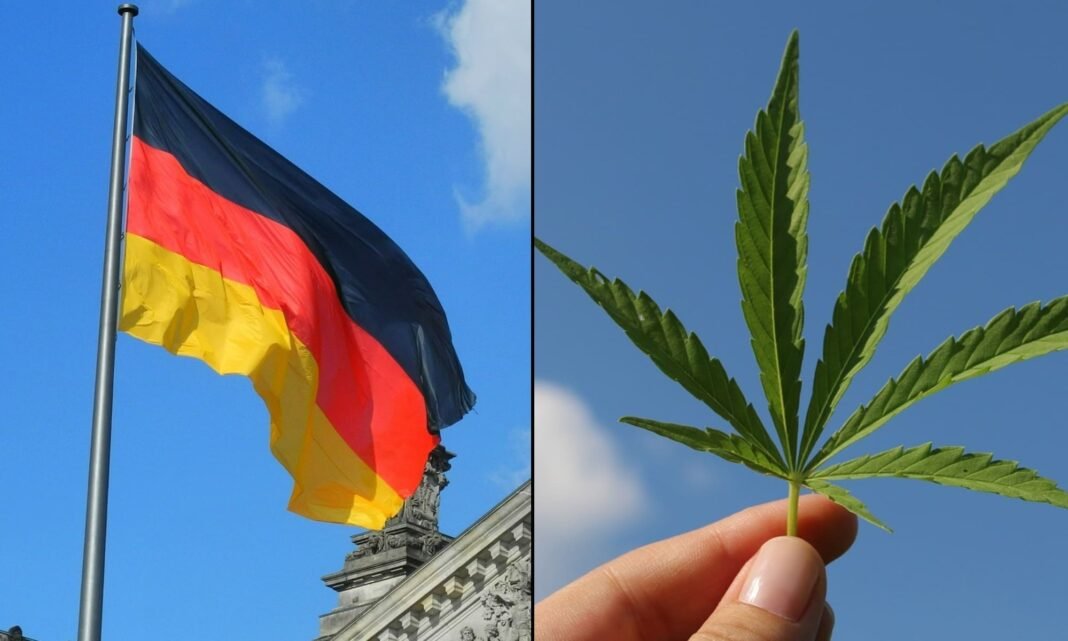

The German Federal Health officials conducted a new study that shows rates of cannabis use among young people have declined since the country’s legalization of adult-use marijuana last year. This contradicts one of the most common arguments used by prohibitionists against this reform.
Drug Affinity Study of the Federal Institute for Public Health, released on Tuesday, looked at marijuana usage trends for 2025. It found that rates for cannabis use by youth between the ages 12-17 dropped from 6.7% to 6.17% since 2023. Regular consumption (atleast ten times over the course of a year) decreased as well, from 1.3 per cent to 1.1percent.
The study found that cannabis consumption among young adults aged 18-25 increased from 23.3% to 25.6% between 2023-2025.
The former German health minister Karl Lauterbach spearheaded government’s plan for legalization. Lauterbach said that research results “confirm the goals of legalization: Through debates about the dangers to children and teenagers, their consumption has not increased or decreased,” according a translation.
He said, “Yet the results need to be verified.” “Bans don’t deter youth.”
The survey was conducted between April and July, this year.
In April 2024, Germany’s legalization laws came into effect. They allowed adults to grow and possess certain quantities of marijuana. Social clubs opened, giving members legal access to marijuana-based products.
Our data indicate that the consumption of alcohol among teenagers hasn’t increased. However, consumption has risen slightly among young adults, particularly among men between 18 and 25 years of age,” Johannes Nießen, acting director of the Federal Institute for Public Health, said in a press release. We must closely monitor the development.
Lack of proof that youth usage increased following legalization supports pro-reform arguments. Many advocates have argued that a regulated framework would reduce the access of minors to marijuana as adults move from illegal markets.
Similar trends have been observed in research conducted in the U.S.
Substance Abuse and Mental Health Service Administration published in July data showing that youth consumption of cannabis has not changed despite state legalization.
The agency also held a webinar in July in which a Johns Hopkins University researcher acknowledged that while self-reported cannabis consumption by adults has risen as more states have legalized, use by youth has generally remained flat or fallen.
A report from the advocacy group Marijuana Policy Project (MPP), for example, found that youth marijuana use declined in 19 out of 21 states that legalized adult-use marijuana—with teen cannabis consumption down an average of 35 percent in the earliest states to legalize. This report included data from national and state youth surveys including the Monitoring the Future (MTF), which is sponsored by the National Institute on Drug Abuse.
Separately, a Canadian government report found that the daily or nearly-daily usage rates of both youth and adults have remained stable over the past six years since the legalization.
Back in Germany, following a pivotal national election earlier this year, political parties that were cooperating to form a new coalition government announced that they would be conducting an “open-ended evaluation” of the country’s marijuana legalization law—meaning that at least for now, officials will allow the policy to stay in place.
—
MEDCAN24 has been tracking the hundreds of bills relating to cannabis, psychedelics or drug policies that have passed through state legislatures as well as Congress in this past year. Patreon subscribers who donate at least $25/month have access to the interactive maps and charts as well as our hearing calendar.
Find out more about our marijuana law tracker. To gain access, become a Patreon supporter.
—
In December, the federal minister for food and agriculture signed off on a plan to allow for research-focused commercial marijuana pilot programs to test legal and regulated access to cannabis for consumers.
At the local level, the city of Frankfurt late last year announced plans to move forward with a five-year pilot program that would make cannabis products available to adults more broadly , with the city of Hanford also pursuing a similar plan. A number of other localities have also expressed interest in conducting cannabis sales pilot projects.
Despite widespread concern that results of February’s election could spell doom for the legalization law, most Germans— 59 percent of eligible voters —support allowing adults to purchase cannabis from licensed stores.
In the three previous years, the support for the marijuana law was just below 50%. In the year that the new marijuana law was implemented in the country, the number of people who supported the policy changed.
Notably, respondents who identified as CDU or CSU—two of the three coalition parties behind the new agreement—were the only political affiliations among which majorities of voters supported rolling back the reform law.
German officials last year convened an international conference where leaders were invited to share their experiences with legalizing and regulating marijuana , with a focus on public health and mitigating the illicit market.
Burkhard Blienert, German commissioner for addiction and drug issues, invited representatives from Luxembourg, Malta and the Netherlands as well as Switzerland and the Czech Republic to a meeting in Berlin.
Different countries have different cannabis policies. Malta, for example, became the first European country to enact cannabis legalization in 2021. Luxembourg followed suit, with the reform officially taking effect in 2023 .
Government officials from several countries, including the U.S., also met in Germany in 2023 to discuss international marijuana policy issues as the host nation worked to enact legalization.
A group of German lawmakers, as well as Blienert, separately visited the US and toured California cannabis businesses in 2022 to inform their country’s approach to legalization.
The visit came after top officials from Germany, Luxembourg, Malta and the Netherlands held their first-of-its-kind meeting to discuss plans and challenges associated with recreational marijuana legalization in 2022.
MEDCAN24 could not exist without readers’ support. Consider a Patreon subscription if our marijuana advocacy journalism is what you use to keep informed.

Sponsored Content
This informative article is brought to you by NUBO CBD →