







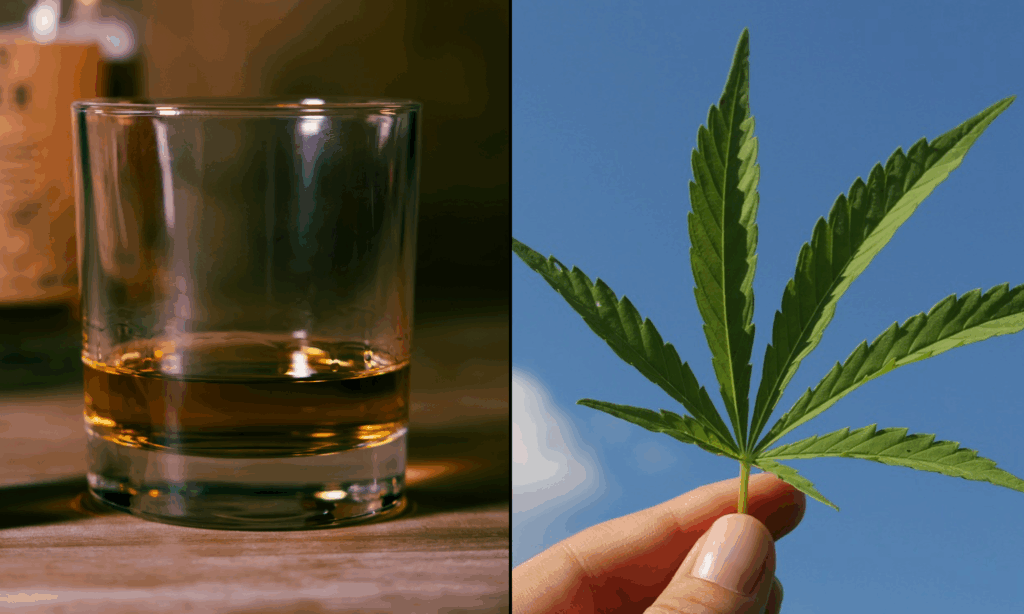

A coalition of major alcohol industry associations is throwing its weight behind a push to get Congress to ban intoxicating hemp products—at least on a temporary basis before the federal government creates a “robust regulatory framework” for the marketplace.
The hemp debate has been raging as lawmakers try to finish appropriations bills. On one side, some are pushing for controversial measures to ban cannabinoids that cause intoxication, and on the other, others have asked for an integrated regulatory system that will prevent the industry from suffering significant economic losses.
A new letter from the American Distilled Spirits Alliance (ADSA), Beer Institute (BI), Distilled Spirits Council of the U.S. (DISCUS), Wine America and Wine Institute seems to promote a middle-ground solution—but one the begins with a ban on hemp THC products as championed by Sen. Mitch McConnell (R-KY) and Rep. Andy Harris (R-MD).
The letter was sent to leaders of Congress on Tuesday. It states that alcohol associations align with a group consisting 39 Attorneys General from state and territorial governments who recently asked federal lawmakers to ban hemp-based products.
In the letter, it is stated that, “Our organizations represent some of the most valuable brands in the world, including beer, wine and distilled spirit, available throughout the entire country.
The ambiguous wording in the Farm Bill 2018 has unfortunately been exploited and manipulated by some actors. This is fueling the growth of an unregulated and largely unregulated industry that ignores the law and regulations. [Food and Drug Administration, or FDA] “We hold that adding intoxicating cannabinoids to foods (like delta-8 and delta-9 THC), is unlawful,” the report says.
“The rhetoric surrounding this issue is unfortunate,” the coalition said, adding that “certain entities, including some within the beverage alcohol space, claim that any effort to rein in the sale of highly intoxicating hemp THC products is tantamount to ‘prohibition’ or a ‘ban’ that will adversely impact industrial hemp farmers or even products that contain non-intoxicating cannabidiol (CBD).”
Wine & Spirits Wholesalers of America (WSWA), a key player in the space, is among those alcohol interests that have pushed back against the proposed prohibition. WSWA added a new company to its roster of members in September that produces THC-infused beverages.
The provisions which have been enacted in the last few months are not clear and leave room for interpretation. They also raise concerns about whether it is possible to market cannabidiol without traces of THC, or any other intoxicating cannabis cannabinoids.
In June, WSWA called on Congress to dial back language in a House spending bill that would ban most consumable hemp products, instead proposing to maintain the legalization of naturally derived cannabinoids from the crop and only prohibit synthetic items.
The other alcohol groups did not necessarily recommend that the government ban all intoxicating hemp-based products.
Manufacturers of beverage alcohol – one of most heavily regulated consumer goods – urge Congress to immediately act to remove hemp THC products until a strong federal regulatory framework has been established. “We are prepared to work with Congress to create regulations to protect consumers. We also want to ensure that these products can be sold in a secure, safe environment.”
In recent months there has been an increase in lobbying by major alcohol associations and companies in Congress. They are attempting to change federal hemp laws to focus on THC-based beverages, which many consumers use as alternatives to beer and liquor.
Some of those who signed this letter sent to the leaders of Congress are lobbyists on the subject.
As Congress continues to navigate a path forward on funding legislation to end an ongoing government shutdown, lawmakers are still at work attempting to reach a deal on federal hemp laws—with one GOP senator telling MEDCAN24 that multiple options are on the table, though it will ultimately come down to what leadership wants.
Two GOP lawmakers—McConnell and Harris—have pushed aggressively for an outright ban on hemp products containing THC. Others, such as Senator Rand Paul (R KY), have asserted that a change in policy would be disastrous for the hemp industry. Paul recently said he would go as far to block large-scale legislation in the event that a ban on all spending was maintained.
He also attacked the letter sent by the attorneys general of the states and territories, in which they pleaded with Republican leaders not to allow the marketing or hemp products containing intoxicants.
They’re banning hemp because some of the people who came to us from places that had legalized cannabis? He said, “It is ridiculous.” “So, they would prefer to have people consume a high dose of THC in cannabis over lower dose hemp products. This doesn’t even make sense.
—
MEDCAN24 tracks hundreds of marijuana, psychedelics, and drug policy legislation in state legislatures this year. Patreon subscribers who donate at least $25/month gain access to interactive maps, charts and a hearing calendar.
Discover more about the marijuana bills tracker. Become a patron on Patreon and you will have access.
—
As far as legislative options go, Paul did put forward legislative language recently to require a study and report on state regulatory models for hemp that could inform future revisions to the federal law—rather than prohibit sales altogether, as McConnell would have it.
In August, McConnell–who ushered in the federal legalization of hemp under the 2018 Farm Bill–took to the Senate floor to criticize those who opposed the ban, including Paul.
Meanwhile, Paul recently filed a standalone bill that would go in the opposite direction of the hemp ban, proposing to triple the concentration of THC that the crop could legally contain, while addressing multiple other concerns the industry has expressed about federal regulations.
He introduced legislation in June entitled the Hemp Economic Mobilization Plan Act. It mirrors versions he’s sponsored over the last several sessions.
Please read below the letter of the Alcohol Trade associations regarding federal hemp law.
MEDCAN24 would not be possible without the support of readers. Consider a Patreon subscription if our marijuana advocacy journalism is what you use to keep informed.

Sponsored Content
This informative article is brought to you by NUBO CBD →