



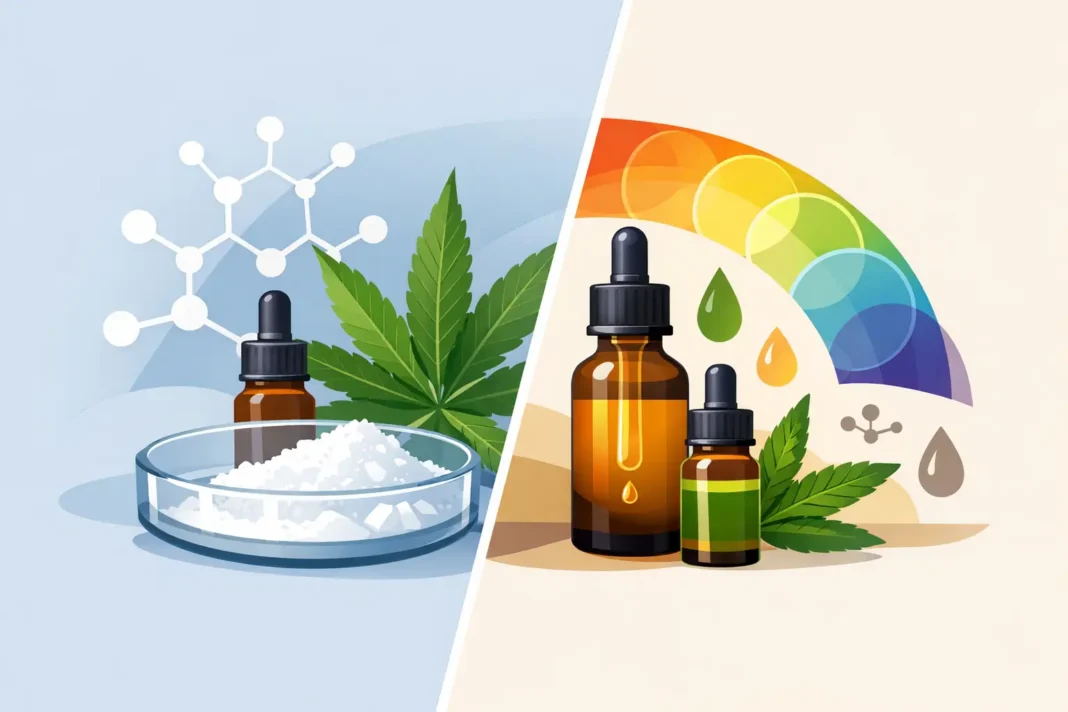

The label of a CBD product can appear straightforward, until a single phrase alters the purchasing decision. Patients, operators, and retailers who are tracking the fast-moving European markets often wonder not if they should use CBD but which CBD isolator is best for their intended purpose.
This distinction is important because the products tested, built and regulated in different ways. The first offers cannabidiol that is almost pure. One keeps more cannabis or hemp components in the final extract. This can have an impact on flavour, formulation and user experience.
CBD Isolate vs Full Spectrum: What’s the real difference?
CBD is stripped down to its bare essentials. The end product is usually refined to almost 100% CBD. It can be found as white powder, or as an ingredient in edibles, oils, and topical products. It is easy to commercialise: easier to standardise and formulate with a neutral taste profile.
Full spectrum CBD has a different design. CBD is present along with other cannabinoids naturally found in the extract, such as terpenes and flavonoids. It may also contain very little THC depending on product and jurisdiction. It is believed that by retaining more plant content, the performance of the CBD-only product may be improved.
It is more important to consider the specific problem that the product intends to address than which of the two is better. Full spectrum may be preferred by a consumer who wants a broad plant composition. Isolate is a good choice for a manufacturer who wants to ensure precision and minimum THC.
The importance of comparison in today’s market
CBD in Europe has evolved beyond the niche category of wellness. Hemp processing and consumer goods are now at its intersection. novel food debatesThe regulation of medicines and compliance with cross-border laws are important. This is when the CBD-isolate vs. Full Spectrum debate comes into commercial relevance.
Isolate can help brands reduce their formulation problems. This allows for a tighter control of cannabinoid levels and makes batch to batch consistency easier. This consistency can be an advantage for pharmacists, healthcare professionals, and readers who are interested in the health care industry.
The full spectrum still has a strong appeal to consumers because they associate it with an extract of hemp that is more complete. This perception stems from the “entourage effect”, the notion that cannabinoids may act differently when combined with terpenes than they do alone. Although the evidence is not yet complete, claims are often made before the science. However, the commercial narrative continues to be influential.
Although promising, the science has not yet been settled
Here is when the conversation becomes too simplistic. Full spectrum proponents often argue that a greater number of compounds will produce better results. Supporters of CBD isolated argue that CBD is purified and offers better dosing with fewer variables. The truth is that neither side tells the full story.
Scientists are interested in what effect combinations of cannabinoids, terpenes and other compounds have on efficacy or tolerance in specific contexts. Some early findings and preclinical studies suggest that formulations containing a broader range of extracts or whole plants may act differently than single-molecule products. It does not necessarily mean that full-spectrum formulations are more powerful or superior in terms of clinical efficacy.
Evidence quality varies greatly depending on conditions being addressed, doses used and exact product composition. Full spectrum isn’t a single category. The terpene profile, cannabinoid ratios or THC content of two oils labeled full spectrum could be very different. That makes making broad claims from the perspective of research and product comparability difficult.
In contrast, an isolate has a smaller compound profile. It can prove useful for researchers and formulators who want to test CBD using fewer factors that could cause confusion. A purified extract may not provide the same subjective experiences as a broader extract.
The THC substance changes the risk profile
THC is the most important factor in determining whether a product will be successful or not. If properly tested and manufactured, CBD isolates should not contain any THC. The full spectrum product may have trace levels of THC, which can cause problems even if it is a small amount.
Customers can also benefit trace THC The reason why it matters is because of the sensitivity involved, or workplace testing. Businesses are affected because there is no practical harmonisation of national rules in Europe, even though the EU has a broad framework that shapes the conversation. The same thing that is accepted in one country can lead to compliance problems on another.
It is especially important for white-label, imported products and online retailers. Even if a full spectrum oil appears to be acceptable, it may not be safe if certifications are old or if cannabinoid limits are misinterpreted. When enforcement is unpredictable, even a small amount of a compound can have a big impact.
The formulation of flavours and the manufacturing process
In terms of production, full spectrum and isolate behave in different ways. CBD isolates are attractive as they’re relatively clean and neutral. The CBD isolate can be added to carrier oils or cosmetics, and dissolved in them. It also has the ability to dissolve into edible formats.
Full spectrum extractions are complex. The complexity of full spectrum extracts can appeal to customers who are looking for a product that is closer to its original source. Formulation challenges are also introduced. It can also introduce formulation challenges.
It has implications for business. If a business is positioning itself as being able to offer premium botanical authenticity, full spectrum could be seen as a competitive advantage. Isolate may be more scalable for a brand looking to achieve mass market consistency with cleaner sensory qualities.
What makes people choose to isolate themselves?
Buyers who are looking for precision and a minimum of uncertainty will often be drawn to Isolate. This can be first-time CBD consumers, those who are trying to stay away from THC, product formulators creating products that have specific cannabinoid goals, and companies selling in markets with narrow compliance margins.
The product is also suitable for those who do not like the taste or texture of hemp extracts, and who wish to include CBD in a product but without changing it too drastically. It is obvious that isolates are valuable in industries where reproducibility is important.
Some users may find that isolate is less balanced in its effect or less aligned to what they would expect from an extract derived from cannabis. This is subjective, but the issue comes up enough on the market to influence demand.
What is the most common reason for choosing full spectrum?
Full spectrum products are often more popular with CBD experts, those who want a wider hemp profile, and brands which market around the plant’s synergy instead of focusing on a single ingredient. Full spectrum products can have a premium, specialist image in retail, even if the evidence isn’t always there to support it.
Complication is the price of complexity. The product labeling must be transparent, the testing must be reliable and users should be aware that traces of THC can be found. Some buyers find this acceptable. Others find it difficult to stop.
In general, full spectrum makes more sense when the consumer is concerned with plant completeness or prefers a broader cannabinoid spectrum. Where purity, neutrality, and THC-free cannabis are priorities then isolate may be the best choice.
Checklist for buyers before they make a purchase
Label claims are only the beginning in this category. Serious buyers should look for current laboratory tests, cannabinoid breakdowns, and sufficient product information in order to determine whether an extract is full spectrum, isolate or broad spectrum.
This last point is important because full spectrum and broad spectrum are often mistaken. The products that are considered broad spectrum retain multiple cannabinoids, terpenes and THC but reduce it to almost undetectable levels. Some consumers find this a good compromise. Some brands find it the most commercially feasible compromise.
The quality of a product is also affected by the source material used, the extraction process and consistency in batches. An isolate that is well made can perform better than an oil with a poor control, or vice versa. Labels based on category do not substitute manufacturing standards.
Regulation is a critical aspect that cannot be overlooked
Regulation is at the heart of all discussions for European operators. Novel food enforcement THC thresholdsThe CBD format that is viable depends on a number of factors, including cosmetics regulations, national drug interpretations, and marketing restrictions. As a result, product selection isn’t solely driven by consumer preferences or science.
It may be difficult to market a full-spectrum product in stricter regulatory environments. It may be easier to prove and justify a formulation that is based on an isolate. This tension will likely remain, as authorities and the market continue to examine cannabinoid claim.
For a magazine like MEDCAN24 this is when the story goes beyond consumer education into industry intelligence. The isolate-versus-full-spectrum question is also a supply-chain, compliance and product strategy question.
It is best to start by comparing CBD isolate and full spectrum. Then, work your way backwards, examining the evidence, testing, and regulations. After checking the labels, laboratory reports and legal frameworks, you will find that the best choice is usually not the loudest option.