







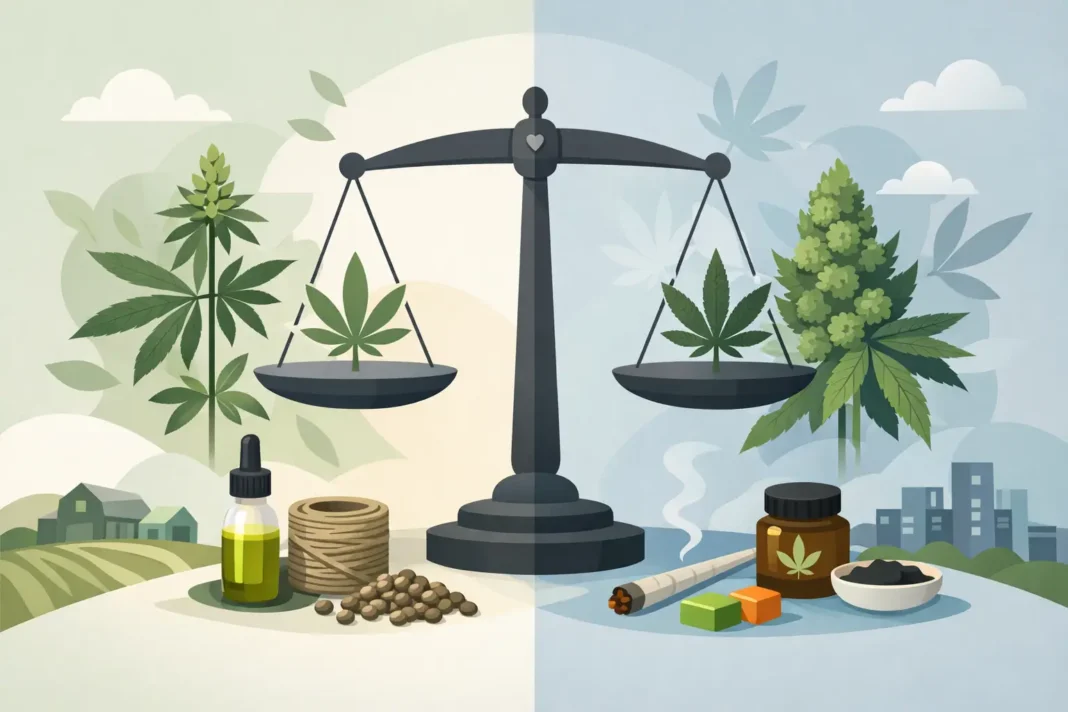

A product label says hemp. A regulator says cannabis. A patient sees CBD on both. That gap between marketing, law and plant science is exactly why hemp vs cannabis differences still create confusion across Europe.
The short version is that hemp and cannabis are not two entirely separate plants in the way apples and oranges are separate. Hemp is generally a legal and commercial classification used for cannabis varieties with very low THC, while cannabis is the broader plant category that also includes higher-THC varieties used in medical and adult-use markets. The distinction matters because a small change in THC content can shift a product or crop from agricultural commodity to controlled substance.
Hemp vs cannabis differences in plain terms
At the botanical level, hemp and what many consumers call cannabis or marijuana come from the same species complex, most commonly Cannabis sativa L. In commercial and regulatory use, however, the words do different jobs. Hemp usually refers to cannabis cultivated for fibre, seed, cannabinoids such as CBD, or industrial applications, provided it remains below a legal THC threshold. Cannabis, in broader industry language, can refer to the plant as a whole, but in everyday use it often means high-THC varieties associated with medical or adult-use consumption.
That is where confusion starts. One term is often legal and economic. The other is botanical, cultural and political all at once. In practice, lawmakers tend to care less about what the plant looks like and more about its cannabinoid profile, especially delta-9 THC.
Across Europe, this distinction is not perfectly harmonised. Different member states and regulators apply different thresholds, licensing regimes and product rules. For businesses, that means hemp vs cannabis differences are not just academic. They affect sourcing, import risk, novel food compliance, labelling, cultivation permits and advertising restrictions.
The THC threshold is the main dividing line
If there is one metric that defines the market split, it is THC concentration. Hemp is typically defined by law as cannabis containing no more than a specified percentage of THC. In many jurisdictions that threshold has sat at 0.2% or 0.3%, though the exact number depends on the country and legal framework involved.
That threshold is not a scientific cliff edge. A plant at 0.29% THC is not biologically transformed compared with one at 0.31%. But from a compliance standpoint, the difference is enormous. One may qualify for agricultural cultivation and commodity-style processing, while the other can trigger narcotics controls, crop destruction or criminal exposure.
This is also why farmers and processors pay close attention to genetics, weather, harvesting windows and testing methods. THC levels can rise during cultivation or appear differently depending on whether regulators assess dry weight, finished product concentration or total potential THC after decarboxylation. Those are not minor technicalities. They influence whether a hemp crop remains marketable.
Why CBD adds to the confusion
CBD appears in both hemp and higher-THC cannabis varieties. Consumers often assume CBD equals hemp and THC equals cannabis, but the chemistry is more mixed than that. Hemp can be rich in CBD, and cannabis grown in medical settings can also contain substantial CBD alongside THC or other cannabinoids.
The real difference is not that one plant has CBD and the other does not. It is that hemp products are usually developed from low-THC cultivars, while medical cannabis products may be formulated across a much wider cannabinoid spectrum. That wider range gives clinicians and manufacturers more flexibility, but it also places products under stricter controls.
Cultivation goals are not the same
Another useful way to understand hemp vs cannabis differences is to look at what growers are trying to achieve. Industrial hemp is typically bred and cultivated for one of three commercial outputs: fibre, seed, or cannabinoid extraction. High-THC cannabis is usually grown for flower quality, cannabinoid expression, terpene profile and pharmaceutical consistency.
Those goals lead to different farming and processing models. Fibre hemp is often planted densely, grown tall and harvested at scale. Seed hemp prioritises grain yield and crop efficiency. Cannabinoid hemp sits somewhere in between, with more attention on flowers and extraction value. Medical cannabis cultivation, by contrast, tends to be tightly controlled, lower-volume and more compliance-heavy, especially under GMP-oriented frameworks.
This distinction matters for investors and operators. A company in hemp textiles is not playing the same market game as a medical cannabis producer seeking flower approvals or prescription access. The word cannabis may cover both sectors, but the economics are very different.
Legal status depends on product category, not just the plant
A recurring mistake in this space is to assume that if a plant is legal hemp, every product made from it is automatically legal. That is rarely true. Regulators often distinguish between cultivation, raw materials, extracts, finished ingestibles, cosmetics, smoking products and medicines.
A hemp seed oil used in food may face one set of rules. A CBD extract may fall into novel food scrutiny. A vape product can raise a separate set of safety and advertising concerns. A flower product sold for smoking may be restricted even if it comes from low-THC hemp. Meanwhile, a medical cannabis preparation containing THC may be lawful under prescription channels but prohibited in ordinary retail settings.
For European operators, this layered approach is one of the central commercial realities. Legal hemp cultivation does not remove the need for product-by-product assessment. It just moves the discussion into a different regulatory lane.
Why nomenclature matters for business
How a company describes a product can affect enforcement risk. Calling something hemp-derived may support a low-THC positioning, but it does not override pharmaceutical, food, narcotics or consumer protection rules. Equally, describing all cannabis as narcotic can flatten meaningful distinctions between industrial hemp, wellness products and prescription medicines.
This is where careful language becomes a strategic issue. Policymakers, investors and operators need terms that reflect both chemistry and law. Loose phrasing can create compliance problems or mislead consumers.
Medical use is where the gap becomes most visible
In healthcare settings, the practical difference between hemp and cannabis becomes clearer. Hemp-derived products are often marketed around wellness, cosmetics or general consumer use, depending on local rules. Medical cannabis products are positioned around diagnosed conditions, prescription oversight, dosage standardisation and clinical pathways.
That does not mean hemp has no medical relevance. CBD isolate or purified cannabinoids originating from hemp can feature in medical development and research. But once a product makes medicinal claims or enters regulated prescribing systems, the discussion usually shifts away from simple hemp branding and towards evidence, manufacturing standards and authorisation.
For patients and clinicians, that distinction matters. A low-THC CBD product bought in a shop is not interchangeable with a prescribed cannabis medicine, even if some ingredients overlap. The route to market, quality controls and intended use are different.
Consumer perception still lags behind industry reality
Public understanding has not kept pace with market development. Many people still treat hemp as automatically non-psychoactive, universally legal and inherently safer, while viewing cannabis as uniformly intoxicating and illicit. Neither view holds up well under scrutiny.
Hemp products can still raise safety and compliance questions, especially around contamination, inaccurate labelling or unsupported claims. Cannabis products can be tightly regulated, medically supervised and manufactured to high standards. The issue is not simply hemp good, cannabis risky. It depends on formulation, dose, quality assurance and legal context.
That nuance is particularly relevant as Europe’s cannabinoid market matures. Retail growth, cross-border trade and policy reform are forcing more precise distinctions between industrial use, wellness positioning and medical access.
What businesses and readers should watch next
The next phase of the sector will likely be shaped less by slogans and more by technical definitions. THC testing methodology, novel food decisions, flower enforcement, synthetic cannabinoid scrutiny and medical access reform will all influence how hemp and cannabis are separated in practice.
For operators, the commercial question is not just whether a product comes from hemp or cannabis. It is how regulators classify that product at each stage of the chain. For readers tracking policy and market signals, that is the more useful lens.
The most credible way to read hemp vs cannabis differences is to stop treating them as fixed opposites. They sit on the same botanical spectrum, but law, medicine and commerce draw different lines through that spectrum depending on the use case. In a market moving as quickly as this one, the winners will be the people who pay attention to where those lines are shifting next.