







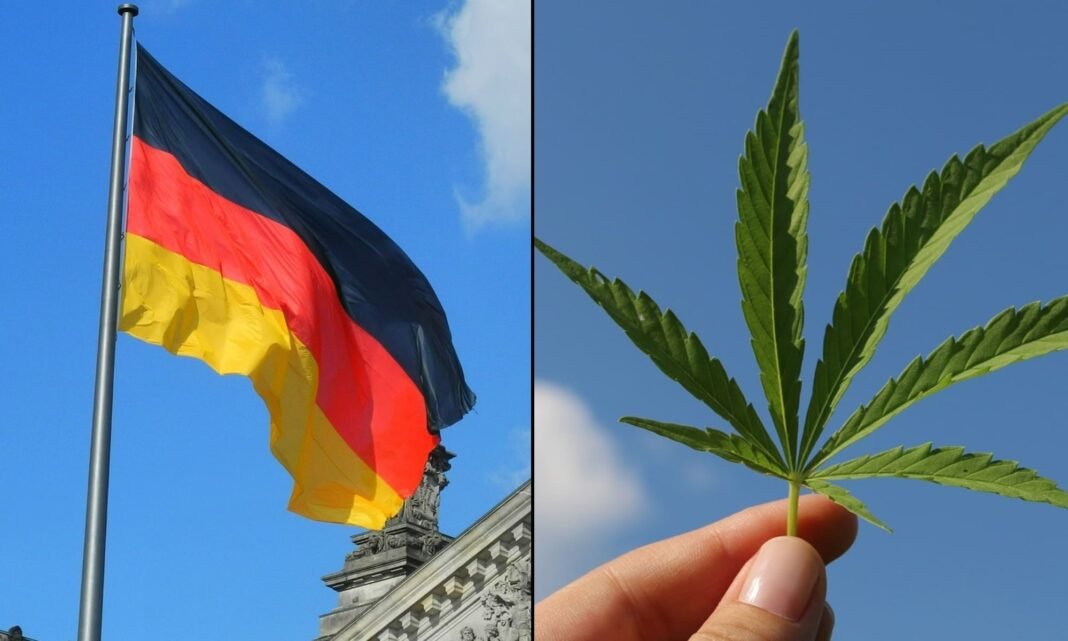

German officials recently released a comprehensive report on the impacts of legalizing marijuana in the country. They found that concerns from opponents over youth use, road safety, and many other issues were largely unfounded. The illegal market, however, has not been reduced significantly under the legal model implemented in Germany to date.
The report assessed the impact of the legalization of cannabis on health, safety, and the economy.
One of the findings that was published Monday, is that youth use of marijuana has decreased even after home cultivation and possession were legalized and clubs for members to access them opened.
Translation: The report conducted for the Federal Ministry of Health states that “no changes were observed in the trend of cannabis consumption by adults.”
“The percentage increase in adults who have consumed cannabis in the last 12 months, which has been observed since approximately 2011, is likely to continue…without any drastic changes,” it says.
The German Federal Health officials conducted a second study that found rates of marijuana usage among youth decreased following the legalization of adult cannabis in Germany.
Researchers found that the legalization change had not resulted in any meaningful changes to traffic incidents.
“In the area of road safety, partial legalization has so far shown no significant changes in self-reported driving under the influence of cannabis or in the number of people killed or injured in road traffic,” the report states.
Report: Early evidence on the effect of legalization of illicit drugs on the market suggests that “the law hasn’t yet contributed significantly to displacement of black market, intended by the legislator,” according to the report.
One reason for the continued presence of the illegal market could be related to how Germany’s legalization law is being rolled out, with a limited number of social clubs that grow cannabis for members to consume—but without a comprehensive commercial industry that could provide wider access to adults. It may be a while before the market is fully populated with legal products, even after a broad retail rollout, as it has taken in Canada, the United States, and other states to implement the law.
The report states that, for now, in order to shift the German population to the legal cannabis market “the approval process and the operation of the cultivation associations should be simplified.”
The report also states that current data does not support a change in the 25-gram possession limit.
Carmen Wegge, MP for the Social Democratic Party of Germany (SPD), said that “the first interim review published today confirms legalizing marijuana was the right thing to do and was long overdue.”
The independent evaluation showed that there was no increase in adult cannabis consumption and, even more importantly, a decline amongst minors. It also revealed no adverse effects on adults’ health and a significant decrease in criminal prosecutions. But the message in the end is very clear. Partial legalization will protect the health of adults and increase the state’s capacity to take action.
Nina Warken of the Federal Health Ministry, who is also a Christian Democratic Union member and an opponent of legalization, has said that the data so far shows “worrisome trends” despite the fact there have been no additional statistics collected in some regions.
The coalition and security agencies will need to be involved in any discussion about possible actions.
Karl Lauterbach, the former German health minister who led the legalization effort, said in response to the report that “cannabis use among youth continues to decrease despite the legalization.”
He said, “It was expected. Other countries show the same tendency.” If one is to fight the black market then cultivation clubs should not be hindered. Consuming cannabis is not criminal.
Former MP Kristine Lütke, who was one of the most vocal champions of legalization, said the report shows “there is no urgent need for action.”
It is encouraging to see that children and teenagers aren’t consuming more cannabis than they did before the partial legalization. “The trend is declining,” said she.
The final impact report of the legalization of marijuana in Germany should be available in April 2028.
The German law legalizing marijuana took effect on April 20, 2024. It allows adult cannabis users to have and cultivate certain amounts. Also, social clubs opened to provide members access to legal marijuana products.
Following a pivotal national election earlier this year, political parties that were cooperating to form a new coalition government announced that they would be conducting an “open-ended evaluation” of the country’s marijuana legalization law—meaning that at least for now, officials will allow the policy to stay in place.
—
MEDCAN24 has been tracking the hundreds of bills relating to cannabis, psychedelics or drug policies that have passed through state legislatures as well as Congress in this past year. Patreon members who pledge at least $25/month gain access to interactive maps, charts, and the hearing calendar.
Find out more about our marijuana law tracker. To get access, become a Patreon supporter.
—
In December, the federal minister for food and agriculture signed off on a plan to allow for research-focused commercial marijuana pilot programs to test legal and regulated access to cannabis for consumers.
At the local level, the city of Frankfurt late last year announced plans to move forward with a five-year pilot program that would make cannabis products available to adults more broadly , with the city of Hanford also pursuing a similar plan. A number of other localities have also expressed interest in conducting cannabis sales pilot projects.
Despite widespread concern that results of February’s election could spell doom for the legalization law, most Germans— 59 percent of eligible voters —support allowing adults to purchase cannabis from licensed stores.
Prior to the last three years of polling, Germans’ support was at just over 50 percent. As the marijuana laws in Germany were implemented, support for the change increased.
Notably, respondents who identified as CDU or CSU—two of the three coalition parties behind the new agreement—were the only political affiliations among which majorities of voters supported rolling back the reform law.
German officials last year convened an international conference where leaders were invited to share their experiences with legalizing and regulating marijuana , with a focus on public health and mitigating the illicit market.
Burkhard Blienert, German commissioner for addiction and drug issues, invited representatives from Luxembourg, Malta and the Netherlands as well as Switzerland and the Czech Republic to attend the Berlin meeting.
Different cannabis policies were adopted by the countries participating in this ministerial. Malta, for example, became the first European country to enact cannabis legalization in 2021. Luxembourg followed suit, with the reform officially taking effect in 2023 .
Government officials from several countries, including the U.S., also met in Germany in 2023 to discuss international marijuana policy issues as the host nation worked to enact legalization.
A group of German lawmakers, as well as Blienert, separately visited the US and toured California cannabis businesses in 2022 to inform their country’s approach to legalization.
The visit came after top officials from Germany, Luxembourg, Malta and the Netherlands held their first-of-its-kind meeting to discuss plans and challenges associated with recreational marijuana legalization in 2022.
MEDCAN24 could not exist without readers’ support. Please consider making a Patreon monthly pledge if you depend on our cannabis journalism for information.

Sponsored Content
This informative article is brought to you by NUBO CBD →