





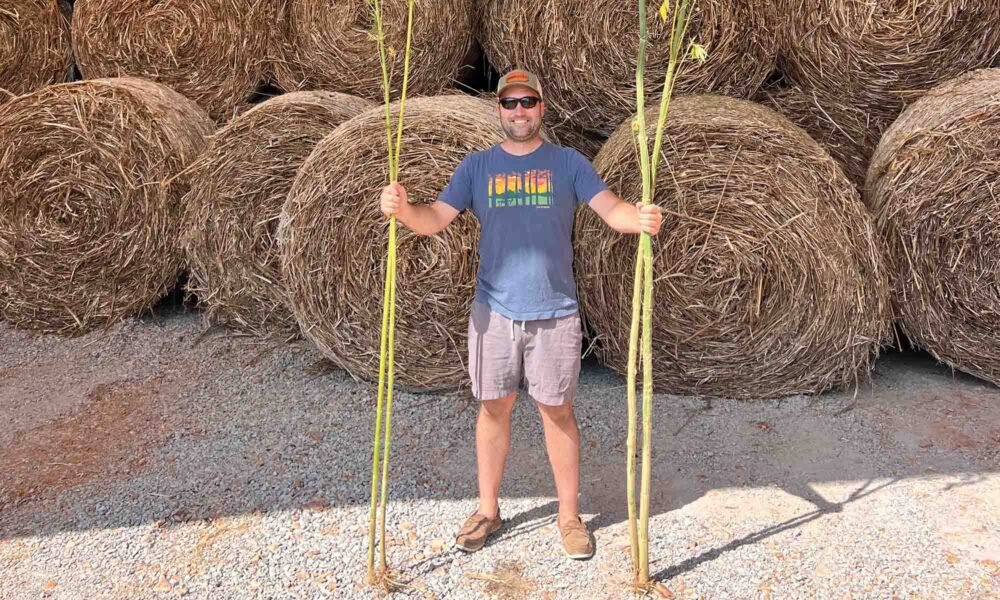

“The first thing a lot of people ask me is ‘can you smoke it?'” Gregory Wilson, the founder of HempWood laughs. He doesn’t want to grow the Cannabis sativa as an intoxicant for commercial purposes. He started to work with hemp for the exact opposite reasons.
Wilson runs a 171-acre farm on Murray, KY where he grows hemp, mushrooms and garlic, and raises chickens, cows and pigs. He cares about where his food comes from and what goes into his body—and he thinks the same level of caution and care should factor into what goes into your home and its building materials.
He spent 14 years in China engineering wood flooring from bamboo—a process that uses formaldehyde to bind the filaments together. “I have all kinds of health problems as a consequence,” he claims.
Wilson is an inventor and entrepreneur who was well positioned when hemp became legal to use as wood flooring. The process he developed for HempWood uses a soy-based adhesive which didn’t work as well with bamboo—a plant with a waxy, oily outer layer.
In 2018, hemp was legalized in Kentucky. After filing some patents, he moved to Murray to work in a region that has historically produced hemp since the pioneer days until 1970 when it became illegal. He started HempWood, a company that will be named “Coolest Things Made in Kentucky 2024” (by the Kentucky Association of Manufacturers) for its hemp-based flooring, which is beautiful, eco-friendly, and zero-VOC.
HempWood grows their own hemp—approximately 300-400 acres annually, and also sources from other local hemp farms. The hemp stalks, once harvested, are converted into wood and the waste hemp is used as heat for production.
In August 2025, Sen. Rand Paul (R-KY) performed the ceremonial “board-cutting” to celebrate the company’s addition of a second factory on the Murray campus—one for the creation, sawing and drying of HempWood (the block mill, 16,450 sq. In August 2025, Sen. Rand Paul (R-KY) performed the ceremonial “board cutting” to celebrate the company’s addition of a second factory on its Murray campus – one for creating, sawing and drying HempWood (the block mill, 16,450 sq. ft.). HempWood’s story is just beginning. Wilson says that “we’re the newest kids on the block.” Only about 6 percent of Americans have heard of HempWood. Wilson’s first successful hemp wood product was developed in 2010. For Wilson, it seems like a lifetime.
HempWood has many advantages. The product is healthy, environmentally friendly, made in the USA, 20% stronger than hickory and is priced about the same for domestic lumber. Yet it faces unique challenges because it’s derived from a plant with ‘cannabis’ in its name. Wilson states that “this is more stressing than bamboo.”

Wilson is in a field that’s often impacted by domino-effects of political politics. People are increasingly unsure about hemp.
For a time, public schools bought a lot of wood (the VOC free nature of the material makes it safer for children), but these projects are now on hold after the Department of Education frozen Kentucky Schools’ $87m funding last summer. HempWood also was specified for two USDA building, but due to budgetary restrictions the federal government frozen the project. Wilson, who is a farmer himself, says that “everything was frozen and stunned”. It will return.
What’s the reason? In less than 6 months, Hemp can grow from seed into lumber. There’s no arguing here—trees, even softwood trees that grow faster than hardwood, need decades to grow mature enough to create lumber. Bamboo grows much quicker but takes three to five more years.
Wilson states, “About 30% of the people don’t like hemp.” “Another 30 percent love it for that reason—he estimates their wood is in about 200 dispensaries nationwide—and the rest are only motivated by price and quality. Wilson’s creation is of the highest quality. Woodworkers can achieve an almost cork like look by using the long hemp strands to give their wood a “grain”.
So, no, you can’t smoke it—but imagine what else you can do with it.

HempWood founder Gregory Wilson loves to showcase the projects that woodworkers make from his product—just check their Instagram account. Wilson ordered HempWood from Marc Lauver two years ago. Marc makes arrows and bows. Wilson gave Marc an extra piece of wood and asked how much the bow would be for him. Marc stopped making bows shortly thereafter due to a medical issue. Wilson was informed and sent Lauver a package of care while he recovered. This year, on his birthday, Wilson opened a package from Lauver—it was this bow. Wilson describes it as “the coolest thing I’ve ever experienced this year”.
This story was originally published in issue 52 of the print edition of Cannabis Now.
Sponsored Content
This informative article is brought to you by NUBO CBD →