







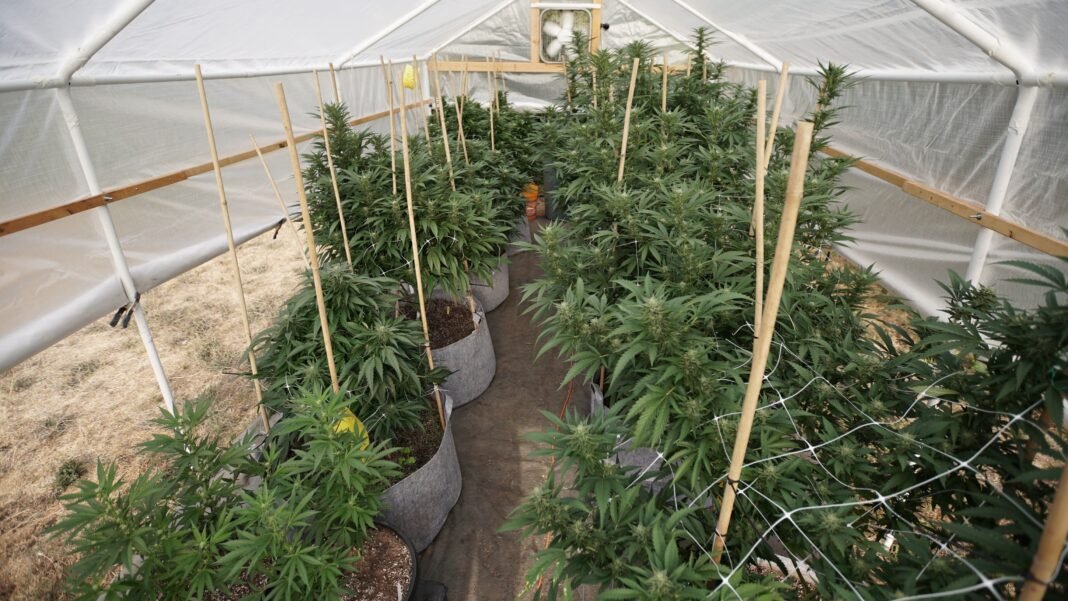

Michigan is “in many ways a sort of central location for illegal operations because of the low penalties here for illicit activities.”
By Ben Solis, Michigan Advance
A House panel considered four bills related to marijuana on Thursday. One bill aimed to alter the rules on how much marijuana, either in its plant or concentrate form, a person can legally possess.
The House Regulatory Reform Committee did not modify or advance House Bills 5104, 5105, 5106, and 5107.
Derek Sova is a policy and legislation assistant at the Cannabis Regulatory Agency. He told the Michigan Senate Committee that the legal marijuana market faced many challenges. Two of these were the large illegal grow operations, as well as the inability for the Cannabis Regulatory Agency to pursue bad actors whose licenses have expired.
The bills being considered by the committee will address these concerns.
House Bill 5105 and House Bill 5107 are sponsored by state Reps. Pauline Wendzel (R-Watervliet) and Mike Hoadley (R-Au Gres), respectively. Both bills will create penalties for those who cultivate, deliver and process black market cannabis, and also alter the maximum amount of marijuana that can be legally owned in both plant and concentrated form.
These bills have been tied together. They both need to be approved by the Legislature, and then signed by the Governor to become law.
According to Wendzel’s bill, someone would be guilty of misdemeanor possession if they have between 10-25 kilograms or 50-100 plants or 1 to 2.5 kilograms marijuana concentrate. A person could face up to an year in prison or a fine of $20,000, or even both.
Keep between 25-125 kg, between 100-500 plants, between 2.5-12.5 kilograms or marijuana concentrate, and you’ll be charged with a crime punishable by up to two years imprisonment or $500,000 in fines.
The following would be considered a criminal offense:
- You can keep between 125-250 kilograms or 500-1,00 plants or 12.5-25 kilograms. A person could be sentenced to four years of prison, or fined $2 million.
- Keep at least 250 kilograms of concentrate marijuana, more than 1,000 plants, more than 25 kilograms. You could face up to ten years of prison time or a fine of $10 million, or you can get both.
Sponsored by state Rep. Kristian Grant (D-Grand Rapids), House Bill 5104 would allow the Cannabis Regulatory Agency to sanction a person even if they are no longer a licensee or if they are no longer operating a marijuana facility.
Under the Medical Marihuana Facilities Licensing Law, an expired state license ends the authority for the licensing agency to issue sanctions. Grant’s bill retains this, but also adds that the agency would still be able to sanction a licensee if an action is already in progress against them.
Jerry Neyer’s (R-Shepherd) House Bill No. 5106 would amend California’s Regulation and Taxation of Marihuana Act in order to address the same issue with recreational licenses. This bill allows the state to summarily revoke a recreational license when the conduct of the licensee poses a threat to public health or safety.
Neyer’s bill would give an agency the authority to take action against someone who has lost their license, or recently had it expire.
According to the bill, the risks of license suspension or disciplinary action include: possessing marijuana obtained from an unknown source, maintaining marijuana stashes acquired in violation, hindering an investigation by the agency, and not providing the required records.
Neyer’s bill impacts growers, processors and retailers. It also affects microbusinesses.
Emily Dievendorf, a state representative from Lansing (D), said that she was concerned by the increase in enforcement. She noted that many people in the marijuana industry were on one side of enforcement in Michigan when it used to be illegal. She asked if it was fair to raise enforcement while the state is actively taxing marijuana at a much higher rate. Some have said that this will push people to the blackmarket.
Sova stated that the purpose of the package is to help the licensed industries as much as they can, and especially those who follow the rules.
Sova stated that “that’s why we need to have more enforcement power over bad actors who violate the licenses and who undermine the good guys who do things the right way.” This has, I think, been an issue in the communities that have had large illegal outdoor growers. The statutes currently in place don’t discourage people from growing thousands, if not tens, of thousands, of plants.
Sova also said Michigan had “become in a number of ways a center for illicit operations due to the low penalties here for illicit activity.”
The committee chair, State Rep. Joseph Aragona of Clinton Township (R), said that he agrees with Dievendorf.
The 24 percent was “difficult”, he added. We didn’t want to pass this in the House but, it will definitely benefit those who have to pay the tax.
Sova confirmed that the current legislation was intended to do just this.
Hoadley testified alongside Iosco County Attorney Jim Bacarella, and Branch County Assistant Prosecutor Zach Stempien. Both supported the bill and voiced concern about those who work in the field. The prosecutors raised concerns about the abuse of foreigners or migrant workers during their testimony.
The original publication of this story is Michigan Advance.
Side Pocket Images. Photo by Chris Wallis.
Sponsored Content
This informative article is brought to you by NUBO CBD →