







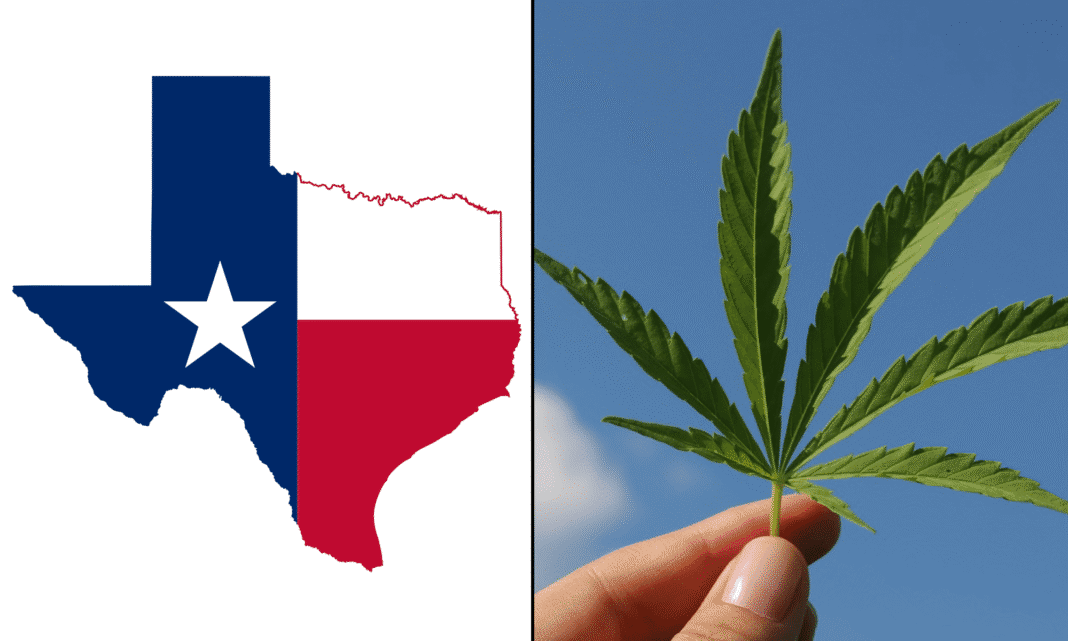

Texas has quickly changed its hemp laws to reflect the recent governor’s executive order. This means that people younger than 21 years old will not be allowed to buy consumable hemp-based products.
Texas Alcoholic Beverage Commission – TABC – issued an urgent rule on Tuesday that came into force. The rule stipulates that all businesses that are licensed with the agency can’t sell marijuana to people under 21. This will result in the automatic cancellation of your license or permit.
If you fail to verify the age of a customer, your license will be automatically revoked.
The TABC issued a warning that said: “This adoption of emergency measures is essential to protect minors against accessing or using hemp-based products for consumption (CHP), as this could negatively impact their health and, in turn, negatively impact public welfare and safety.”
It was only two weeks ago when Gov. Greg Abbott, a Republican, signed an executive ordering new hemp regulations. According to the USDA, these rules will take effect as soon as possible because they are adopted in an “emergency” manner.
It said: “The harmful effects of cannabis/THC consumption by minors have been well documented.”
State statute says emergency rules can only be effective for up to 180 days, and TACB said it ‘intends to propose these or similar rules under the normal rulemaking process and will consider any additional action necessary in the event unforeseen issues arise with the adopted sections. The future rulemaking process may provide further guidance.
The agency has stated that enforcement will start on October 1st, even though the regulations are currently in force.
Texas Cannabis Collective (TABC), which has strongly opposed recent legislative proposals to ban any hemp that contains THC at all, stated the TABC’s action as “following Governor Abbott’s decisive step earlier this year”, when he vetoed a Senate Bill to recriminalize cannabinoid-containing products.
Meanwhile, Texas officials have separately taken another step toward implementing a law to significantly expand the state’s medical marijuana program—proposing rules to to let physicians recommend new qualifying conditions for cannabis and to create standards for allowable inhalation devices in line with legislation enacted by lawmakers and the governor earlier this year.
Last month, the Department of Public Safety (DPS) also posted a set of additional rules in the Register to increase the number of licensed medical marijuana dispensaries in Texas under the recently enacted legislation.
DPS is expected to issue 12 licenses in the future for new dispensaries throughout the state. At the moment, there are just three. Additional licensees are selected through a competition, and officials will prioritize the public health regions of Texas to maximize access.
Nine of the 139 applicants that submitted forms in a previous application window, 2023, will receive the first round. DPS will choose these nine licensees by December 1. The applicants from 2023 who did not receive a licence, and any potential new licensees can have another opportunity to get their license in a second phase, where the awardees are announced on April 1st, 2026.
DPS has separately outlined future rules to be implemented in compliance with the Medical Marijuana Expansion Law.
That includes proposals to establish “security requirements for dispensing organization satellite locations if approved by the department,” creating rules to revoke licenses for dispensaries that fail to dispense cannabis within two years of a license issuance and setting a timeline for “reviewing and taking action on dispensing organization licenses.”
—
MEDCAN24 tracks hundreds of marijuana, psychedelics, and drug policy legislation in state legislatures this year. Patreon members who pledge at least $25/month gain access to interactive maps, charts, and a hearing calendar.
Find out more about our marijuana law tracker. To gain access, become a Patreon supporter.
—
In Texas, another bill, HB 195, introduced by Rep. Jessica González (D), would have legalized marijuana for people 21 and older, allowing possession of up to 2.5 ounces of cannabis, with no more than 15 grams of that amount being in concentrated form—but it did not advance.
AnonMoos. Image element.
MEDCAN24 could not exist without readers’ support. Consider pledging a monthly Patreon if our marijuana advocacy journalism is what you use to keep informed.

Sponsored Content
This informative article is brought to you by NUBO CBD →