






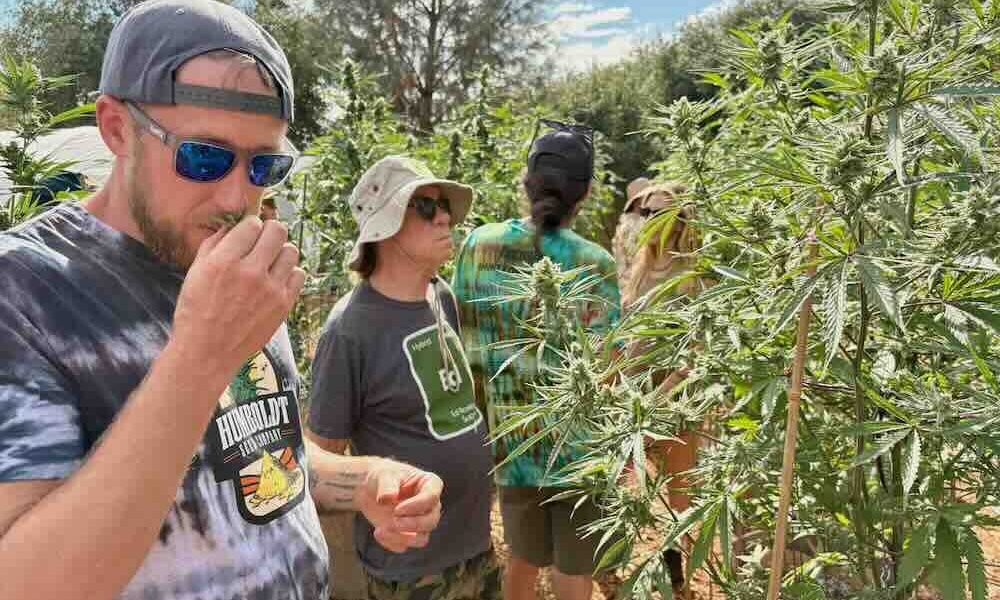

The Humboldt Seed Company’s (HSC), Pheno Hunt, is one of America’s most important genetic selection events. The project began small, and has grown to include multiple farms, regions, and influence trends far beyond Northern California. It was a truly memorable event, with experts and connoisseurs of cannabis from around the world in attendance.
In addition to HSC’s Anchor Farm in Humboldt County, as well as its satellite farm in Grass Valley and Errl Hill/Black Bear the crew was spread across several noteworthy farms, including Casa Flor, Wild Leaf and Errl Hill/Black Bear. This hunt was a unique intersection between modern extraction and craft agriculture. With water hash extracts now sitting at the top of the connoisseur market—much like grand cru wine in its own world—the emphasis has shifted from how a plant looks in a jar and how it smells to how its resin behaves under ice, water and curing.
What makes a “Pheno Hunt For Washers” different?
In a traditional pheno-hunt, flower is evaluated for structure, bag appearance, coloration and scent. However, A Pheno Hunt for Washers2025 focuses on resin. The question here isn’t “How does the bud look?” Instead, we ask, “How does this resin behave & live once removed from the plant?”
When agitated by ice, trichomes are a firm, sandy color and easily separate from the stalk. The resin should feel dry and gritty, not oily. That sand-like texture is a sign of durable membranes and well-formed resin glands—traits that survive agitation, settle smoothly on the screens, withstand cold cure, and preserve volatile terpenes.
Once the plant is cleaned, the resin will collapse and become smeared. A weak resin can’t be compensated by loud terpenes, impressive structure or even loud terpenes. Breeders, hashmakers, and connoisseurs all insist on the fact that only the hash can reveal the true nature of a particular cultivar.
This truth was fully embraced by the Humboldt Seed Company hunt. The farms that participated in the hunt conducted tests on their plants, watched how the resin separated and observed how it melted. They also studied what aromas developed after plant material is gone. The only phenotypes with the best post-harvest performance were those that would become future staples.

The final lens: where the true identity of a cultivar appears
Flowers can hide certain flaws. The density, frost and coloration of a flower may fool the casual observer into thinking that it is a special plant. Hash reveals everything. After the trichomes become isolated, they are impossible to disguise. It is possible to see the melt texture, intensity of the terpenes and stability.
After the resin has been collected, dried and washed many of the finer details that distinguish a high-quality cultivar are revealed. Hash represents the plant’s chemical composition in its purest form. With the visual distractions of the flowers gone, it is possible to see clearly the interaction between the volatile sulfur compound, the esters, the flavonoids and the molecular signature that distinguishes one phenotype.
It is in hash—especially in a cold-cured rosin that even subtle aromatic layers become obvious: From tropical notes, the trace gas behind bright citrus, the creamy back-presence beneath berry compounds. The solventless community uses the bathroom as a laboratory and an art studio. This is the reason why HSC’s hunt for washers has such significance.

Hash-Connoisseurs’ View of the Wine Comparison
Cannabis and wine are often compared, but this analogy is even better when seen through the eyes of hash experts.
Wine connoisseurs obsess on terroir. They study subtle differences in clones and how microclimate affects aroma. Hash lovers do the same thing, studying how the resin reacts to different soils, such as those in valley bottoms or ridges above fog lines.
The HSC Pheno Hunt uses the same method to improve the expression of cannabis as do winemakers. However, it does not use grapes, but resin.
The group of hashmakers evaluating the barrel samples is similar to sommeliers standing in front of a jar with a cold cure. The two groups are looking for depth, complexity, long-lasting, and tension. While wine connoisseurs will swirl their glass to see how volatile the aroma is, hash lovers will crack open a container to check terpenes and temperature-induced structural changes.
In this year’s hunting, both the plant world and humankind shared a similar truth: The deepest characteristics of plants are revealed in their essence.
This moment occurs in the wine barrel. In the case of cannabis, this moment occurs in the hash.

Johnny Casali: Legacy Farmer Perspective
Johnny Casali from Huckleberry Hill Farms is one of California’s best-known cultivators. Casali’s experience on the Casa Flor farm is a reflection of both HSC’s precision and its cultural impact.
The Humboldt Seed Company 2025 Pheno Hunt at Casa Flor Farms, was the most inspiring and professional event I have ever been to. Casali says that their focus on identifying elite washer varieties with superior resin structure, high terpene content and exceptional wash yields is a reflection of the innovation occurring in Humboldt County and Mendocino. Events like these push the industry forward, uniting farmers, hashmakers and breeders in a mission to discover the next generation standout cultivars.
Casali’s attention to resin structure and yields of washes highlights the fact that the modern breeding directions in Northern California are primarily driven by the space without solvents.

Jason Gellman says there are multiple true washers out there
Jason Gellman, of Ridgeline Farms highlighted the precision and scale of the event while he walked through the rows of Casa Flor. “Getting to walk around the HSC hunt was truly amazing. It was amazing to see the size of the farm, and how many winners were in the field. It was set up correctly, as well, with binder and jars to allow you full access to inspect, smell, or test anything. “We found numerous true washers, which you do not come across very often.”
Gellman’s remarks illustrate that it is rare to find multiple washer phenoms at one location. This highlights HSC’s genetic line-up and Casa Flor’s commitment.
Gellman speaks about the innovation that is taking place in HSC. “HSC’s breeding program is on another level right now….From my own projects, I know how rare it is to hit that perfect combo of vigor, terp profile and resin, so seeing that many standouts in one place says a lot about the work they’re doing.

Ed Rosenthal: Global Lens on Local Craft
The 2025 hunt had an impact beyond the Emerald Triangle. Ed Rosenthal, cannabis legend and after visiting Wild Leaf, Casa Flor, highlighted the international impact of these farms: “On the Humboldt Seed Company’s phenohunts, it is always nice to see well-maintained farmland. Wild Leaf, and Casa Flor were both farms I visited. Both featured large flowers. The reaction I get when I show photos of these farms to advocates who campaign for the right in India to harvest and grow buds is the same. In India, only the leaf can be legally harvested. The flower – known locally as ganja – remains criminalized. The California plants that represent progress and possibility are these California plants.
Rosenthal’s global perspective positions the phenohunt as more than a local affair, but also a benchmark in modern cannabis cultivation and freedom.
The Science Behind Premium Hash: Resin behavior, temperature and science
As with wine, hash also requires strict control of temperature. To reveal the full potential of resin, it is important that the resin remains cold when collected and stays stable while curing. If stored incorrectly, even the most beautiful cultivars can look one-dimensional.
Temperature control became a critical component during the wash-focused evaluations. To preserve the terpenes, fresh frozen materials needed to be kept at deep freeze levels. Cold-cured Rosin required near-perfect conditions for flavors to crystallize and not degrade.
Hashmakers and farmers observed the behavior of resin not just in the wash but over time. Did it retain clarity? Terpenes grew sharper or rounded? Was the texture smooth or sloppy? The subtleties of a variety can determine if it is a novelty for a season or an everlasting staple.
Collaboration is the Engine of Genetic Progress
The ecosystem that supports the HSC Hunt is what makes it unique. HSC’s genetic data collection is a diverse one, as it uses farms with different microclimates like Errl Hill/Black Bear and Casa Flor.
The differences in soil, elevation and climate can have a profound effect on resin behaviour. The phenotypes that produce sand resin on Errl hill/Black Bear could have more oily qualities at lower elevations. Breeders can use these environmental differences to guide future crosses and stabilizers.
The shared philosophy of hashmakers as well winemakers is that complexity comes out of diversity and real excellence demands collaboration.

Hash is the Future.
Consumer expectations continue to increase as the market for solventless products grows. Resin quality, melt behavior and terpene complexity are now the metrics that define connoisseur cannabis—far more than THC percentages or simple flower aesthetics.
The 2025 Humboldt Seed Company Pheno Hunt not only acknowledged this reality—it embraced it. The 2025 Humboldt Seed Company Pheno Hunt was dedicated to genetics that put resin first. It was designed by farmers, breeders and hashmakers, who know the future of marijuana is in the wash.
In the rows of Errl Hill/Black Bear and Errl Hill/Casa Flor, there were dozens of plants that stood out. They showed what hash of the future could be: sand-like, robust, with a resin so expressive, it shines in its purest state. These plants will shape the future generation of California Hash.

These are the Standout strains in 2025
As the final wash tests, cold-cure sessions and field impressions came together, the focus naturally shifted to the phenotypes that distinguished themselves across the farms—strains whose resin didn’t just perform well, but demonstrated the kind of nuance, structure and aromatic depth that define exceptional solventless cultivars.
At Errl Hill, the response to these standout expressions was immediate, captured vividly by Scott Harris: “Having hashianados from all over the world visit our facility to share their ‘passion for hashin’ was an incredible experience,” he says. People’s mouths watered for a dab or two of Orange Creampop.
The Press Club: Honey Bear & Blueberry Honey
Among the most promising lines, Honey Bear and Blueberry Honey quickly became favorites during the wash evaluations—something Jeffrey Oy from The Press Club noted during hands-on testing:”Honey Bear and Blueberry Honey performed really well during the test wash, and they both had a vibrant, sweet, fruity essence. The cuticles have a sandy texture, when the trichomes are rolled in between your fingers. They make great washers.

Nat Pennington from HSC: ‘The World Gets Smaller and the Community Gets Bigger‘
For Humboldt Seed Company, seeing these resin-forward traits shine under varied microclimates confirmed the direction of their breeding program, a sentiment expressed by Nathaniel Pennington, founder & CEO of HSC: “It was exciting to be able to see, taste and process our new strains Bubbles, Puff Pastry, Blueberry Honey and Honey Bear. Aficionados traveled from different continents to California in order to hunt for phenos. It was amazing to watch. “The world is getting smaller, and our community bigger.”
After the observations made in the field, and the laboratory analyses will be performed to ensure that the promising cultivars are consistent and have a chemically sound structure before they can move into larger scale production.
Even before the lab results arrive, the picture is already clear: Orange Creampop, Honey Bear, Blueberry Honey, Bubbles and Puff Pastry represent the strongest resin-focused expressions of the 2025 hunt—cultivars with the sandy trichomes, terpene saturation and structural reliability that hashmakers value above all else.
These are the strains poised to influence next year’s rosin, inspire HSC‘s breeding directions and shape the future of solventless craft—selections made not for the jar, but for the melt.
Sponsored Content
This informative article is brought to you by NUBO CBD →