







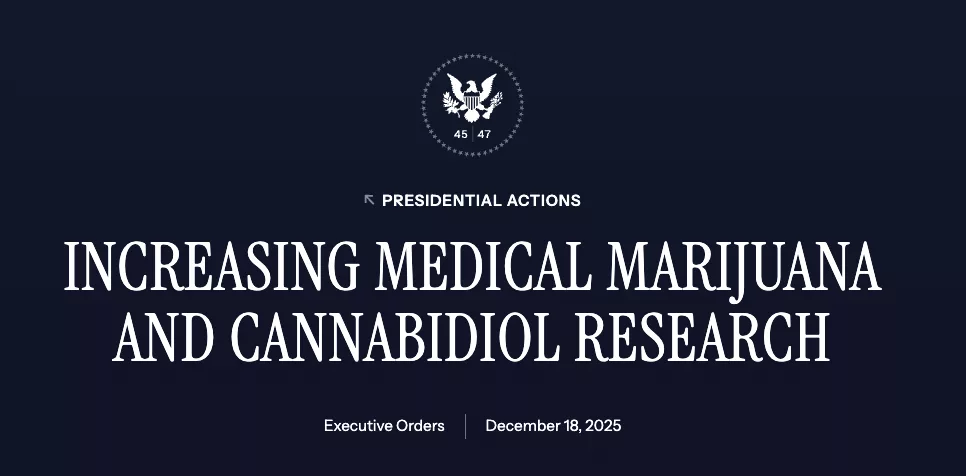

Donald Trump, after two years’ worth of rumours and speculation, as well as stock price swings, broken commitments, political drama, signed an executive (EO), urging the reclassification of cannabis, on Thursday (18th December).
In a bid to fulfill his earlier promises, Trump signed an EO directing federal agencies to shift cannabis from Schedule I of the Controlled Substances Act to Schedule III.
Trump’s decision, regardless of its underlying motives, will be remembered as one of America’s most important drug reforms in history. It is likely to affect cannabis around the world for many years.
Although it is hard to anticipate the impact of drug reform on the world, the joy felt by the entire cannabis industry around the globe has been well-earned. Major factors driving the increase in MSO’s and LP’s stock prices are tax reductions for US-based companies. The US Government’s formal recognition of cannabis as a medical drug could change the entire medical industry. It will allow for the clinical research the sector has demanded since it was founded.
Stephen Murphy, CEO of Prohibition Partners, said that this represents a ‘historic pivot’ in US drug policy, sending a critical signal to regulators across the globe.
The federal government has officially acknowledged the use of cannabis for medical purposes under federal law.
The deeper meaning lies in the message it sends regulators, scientists, and global medical communities. The move to schedule cannabis at Schedule III represents a major shift for the US government’s approach to cannabis research. Since the 1970s, cannabis researchers faced a bureaucratic dead end, poor study material and countless restrictions because of its Schedule I status.
The reclassification of cannabis will remove these obstacles, opening the door to clinical trials and longitudinal studies. It also allows for evidence-based care standards. This opens the way for pharmaceutical, hospital, and university companies to consider cannabis as a valid therapeutic compound. It could speed up FDA approved treatments, while changing perceptions around medical marijuana.
What does the Executive Order actually do?
Executive Order No. ‘Increasing Medical Marijuana and Cannabidiol Research,’ The report is more focused and narrower than many of the speculations that came before it. It contains three main directives, rather than the broad reforms expected by most.
While this does not bypass existing legal procedures, the order specifies the AG must act ‘in accordance with Federal law,’ meaning the DEA’s formal rulemaking process remains in place, agencies are now directed to move ‘in the most expeditious manner’, meaning the static process should begin moving forward, and quickly.
Also, the order directs the White House’s Deputy Chiefs of Staff (Legislative Political and Public Affairs) to update the legal definition for hemp-derived products. This provision aims to ‘allow Americans to benefit from access to appropriate full-spectrum CBD products while preserving Congress’s intent to restrict the sale of products that pose serious health risks.’
Furthermore, the directive includes consultation with executive agencies to develop a regulatory framework that would establish ‘guidance on an upper limit on milligrams of THC per serving with considerations on per container limits and CBD to THC ratio requirements’, effectively creating a tiered system that distinguishes between low-dose wellness products and higher-potency intoxicating products.
Finally, the order directs HHS, FDA, CMS, and NIH to develop research methods utilising ‘real-world evidence’ to improve access to hemp-derived cannabinoid products and inform standards of care.
In the White House factsheet accompanying the Order, the White House emphasized the medical rationale. It noted that over 30,000 licensed health care practitioners in 43 jurisdictions have the authority to prescribe medical marijuana for more than six million patients registered with at least 15 conditions.
In its 2023 review, the FDA found that cannabis was effective in treating nausea, vomiting, chemotherapy-induced nausea, pain and anorexia.
The executive order did not mention the SAFER Banking Act or federal clemency for marijuana convictions. Nor was there any direct mandate for Medicare CBD coverage.
Next year is anticipated to see the start of a $500 CBD pilot program for seniors aged 65 and older. This appears to be an administrative initiative separate from the executive order.
The decision, which was made during a signing ceremony attended by doctors, health officials and veterans’ advocates, was presented as a response to the overwhelming support of the public, using polling results showing that 82% Americans are in favour of rescheduling.
Sponsored Content
This informative article is brought to you by NUBO CBD →