







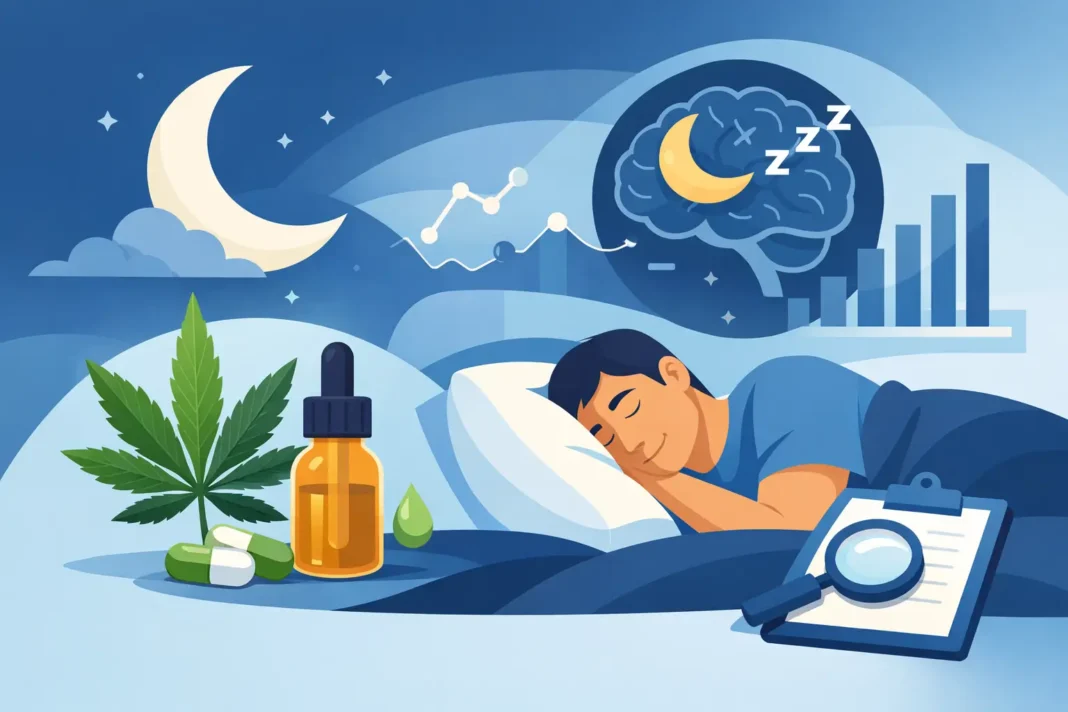

Cannabis has been marketed as a sleep aid, but this is not true. cannabinoid sleep evidence It is not as clear-cut as social media and product labels suggest. The central question for patients, doctors and operators within the UK medical cannabis industry is not whether cannabis makes some people sleepy. It can. It can.
Based on the clinical picture at hand, I would say that there is some qualification to this answer. Some people may find that THC-containing medications help them sleep, especially if they are awake because of pain, spasticity, or other symptoms. The evidence of chronic insomnia is inconsistent, limited and short-term. CBD has not been proven to be a sleep aid, despite its popularity on the market.
Cannabinoid Sleep Evidence: What the Research Measures
Not all studies are the same. Some studies ask participants to rate their sleep quality. Other studies track the time to fall asleep, sleep duration or total time spent sleeping. Polysomnography is a laboratory test that measures sleep stages and physiological activity.
That distinction matters. The person who uses THC may sleep faster, but still experience changes to their sleep patterns or tolerance. It is not always the case that more sleep leads to better sleep. A trial that involved people suffering from multiple sclerosis can’t be interpreted as proof that the same medication will cure primary insomnia.
Most of the evidence available is for cannabinoid medicines that are used to treat conditions other than insomnia. Sleep improvement is usually a secondary endpoint, and not the primary one. This is a good thing for the clinical data, but limits the certainty in the conclusion.
THC may relieve symptoms, but there are trade-offs.
Delta-9-tetrahydrocannabinol, or THC, is the cannabinoid most closely associated with sedation. Short-term studies and patient reports Some studies suggest that it can improve sleep quality in people who are affected by chronic pain or neuropathic symptoms.
This applies to all cannabis-based medicines in the UK that contain THC. This includes both licensed and unlicensed products. Some studies on THC-CBD combination products, including those used for multiple sclerosis related spasticity, reported improvements in sleep measures. But those gains may be the result of better control over the underlying condition, not an effect directly on insomnia.
It is important to consider the timing and dose of your medication. Higher doses could produce unpleasant effects such as anxiety, palpitations or impaired coordination. Oral products may also be delayed or variable in their onset. This makes repeating doses a risk. Inhaled products are more effective, but they also have different clinical and public health considerations.
Tolerance may develop as a result of regular exposure to THC. Some users will increase their consumption as the sedative effect fades. Stopping frequent usage can trigger vivid dreams, fragmented sleeping and insomnia. The rebound effect does not prove long-term insomnia caused by cannabis, but is a real risk for those who use THC regularly.
The safety and operation aspects are also important. The residual impairment can impact driving, the use of machinery and safety-sensitive jobs. Patients and employers should not mistake a prescription for driving fitness with a legal prescription. It is still a matter of determining whether the individual is impaired.
Sleep stages is not a marketing claim
THC is capable of altering rapid-eye movement (REM) sleep, especially with acute use. Researchers are still trying to determine what the effects of these changes on memory, mood, and recovery will be at different dosages and usage patterns. Claims that a particular product delivers “deep sleep”, should be taken with caution unless they are backed up by specific clinical data.
It is the same with terpenes. Linalool and myrcene are frequently mentioned in relation to relaxation. But controlled human studies that show that a named profile of terpenes consistently treats insomnia remain thin. Commercial language may have surpassed clinical evidence, even though chemistry can influence an experience.
CBD is not as strong as its reputation would lead you to believe
CBD is widely advertised as a sleep aid that does not cause intoxication, but there are no conclusive studies to support this. The results of small trials are mixed, and the dosages used for clinical research could be significantly higher than what is found in most retail oils, drinks, and gummies.
CBD can indirectly affect sleep in some people, by reducing anxiety or seizures. Certain doses of CBD or certain times of the day may make you alert. The effect of CBD is not always sedating. It is also not a fact that CBD increases sleep.
The quality of products remains a concern for the consumer market. The CBD content stated may not be the true content. However, some products contain detectable THC. It is important for those who are subjected to workplace testing, people taking other medications and consumers who think “CBD” means “risk-free”.
CBD can interact negatively with certain antiepileptics (e.g. anticoagulants), antidepressants, and anticoagulants that are metabolised in the liver. Patients who are taking regular medications should consult a prescribing physician or pharmacist to discuss possible interactions. CBD can be used as a bedtime supplement.
CBN, and other minor cannabinoids, remain a largely commercial story
Cannabinol (CBN) is being marketed as a sleep-cannabinoid. At the moment, evidence does not match this positioning. CBN is not well-studied in humans, nor are there any established dosages, safety profiles or proof that CBN can achieve meaningful sleep outcomes.
This pattern is familiar in a category that moves quickly. A plausible biological theory, some early findings and consumer demands can become a confident marketing claim. It is not the exact same thing as a standard of treatment. As regulators and consumers gain more knowledge about the evidence, businesses that market minor cannabinoids will be scrutinized.
What questions should clinicians ask before considering cannabis?
Cannabinoids will not be the first intervention proven to work for chronic insomnia. While cognitive behavioural therapy is a popular non-drug option for treating insomnia, it’s important to assess the cause. Depression, anxiety and obstructive snoring, restless leg syndrome, chronic pain can all affect the course of treatment.
When a cannabinoid is being considered to treat another condition, and sleep is a part of the discussion it is important that the conversation is specific. The patient may be having difficulty getting to sleep or waking up too often. The intended benefit is symptom relief, which may improve sleep or treatment of insomnia.
A cautious plan should include a clear treatment goal, low dosages when clinically appropriate, and a point of review. It also pays attention to any adverse effects. Patients with a past history of psychosis or significant cardiovascular risk may need extra caution. They may also not be good candidates for THC treatment.
Evidence gap is also a problem for industry
In Europe’s medical marijuana market, sleep is an example of a gap between the patient demand and the level of certainty that can be achieved through trials. Real-world information can be used to identify patterns, tolerance and possible subgroups of patients, but cannot completely replace well-designed, randomised trials using standardised products with validated sleep measurements.
Research priorities are clear. They include: separating primary insomnia from sleep disruption caused by pain or neurological illnesses; comparing THC, CBD, and balanced formulations in defined doses; measuring daytime impairment and nighttime symptoms; and following participants for a sufficient amount of time to identify tolerance and dependence effects. Research on specific products is important because the results of one preparation can’t be automatically applied to all flowers, oils or extracts.
The most responsible stance is not to dismiss or hype. Cannabinoids could play a role in the case of a medical condition that disrupts sleep, and when conventional treatments have failed to provide adequate relief. Evidence does not support cannabis, CBD or CBN being used as an all-night solution. Better trials, clearer prescription standards, and a market that is willing to let the evidence set expectations, not bedtime branding, will be the next significant advance.