





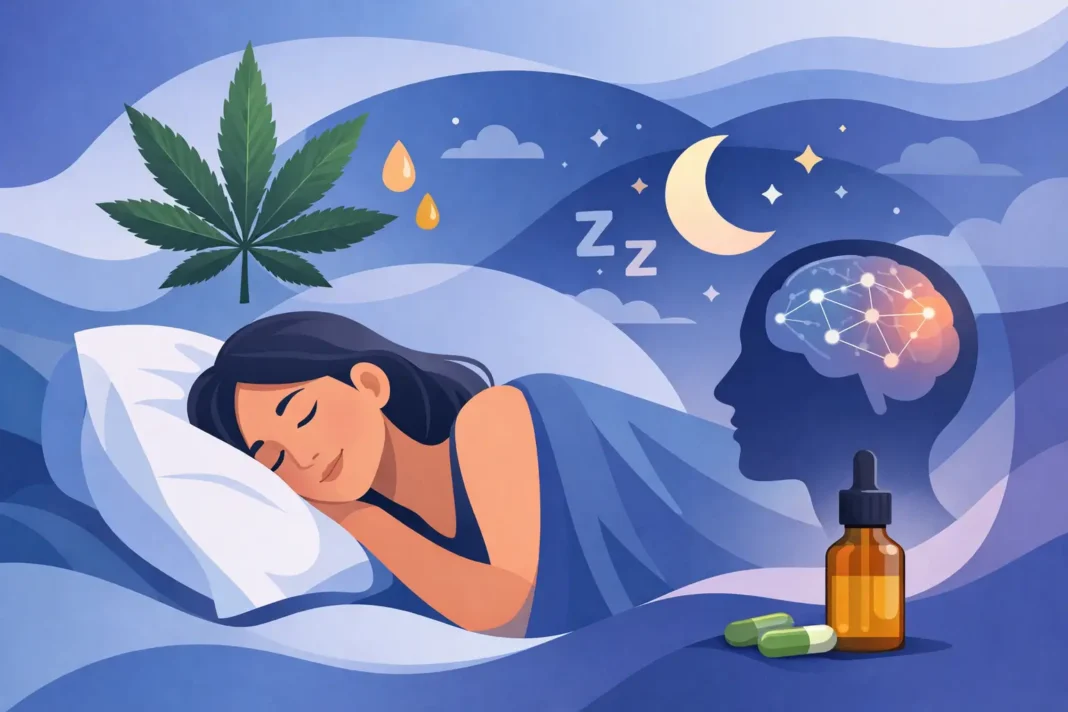

A patient who says cannabis helps them fall asleep may be telling the truth. A patient who says it wrecks their sleep quality may also be telling the truth. That tension sits at the heart of how cannabinoids affect sleep, and it explains why the subject keeps surfacing in medical cannabis policy, prescribing debates and product development across Europe.
Sleep is not one thing. It is a sequence of stages, driven by circadian rhythms, stress signalling, pain levels, mental health, medication use and basic sleep hygiene. Cannabinoids enter that system at multiple points. Some may shorten the time it takes to fall asleep. Some may reduce overnight waking in certain people. Others can leave users groggy, alter dreaming, or stop helping once tolerance builds. The commercial market often flattens these differences. The evidence does not.
How cannabinoids affect sleep in the real world
In practice, sleep outcomes often depend less on a broad cannabis label and more on the exact cannabinoid, dose, route of administration and reason for use. Someone using a high-THC flower at night for chronic pain is dealing with a different risk-benefit profile from someone taking a low-dose CBD oil for anxiety-related insomnia.
That matters because sleep complaints are usually secondary. Pain, menopause symptoms, post-traumatic stress, anxiety, medication side effects and inflammatory conditions can all disrupt sleep. When cannabinoids appear to improve sleep, they may be acting indirectly by reducing the symptom that keeps the person awake. This distinction is clinically relevant and commercially relevant. It changes what counts as a successful product and who is most likely to benefit.
THC and sleep: faster onset, mixed quality
Delta-9-THC is the cannabinoid most closely associated with sedation, particularly at lower to moderate evening doses in people who tolerate it well. Many users report that THC reduces sleep onset latency, meaning they fall asleep more quickly. In pain populations, this can be meaningful. If discomfort is the main barrier to sleep, a cannabinoid that lowers pain perception may improve both sleep initiation and perceived rest.
The complication is that THC does not behave like a clean sleep medicine. Its effects are biphasic in some users, meaning low and high doses can feel very different. A small amount may be calming, while a larger amount can increase anxiety, raise heart rate, or produce mental stimulation. That is one reason some consumers describe the same product as relaxing and others as unsettling.
There is also the question of sleep architecture. Some evidence suggests THC may reduce REM sleep, the stage associated with vivid dreaming. For people with nightmares, especially those linked to trauma, that can look like a benefit. For others, changing REM patterns may not be desirable, particularly over longer periods. Add tolerance to the picture and the story gets even less straightforward. Regular THC use can blunt the initial sedative effect, leading some users to escalate dose. When they stop, rebound sleep disturbance and more intense dreaming are common reports.
CBD and sleep: less sedating than the market suggests
CBD is often sold as the gentler sleep cannabinoid, but the evidence is more nuanced than the packaging usually implies. CBD is not reliably sedating in the same way THC can be. In fact, its effects may vary with dose, timing and individual neurobiology. Some people find it calming. Others feel more alert.
Where CBD may help is in sleep problems linked to anxiety, stress or inflammation. If evening rumination is the issue, reducing anxiety may make sleep easier without producing a strong sedative effect. That distinction is important for clinicians, employers and consumers who want symptom relief without intoxication or next-day impairment.
CBD also has a cleaner regulatory and commercial pathway in many European markets than THC-rich products, which partly explains the explosion of sleep-positioned CBD oils, capsules and drinks. But product claims have moved faster than the research. Dose inconsistency, weak formulations and poor labelling remain persistent issues across parts of the wider wellness market. For readers tracking the sector, this is where science and compliance collide. A sleep claim is easier to print than to substantiate.
What about CBN and minor cannabinoids?
CBN has become a favourite ingredient in sleep-focused product launches, often framed as the cannabinoid for bedtime. The problem is that the evidence base remains thin. Much of CBN’s sleepy reputation appears to come from anecdote, early assumptions and product marketing rather than strong clinical data.
That does not mean CBN has no role. It means the market is ahead of the science. The same applies to several minor cannabinoids now entering formulations aimed at rest and recovery. Some may eventually show value as part of broader cannabinoid blends or entourage-style products. For now, confidence should be modest.
This gap between consumer narrative and evidence is familiar across cannabis. Sleep is a commercially attractive claim because it is common, emotionally resonant and easy to self-assess. It is also hard to measure well outside controlled studies. A person may feel they slept better because they fell asleep faster, even if total sleep quality did not improve.
How cannabinoids affect sleep across different patient groups
The strongest case for cannabinoid-assisted sleep tends to appear when insomnia is not a stand-alone condition. Chronic pain is a leading example. If night-time pain falls, sleep may improve as a downstream effect. Similar logic may apply in some patients with spasticity, neuropathic symptoms or cancer-related discomfort.
Mental health adds another layer. In anxiety-related sleep disturbance, some cannabinoid products may help certain patients settle. In others, particularly those sensitive to THC, the same product can worsen anxiety and fragment sleep. That unpredictability matters in prescribing and in consumer education.
Age, prior cannabis exposure and co-medication also shape outcomes. A cannabis-naive patient may respond strongly to a dose that a regular user barely feels. Someone already taking sedatives, antidepressants or antihistamines may experience additive effects, including morning drowsiness. Older adults may be more vulnerable to balance problems, confusion or unwanted psychoactive effects, especially with THC-containing products.
Delivery method changes the sleep result
The route of administration affects not just how strongly a cannabinoid works, but when it works. Inhaled products act quickly, which can suit sleep onset problems, but the effect may fade sooner. Oral oils and capsules take longer to kick in, yet may last further into the night. That sounds simple, but it creates practical trade-offs.
A product that helps someone fall asleep in 15 minutes may not prevent 3 am waking. A product that lasts longer may be mistimed and leave the user heavy in the morning. This is one reason standardised dosing remains difficult in real-world cannabis care. Sleep is a timing problem as much as a substance problem.
Risks the market should not gloss over
Cannabis and sleep are often discussed in reassuring terms, but there are clear downsides. Tolerance can develop. Dependence can develop. Next-day impairment is possible, particularly with THC, oral products, or late-night redosing. For some users, cannabinoids mask poor sleep habits rather than solve them.
There is also a broader public health concern. As sleep gummies, beverages and wellness formulations multiply, consumers may assume all cannabinoid sleep aids are mild and interchangeable. They are not. Potency, contaminants, inaccurate labels and interactions with alcohol or medicines can all change the risk profile.
For the industry, this raises a familiar challenge. If brands want sleep to remain a credible medical and consumer category, they need better data, clearer labelling and more disciplined claims. Otherwise, the sector risks repeating the same credibility problems that have followed CBD in other health categories.
What the current evidence really supports
If the question is whether cannabinoids can help some people sleep, the honest answer is yes. If the question is whether cannabinoids are a reliable, evidence-settled solution for insomnia across the board, the answer is no.
THC appears most likely to help with sleep onset and symptom-driven night disturbance, but it also carries the clearest drawbacks, including intoxication, tolerance and altered sleep architecture. CBD may help where anxiety or inflammation is part of the picture, but it is not a guaranteed sedative. CBN remains commercially prominent and scientifically underpowered.
For policy watchers and operators across the European cannabis space, that leaves a market with genuine potential but uneven proof. Sleep will remain one of the most commercially active cannabinoid categories because demand is constant and patient interest is high. The winners are likely to be the companies and clinicians that treat sleep as a serious medical endpoint, not just a marketing angle.
The useful question now is not whether cannabis can be sold for sleep. It is whether the sector can produce products, evidence and guidance good enough to justify the confidence consumers are already placing in them.