








In spite of this opposition, on Monday 8th January the House (397-28) passed a bill to remove a crucial obstacle for rescheduling. This bill removed Section 607 which was a Republican provision that had been advanced by Republicans in July 2024. It would have prohibited the Justice Department to use federal funds for rescheduling. However, it preserved longstanding Rohrabacher-Farr Amendment Protections for state medical marijuana programs.
In July 2024 the Republicans proposed section 607 which would explicitly prohibit the Justice Department using federal funds in order to act upon rescheduling. This bill eliminated this funding block, but preserved the long-standing Rohrabacher/Farr Amendment that protects state medical cannabis programs from federal interference.
The bill, however, retained problematic language regarding enforcement that allowed the DOJ the ability to seek enhanced penalties within 1,000 feet from schools or other protected areas. Cannabis policy analysts have warned that this provision could be used as a way of removing medical cannabis protections for the majority of populated areas. It is also unclear why Nebraska, Idaho Kansas and American Samoa were not included in the protected jurisdictions.
The state-level resistance has taken on a new form. On January 8, Nebraska Attorney General Mike Hilgers led a coalition of eight Republican state attorneys general in issuing a statement opposing rescheduling, arguing that cannabis is already ‘properly classified’ as a Schedule I drug.
Meanwhile, Marijuana Moment On January 12, it was reported that Maine Massachusetts Arizona and other states are pushing for ballot initiatives repealing existing cannabis laws.
David Boyer of the Republican Party and representatives from industry in Maine have accused petitioners and signature gatherers who are out-of-state, using deceptive methods. A video shows a person posing as if it was about safety but actually, this would end recreational sales, eliminate rights to home cultivation, and put an end to regulated retail.
CRS Report reveals that rescheduling of benefits is limited.
A Congressional Research Service (CRS) report, published by the CRS on Jan. 2, provides the most complete assessment to date of what changes would occur if marijuana was moved from Schedule III. This revealed that criminal penalties would not change and most collateral consequences would also remain unchanged.
The report clarifies that while rescheduling would eliminate specific penalties tied to Schedule I classification, ‘most of the consequences for marijuana use or for marijuana-related convictions would remain the same if it is moved to Schedule III.’
In terms of criminal penalties, the CSA’s cannabis trafficking laws are written for the substance and not based on its classification in the schedule. This means that they will remain the same. Trafficking marijuana in excess of 1,000 kilograms would carry a 10-year minimum sentence. However, trafficking between 100 and 999 kilograms would carry only a five-year minimum term.
Some Schedule I provisions, however, would be removed. Current federal law makes it unlawful to ‘place in any newspaper, magazine, handbill, or other publications, any written advertisement [that] The violation can result in up to 4 years imprisonment.
Schedule III would eliminate these advertising restrictions, which could have a major impact on the cannabis industry by increasing sales as well as creating specialist advertising firms.
This tax break has also been confirmed. 280E, which prohibits businesses from deducting costs of ‘trafficking in controlled substances (within the meaning of Schedule I and II),’ would become ‘inapplicable to marijuana businesses’ under Schedule III, allowing them to deduct operational expenses like payroll, rent, and advertising.
In spite of these advantages for businesses, the report emphasizes that there remain many barriers to entry for students, employees, postsecondary and university students. These include inability for them to obtain federal loans or grants and loss of housing and other social programs.
In addition, the report highlights an abrupt decline in marijuana prosecutions at federal level. Only 471 people were sentenced to federal prison for marijuana trafficking during FY2024. This is down from 1,518 in FY2020, and 87% from 3,543 in FY2015.
Seventy-six percent of the sentences in FY2024 were less than five year prison terms, indicating that federal enforcement is already changing significantly, even without any formal schedule rescheduling.
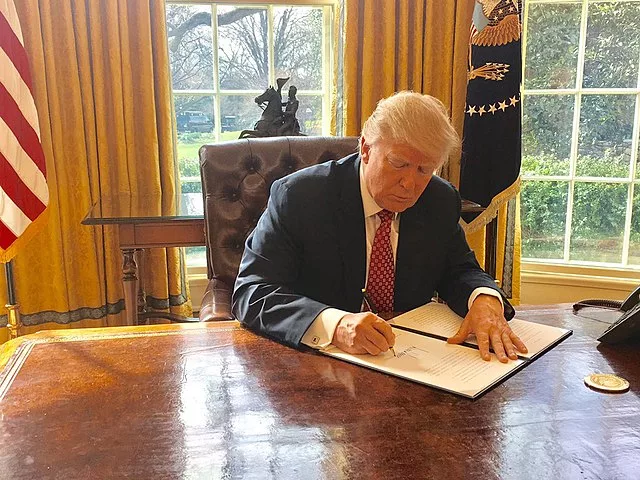
Procedural uncertainty remains despite Trump’s directive. The Drug Enforcement Administration (DEA) said on January 6 that the cannabis rescheduling appeal process ‘remains pending’ despite the executive order, and the Justice Department could potentially restart the process entirely, though such scenarios seem politically unlikely given Trump’s public commitment.
For now, Republican legislators and financial institutions as well as state-level opposition to Trump’s policy are resisting the larger shift he has advocated.
Sponsored Content
This informative article is brought to you by NUBO CBD →
In spite of this opposition, on Monday 8th January the House (397-28) passed a bill to remove a crucial obstacle for rescheduling. This bill removed Section 607 which was a Republican provision that had been advanced by Republicans in July 2024. It would have prohibited the Justice Department to use federal funds for rescheduling. However, it preserved longstanding Rohrabacher-Farr Amendment Protections for state medical marijuana programs.
The Republicans had proposed Section 607 in July 2024. This section would have prohibited the Justice Department to use federal funds for rescheduling. The bill eliminated this funding block, but preserved the longstanding Rohrabacher/Farr Amendment that protects state medical cannabis programs from federal interference.
Cannabis analysts say that the provisions in the bill could be used to effectively eliminate medical cannabis protections across most of the country. It is also unclear why Nebraska, Idaho Kansas and American Samoa were not included in the protected jurisdictions.
State-level opposition is different. On January 8, Nebraska Attorney General Mike Hilgers led a coalition of eight Republican state attorneys general in issuing a statement opposing rescheduling, arguing that cannabis is already ‘properly classified’ as a Schedule I drug.
Meanwhile, Marijuana Moment Reports on 12 January indicated that Maine, Massachusetts and Arizona were promoting ballot measures to repeal the existing marijuana legalisation laws.
David Boyer of the Republican Party and representatives from industry in Maine have accused petitioners and signature gatherers who are out-of-state, using deceptive methods. A video shows a person posing as if it was about safety but actually, this would end recreational sales, eliminate rights to home cultivation, and put an end to regulated retail.
CRS Report reveals that rescheduling of benefits is limited.
A Congressional Research Service (CRS) report, published by the CRS on Jan. 2, provides the most complete assessment to date of what changes would occur if marijuana was placed in Schedule III. This revealed that criminal penalties would still be enforced and most collateral consequences would continue.
The report clarifies that while rescheduling would eliminate specific penalties tied to Schedule I classification, ‘most of the consequences for marijuana use or for marijuana-related convictions would remain the same if it is moved to Schedule III.’
In terms of criminal penalties, the CSA’s cannabis trafficking laws are not tied to schedule classifications, but rather, they have been written for this substance. They would therefore remain the same. Trafficking marijuana in excess of 1,000 kilograms would carry a 10-year minimum sentence. However, trafficking between 100 and 999 kilograms would carry only a five-year minimum term.
Some Schedule I specific provisions will be deleted. Current federal law makes it unlawful to ‘place in any newspaper, magazine, handbill, or other publications, any written advertisement [that] The violation can result in up to 4 years imprisonment.
Schedule III will eliminate the advertising penalty, leading to a potential economic boost for the industry through increased sales or the establishment of cannabis advertising agencies.
This tax break has also been confirmed. 280E, which prohibits businesses from deducting costs of ‘trafficking in controlled substances (within the meaning of Schedule I and II),’ would become ‘inapplicable to marijuana businesses’ under Schedule III, allowing them to deduct operational expenses like payroll, rent, and advertising.
In spite of these advantages for businesses, the report emphasizes that there remain many barriers to entry for students, employees, postsecondary and university students. These include ineligibility from federal grant, contract, loan and license programs as well as restrictions regarding immigration.
In addition, the report highlights an abrupt decline in marijuana prosecutions at federal level. In FY2024 only 471 persons were sentenced in federal court for marijuana-trafficking, which is down by 58% in comparison to 1,118 sentences in FY2020.
In FY2024 76% of those who were sentenced received a prison term less than 5 years, indicating that federal enforcement had already changed significantly, even without any rescheduling.
Procedural uncertainty remains despite Trump’s directive. The Drug Enforcement Administration (DEA) said on January 6 that the cannabis rescheduling appeal process ‘remains pending’ despite the executive order, and the Justice Department could potentially restart the process entirely, though such scenarios seem politically unlikely given Trump’s public commitment.
Right now, Republican lawmakers and financial institutions as well as state-level opposition to Trump are resisting the larger shift he has advocated.
Sponsored Content
This informative article is brought to you by NUBO CBD →
Cannabis Law Resources in Poland
Discover essential legal information about the cultivation of cannabis, its sale, and regulations governing medical products in Poland. You can use these resources to learn about the requirements for certification, permissions and compliance.
-
Polish News Registration and Interests of Cannabis Businesses
-
Permissions for Cannabis Sales in Poland
-
Authorization for Importing or Manufacturing Medical Products
-
Permission for Manufacturing or Importing Medical Products
-
Certificate of Good Manufacturing Practices (GMP)
-
Registration of Medical Products in Poland