



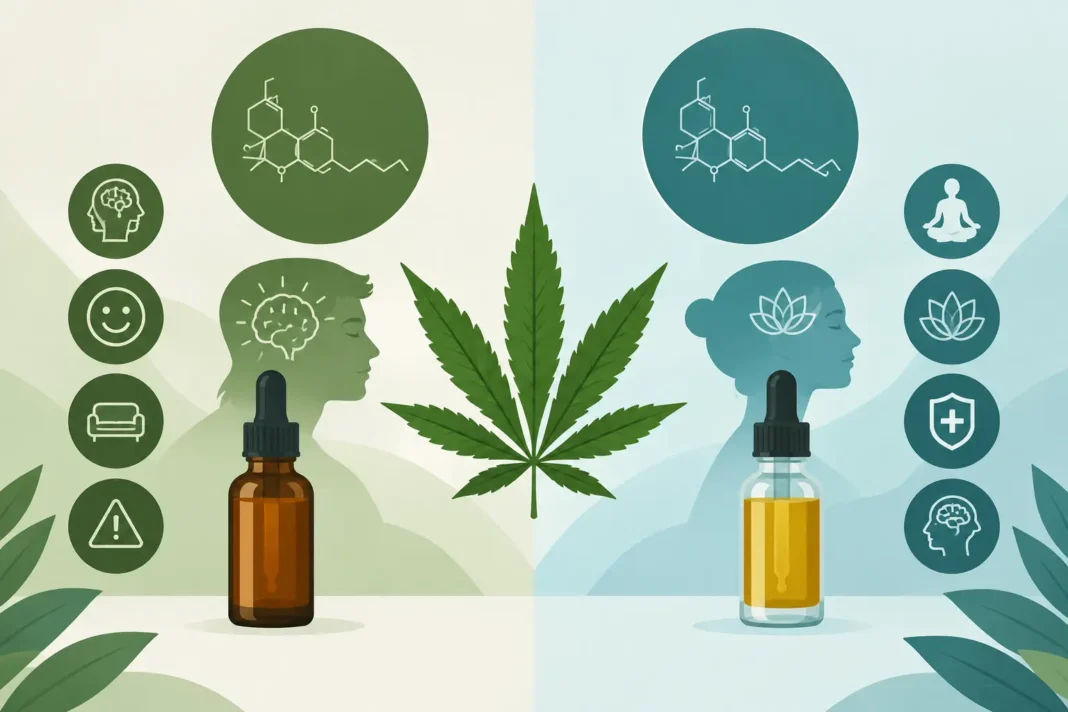

A THC CBD comparison is often reduced to one line: THC gets people high, CBD does not. That distinction is broadly true, but it is not enough for a patient assessing symptom relief, a retailer reviewing compliance, or an investor reading a cannabinoid market claim. The compounds differ in pharmacology, impairment risk, evidence base and legal treatment – and those differences can change significantly with dose, formulation and jurisdiction.
For Europe’s cannabis sector, the practical question is not which cannabinoid is “better”. It is which product, claim and route of use can be justified for a particular purpose without overstating the science or overlooking safety and regulatory exposure.
THC and CBD act differently in the body
Tetrahydrocannabinol, usually shortened to THC, is cannabis’s principal intoxicating cannabinoid. It acts mainly at CB1 receptors in the central nervous system, influencing mood, memory, appetite, pain perception and coordination. This activity explains both its therapeutic potential and its familiar adverse effects: euphoria, altered sensory perception, anxiety, short-term memory disruption and impaired reaction time.
Cannabidiol, or CBD, has a more complex and less direct relationship with the endocannabinoid system. It does not produce the characteristic intoxicating effect associated with THC. That does not mean CBD is inert. It can affect several signalling systems and may alter the way the body processes other medicines. At higher doses, CBD can also cause tiredness, diarrhoea, appetite changes and abnormal liver-function results in some people.
The contrast matters because a non-intoxicating product may be more suitable for daytime use or for people who must drive, operate machinery or make safety-critical decisions. However, “non-intoxicating” should not be marketed as synonymous with risk-free, clinically proven or legally uncomplicated.
THC CBD comparison: the evidence is not equal
The strongest evidence for CBD is not a blanket endorsement of over-the-counter oils, gummies or drinks. Pharmaceutical-grade cannabidiol has established uses in specific severe epilepsy syndromes, under specialist supervision and at carefully controlled doses. That evidence cannot automatically be transferred to low-dose wellness products or to claims around stress, sleep, pain or general health.
THC-containing medicines also have defined, though narrower, clinical roles. In the UK, nabiximols – a prescribed cannabis-based medicine containing both THC and CBD – is authorised for treating spasticity associated with multiple sclerosis in eligible patients. Other cannabis-based products may be prescribed in limited circumstances by specialist clinicians, but this is not the same as broad approval for every condition frequently cited in consumer marketing.
For chronic pain, nausea, sleep disturbance, anxiety and other common indications, the evidence is mixed and highly dependent on the condition, study design, cannabinoid ratio and dose. Some patients report meaningful relief from THC-dominant or balanced products, while others experience side effects that outweigh any benefit. Research also remains difficult to compare because products, delivery methods and patient populations vary widely.
A responsible reading of the evidence separates three questions: whether a cannabinoid can plausibly affect a symptom, whether a studied medicine has shown benefit for a defined condition, and whether a commercially available product matches that medicine in composition and dose. Those are not interchangeable claims.
Intoxication, impairment and mental health risk
THC’s most immediate commercial and public-health distinction is impairment. Effects can begin within minutes when inhaled and later when consumed orally. Oral products can be particularly unpredictable: onset may be delayed, effects can last longer, and consumers may take more before the first dose has fully taken effect.
Higher THC exposure is associated with greater risk of acute anxiety, panic, confusion and psychotic-like experiences, particularly in susceptible individuals. Frequent use of high-potency THC products may also pose a greater concern for people with a personal or family history of psychosis. Young people, pregnant or breastfeeding people, and those taking medicines that affect the central nervous system need especially cautious clinical advice.
CBD does not usually impair in the same way, but the distinction has limits. A CBD product containing trace or undeclared THC may still create a problem for a driver, employee subject to drug testing or competitive athlete. CBD itself can cause drowsiness, especially when combined with alcohol, sedatives or certain prescription medicines.
For employers and operators, labelling alone is not an adequate risk-management strategy. Product batch testing, clear cannabinoid disclosure and careful claims language are more useful than a generic promise that a product is “THC-free”.
The formulation can matter as much as the cannabinoid
Cannabis products are often described as THC-dominant, CBD-dominant or balanced. These labels are useful shorthand, but they conceal important details. A 1:1 THC-to-CBD oil may affect an individual very differently from a flower product with the same nominal ratio, because dose delivery, inhalation versus oral use, terpene content and prior cannabis exposure all vary.
CBD may moderate certain unwanted effects of THC for some users, but it should not be treated as a universal antidote to THC-induced anxiety or impairment. The clinical picture is more complicated than a simple balancing mechanism, and a high-CBD product can still be unsuitable for a person taking interacting medication.
Route of administration introduces further trade-offs. Inhaled products act quickly but can make consistent dosing harder and may raise respiratory concerns. Oils and capsules offer more measured administration but have slower, more variable absorption. Topicals may be attractive for localised use, yet evidence for many topical claims remains limited. Product decisions should begin with the desired outcome and risk profile, not with a fashionable format.
Quality is a central part of the THC CBD comparison
In regulated medical supply chains, products are expected to meet manufacturing and testing standards. In the wider CBD market, quality can be uneven. Independent testing has repeatedly found discrepancies between labelled and actual cannabinoid levels in parts of the sector. Contaminants such as pesticides, heavy metals, residual solvents and microbial material are also material concerns where oversight is weak.
A credible certificate of analysis should be tied to the relevant batch and cover cannabinoid potency as well as contaminant screening. It is not enough for a brand to display a generic laboratory document with no clear relationship to the item on sale. Businesses should also be precise about whether a product contains CBD isolate, broad-spectrum extract or full-spectrum extract, since the likelihood of detectable THC differs.
For consumers, a lower price can reflect a smaller dose or a less expensive extraction process, but it can also reflect a thinner quality-control programme. For retailers and distributors, poor documentation is more than a reputational issue. It can become a recall, enforcement or product-liability problem.
European rules do not follow a single script
THC remains tightly controlled across much of Europe, although medical access frameworks and adult-use reforms are changing the landscape. A product lawfully supplied in one country may be restricted, prohibited or treated differently in another. Possession rules, prescribing requirements, permitted product forms and limits for driving can all diverge across borders.
CBD regulation is equally fragmented. Hemp-derived CBD is not automatically lawful simply because it is non-intoxicating. Depending on the country and product category, rules may involve novel food authorisation, medicines legislation, cosmetics requirements, controlled-drug thresholds, advertising restrictions and local consumer-protection law.
This is particularly relevant for companies selling online across national markets. The origin of the cannabinoid, the THC specification, the intended use and the wording of every health claim may all affect compliance. A label designed for one territory should not be assumed suitable for a pan-European launch.
How patients and consumers can assess a claim
Marketing frequently treats THC and CBD as two ends of a simple spectrum: THC for stronger relief, CBD for everyday calm. That narrative is commercially convenient but medically incomplete. A better approach is to ask what outcome is being claimed, what dose and formulation were studied, whether the product is comparable to the research, and what risks apply to the individual.
Patients considering cannabis-based treatment should discuss it with an appropriate clinician, particularly if they have cardiovascular disease, liver problems, a history of psychosis, are pregnant, or take medicines such as anti-epileptics, anticoagulants or sedatives. Consumers using non-prescription CBD should be equally candid about other medicines and about the possibility of a positive drug test.
For the cannabis industry, precision is increasingly a competitive advantage. The brands most likely to retain trust will not promise that CBD solves every modern complaint or present THC as consequence-free wellness. They will explain what is in the product, what is known, what remains uncertain and which legal boundaries apply.
As European rules and clinical research continue to move, the most useful question is not whether THC or CBD wins. It is whether the evidence, product specification and local law point in the same direction before a patient, consumer or business acts.