





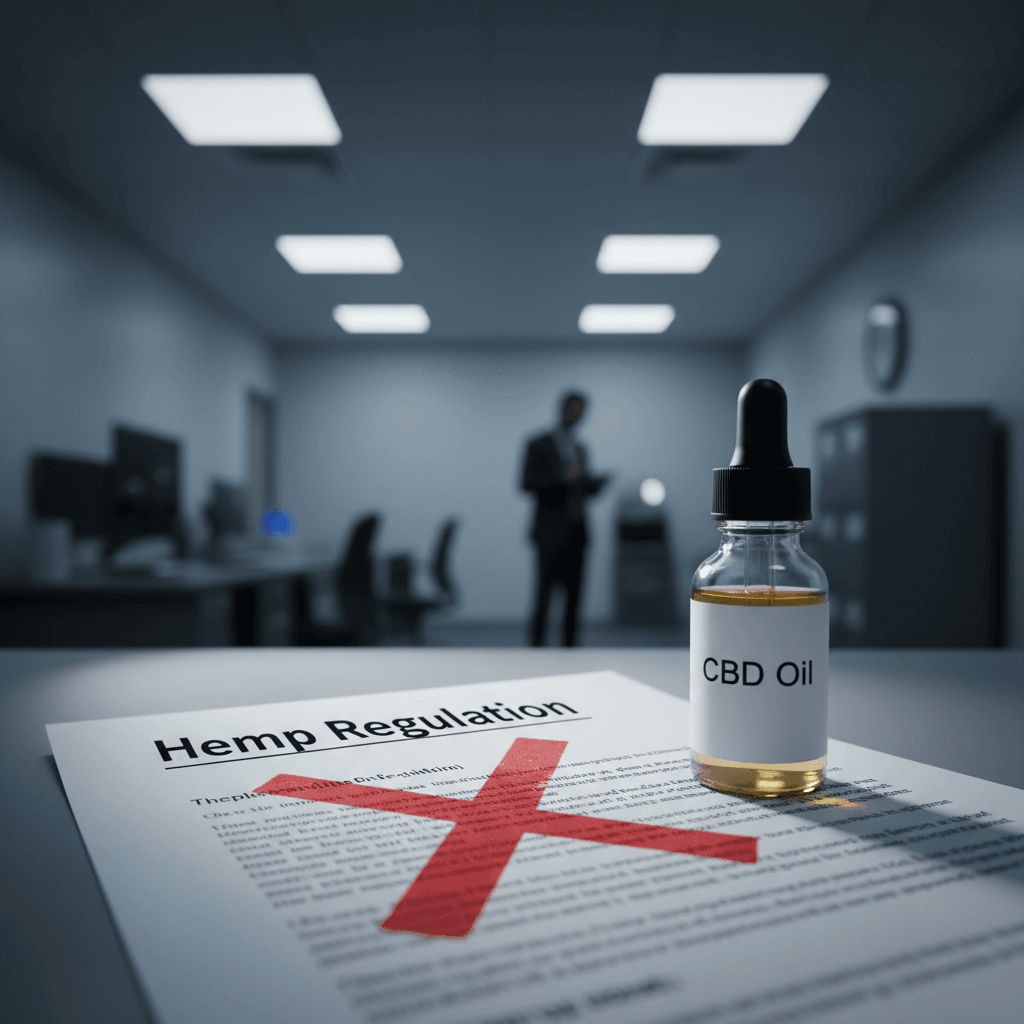

A federal hemp banThe hemp-derived CBD market faces significant challenges in terms of regulatory and commercial issues. This is because the law, which was passed by Congress and will take effect November 12, 2026 poses major obstacles for both the industry and the government. The proposed legislative changes could make a wide range of CBD-based products that are not intoxicating illegal at the federal level, which would undermine a newly-launched Centers for Medicare & Medicaid Services (CMS), pilot program to reimburse patients for products derived from hemp.
Regulatory Redefinition & Market Impact
Impending hemp ban The 2018 Farm Bill introduced a more strict definition of legal hemp products. In the 2018 Farm Bill hemp was defined to be any cannabis product that contained less than 0.3% delta-9-tetrahydrocannabinol. However, the new ban stipulates that any product containing more THC than 0.4mg will be illegal on a federal level.
Jonathan Miller, of the US Hemp Roundtable, stated that this new definition would criminalize most hemp products including non-intoxicating CBD. Manufacturers and distributors may have to make significant adjustments as a result of this change, which could impact the product formulations available on the market and their availability.
The CMS Pilot Program: Implications
Recently, the Centers for Medicare & Medicaid Services launched a pilot project to reimburse Medicare and Medicaid beneficiaries for hemp-derived goods up to US$500 per year. This program is designed to determine if these products could reduce other costs associated with health care for patients. The program’s definition for hemp is aligned with the Farm Bill of 2018, creating a conflict between the upcoming federal ban and the current program.
The Drug Free America Foundation, Cannabis Industry Victims Educating Litigators and Health Secretary Robert F. Kennedy Jr. filed a suit against CMS Administrator Mehmet OZ, alleging the program was promoting substances which could soon become federally illegal, without following proper administrative procedures. The lawsuit was denied by the court.
Legislative Efforts & Advocacy for Industry
Legislators and stakeholders in the hemp industry have actively pursued legislative avenues that would either delay, or replace, the imminent ban on hemp with a comprehensive regulatory framework. Included in these efforts are:
- Cannabinoid Safety and Regulation Act This act was reintroduced by Oregon Senator Ron Wyden in December 2025. In it, he proposes that the prohibition be replaced with a regulatory system designed to make sure hemp products are both safe and free from contaminants.
- Two-Year Delay Bill: Indiana Representative Jim Baird, introduced in January 2026 a bill that would defer the implementation of hemp prohibition for two years. This will give the industry more time to adjust.
Jonathan Miller said that the failure of these bills to move forward was due to political polarization among Congress. Former President Trump called upon Congress to amend the law so that CBD products with full spectrum could continue to be available.
Inesa, the owner of Nesa’s Hemp has met with Congress members to promote regulation. She said that she was often forced to teach senators about the endocannabinoid (EC) system during meetings. This highlighted the lack of understanding among policymakers on cannabinoids’ biological interactions. Ponomariovaite said that products with a variety of cannabinoids could have stronger effects than CBD alone, which may become the only option legal if the prohibition continues.
Quality Control and Future Outlook
Ponomariovaite and other industry advocates argue that the regulatory focus on cannabis plants should not be the chemical composition but rather the product contamination. Hemp has a natural ability to soak up toxins in the soil, which makes quality control of extracts crucial. Forbes Health recently found mold, yeast and fungicides in popular CBD products. This highlights the importance of universal safety standards.
While certain hemp companies conduct rigorous laboratory testing and some states even mandate them, there are no uniform quality controls across the entire industry. The Cannabinoid Safety and Regulation Act, for example, would allow the Food and Drug Administration to control hemp products and establish consistent safety standards.
Miller expressed cautious hope that Congress would act to stop the ban from taking effect in November 2026. Ponomariovaite said that her company will continue to manufacture hemp products if the ban is implemented, but that they may be less effective because of the need to isolate legal cannabinoids. She described this process as “plant-surgery,” and added, “I’m not a fan.” I would like to have all of the chemicals in a single bottle.
Disclaimer: This article does not provide medical advice and is only intended for general informational purposes. Hemp Gazette is not a medical provider and does not offer diagnoses or treatment plans. Before making decisions about your health, or any condition that may affect it, always consult with a medical professional. Therapeutic Goods Administration of Australia has not evaluated statements about the therapeutic benefits of cannabinoids, hemp or cannabis. TGA regulations allow Australians to access medical cannabis through prescription.
Sponsored Content
This informative article is brought to you by NUBO CBD →